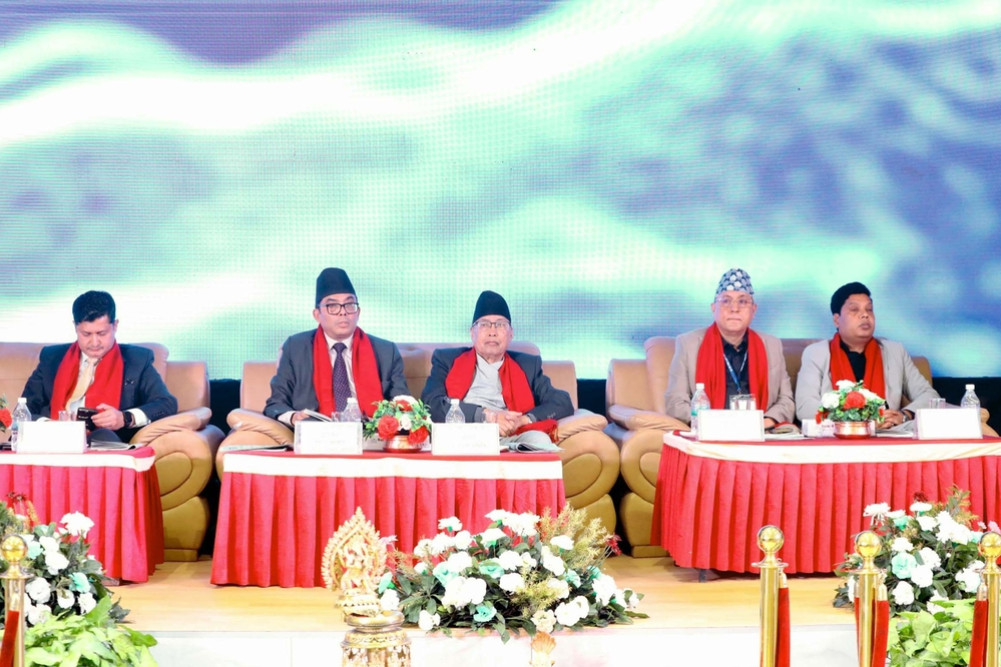
The two-day conference, organized with the main slogan ”Let's spread entrepreneurship, let's make youth self-employed,” will be attended by policymakers, representatives of regulatory bodies, microfinance operators, and more than 600 members from across the country.
We use Google Cloud Translation Services. Google requires we provide the following disclaimer relating to use of this service:
This service may contain translations powered by Google. Google disclaims all warranties related to the translations, expressed or implied, including any warranties of accuracy, reliability, and any implied warranties of merchantability, fitness for a particular purpose, and noninfringement.
The two-day fifth National Microfinance Members Conference has begun in Kathmandu from Sunday to discuss the current status, challenges and future directions of the microfinance sector. The two-day conference, organized with the main slogan ‘Let’s spread entrepreneurship, let’s make youth self-employed’, will be attended by policymakers, representatives of regulatory bodies, microfinance operators and more than 600 members from across the country.
Inaugurating the conference, National Planning Commission Vice Chairman Prakash Kumar Shrestha said that microfinance has made a major contribution to the significant reduction in the poverty rate in Nepal. According to him, according to the new criteria, poverty in Nepal has come down to 20 percent and according to the old criteria, it has come down to 4 percent. ‘Since poverty still exists in some local levels of remote districts like Jajarkot, it is necessary for microfinance institutions to focus on remote areas instead of being limited to urban areas,’ said Vice Chairman Shrestha.
Discussing the recent problems seen in the microfinance sector, Dr. Shrestha pointed out the economic slowdown after COVID-19, lack of institutional governance, and increasing non-performing loans as the main challenges. He said, ‘Microfinance institutions should follow institutional governance and members should also maintain financial discipline.’ He suggested that the microfinance sector should now move to the credit plus model and not be limited to just loan flow but also focus on marketing of products. In a context where many entrepreneurs and farmers complain about not getting a market, he emphasized that microfinance should help in marketing.
Stating that there is a shortage of labor force due to increasing migration and foreign employment in the country and there has been a relaxation in demand, he urged microfinance to reform itself according to technology and changes in time and not from the old model.
Conference Organizing Committee Chairman Shankarman Shrestha is of the opinion that microfinance institutions should now become traders of enterprises rather than traders of money. ‘Microfinance is not just a business of clean loans, it should be linked to entrepreneurship. We should not just make our members debtors, but entrepreneurs. If members become entrepreneurs, there will be no problem in recovering loans and their income will increase,’ said Chairman Shrestha.
He emphasized that Nobel Prize winner Mohammad Yunus’ ‘Three Zeros’ concept of zero poverty, zero unemployment and zero net carbon emissions should be made the main mantra of microfinance. Along with this, Chairman Shrestha has expressed serious concern over the increasing distortions and anomalies in the microfinance sector. ‘When the total number of households in Nepal is about 6 million, it is unrealistic to have the same number of microfinance members.’ Since an average person has multiple banking institutions to borrow from three institutions, there is duplication in the data and when we reduce this, the actual borrowers in microfinance are around 2.9 million,’ he said.
Although Nepal has been following the 'rural model' of Bangladesh since 2048 BS, Shrestha said that over time, there have been many sabotages and distortions in it. He said that although this model was very effective in the initial phase, there has been a deviation in microfinance, which was started as a social business later. He complained that no action was taken in the report submitted to the then governor even when borrowers reached a point of committing suicide due to multiple financing.
Chairman Shrestha has urged Nepal Rastra Bank to pay special attention to the 'manipulation' taking place in the microfinance sector if the situation is not brought to light. He also warned the boards of directors and CEOs of the concerned institutions not to hide or cover up the truth and to walk on the right path.
Nepal Microfinance Bankers Association President Ram Bahadur Yadav has proposed the establishment of a Microfinance Development Fund with the government to make Nepal's microfinance sector more effective and systematic. "The government needs to set up a fund in coordination with bodies like the World Bank and ADB. By providing funds to microfinance institutions at concessional interest rates through this fund, the poor will also get loans at low prices, and this will be a win-win situation," said Chairman Yadav.