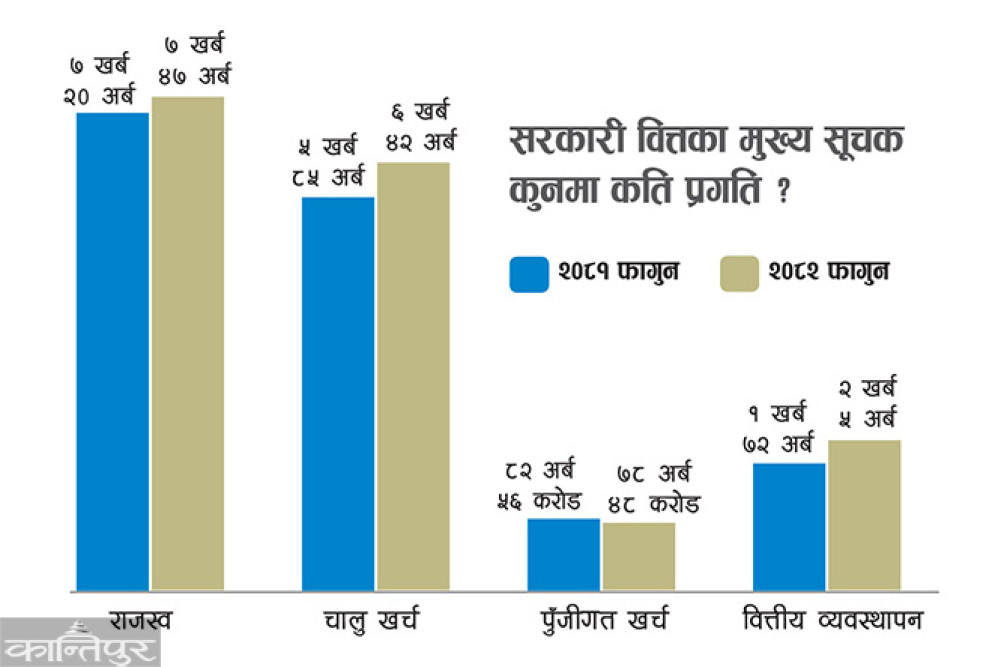
With only four months left in the fiscal year, the situation of capital expenditure and revenue collection is critical. Current expenditure has increased compared to last year. Capital expenditure allocation is 407 billion, but only 78.5 billion was spent in 8 months.
We use Google Cloud Translation Services. Google requires we provide the following disclaimer relating to use of this service:
This service may contain translations powered by Google. Google disclaims all warranties related to the translations, expressed or implied, including any warranties of accuracy, reliability, and any implied warranties of merchantability, fitness for a particular purpose, and noninfringement.
In the eight months of the current fiscal year (Shrawan-Falgun), the government has spent Rs 78.48 billion on capital expenditure. This is 19.24 percent of the annual target. The capital expenditure up to Falgun of the current fiscal year is about Rs 4.11 billion less than the same period of the previous fiscal year. Up to Falgun of the previous fiscal year 2081/82, the government had spent Rs 82.56 billion on capital expenditure, or 23.43 percent of the annual target.
In the current fiscal year, the government had allocated Rs 407.88 billion under the capital heading. But with four months left to end the fiscal year, the government has spent only 19 percent of the target. The government in Nepal has been weak in terms of capital expenditure. Looking at the data for the last three decades, on average, capital expenditure has been around 60 percent annually. Officials at the Ministry of Finance admit that the same trend has been repeated this year as well.
‘It is very disappointing that only Rs 78.5 billion has been spent in eight months out of the Rs 407 billion allocated for capital expenditure,’ said Tanka Prasad Pandey, spokesperson for the Ministry of Finance. ‘On the issue of capital expenditure, we need structural changes in policies, regulations and procurement processes. Because every year we are saying that capital expenditure has not been made by giving various excuses like earthquake, Covid, Gen-G movement.’ Therefore, he said that now there is a need for comprehensive structural reforms to increase capital expenditure.
In the eight months of the current fiscal year, Rs 751.86 billion has been collected in revenue. This is 82.60 percent of the monthly target for the same month. The government’s target was to collect Rs 910.20 billion in revenue by Falgun. In Falgun alone, Rs 82.53 billion in revenue has been collected. This is 85.46 percent of the Falgun target. The government had set a target of collecting Rs 96.57 billion in revenue in Falgun. This year, the government has set a target of collecting Rs 1.419 billion 300 million in revenue.
Ministry spokesperson Pandey claims that the revenue collection of 7 percent is satisfactory in the current adverse situation. ‘The current situation is not favorable, the expected improvement in industry and business has not been achieved. In such a situation, such a revenue increase is good,’ he said, ‘There is much room for improvement in revenue collection. However, the current achievement is also satisfactory.’
After the Gen-G movement demanding corruption control, good governance and improvements in public services, the government changed, ministers changed. But the aforementioned data confirms that the state of government finance indicators has not changed.
Economists say that the current government that came after the Gen-G movement has also not been able to increase government spending as expected. ‘Most of the capital expenditure is to be done by the development ministry. However, it is the job of the Finance Ministry and the Prime Minister’s Office to continuously urge those ministries. This government failed in that task,' said economist Keshav Acharya, 'Since the interim government and the election were the priority, this government could not do much in development work.' The government's entire attention was focused on the election, and now it is in the process of handing over power and exiting, development expenditure has not been given priority, Acharya argues.
'Meanwhile, the National Planning Commission should have been made powerful under the leadership of the Prime Minister's Office, but that could not happen,' said Acharya, 'The commission has also become only a temporary one.' Now the government has canceled projects worth about 1.25 trillion rupees. Expenditure on unnecessary areas should have been cut. However, Acharya complains that the selection of projects for cutting expenses has not been effective. He says that since the entire government has not been able to pay enough attention, the public finance indicators have not improved despite Finance Minister Rameshwor Khanal's wishes.
As of last Falgun, 54.37 percent of the annual target, or 642 billion 140 million rupees, has been spent. This is more than the current expenditure of the same period of the last fiscal year. This year, the government has spent some amount from current expenditure and other miscellaneous headings for elections. That is why the current expenditure has increased. Till Falgun 2081, the current expenditure was Rs 585.61 billion, or 51.34 percent of the annual target.
In the last eight months, the government has paid Rs 255.95 billion (54.89 percent of the annual target) on the principal repayment of government loans and investment in government institutions (financial arrangements). Till Falgun 2081, the government had spent Rs 172.96 billion or 47.09 percent of the target on this heading. Till the last eight months of this year, the government has received Rs 13.245 billion in foreign grants. This is 24.78 percent of the annual target. Till Falgun month of the last fiscal year, the government had received Rs 9.162 billion (17.51 percent of the target) in grants.
Looking at the government's income and expenditure in the first eight months of this year, the government has a deficit of about Rs 161.78 billion. During that period, the government has earned Rs 765.10 billion and spent Rs 926.58 billion. By Falgun of the last fiscal year, the government had a deficit of about Rs 196.41 billion.
This year, the government initially announced a budget of Rs 196.41 billion, but through the half-yearly review, it has been fixed at Rs 168.83 billion. The distortion of initially bringing a large budget by including arbitrary plans and making heavy cuts through the half-yearly review has been growing in recent years. Unable to raise and spend resources, Finance Minister Rameshwor Khanal initially reduced the total allocated budget by Rs 275.78 billion in the half-yearly review of the current fiscal year's budget. Bishnu Prasad Poudel, who became the Finance Minister from UML in the current fiscal year, had made public a budget worth Rs 196.41 billion.
It is said that the budget allocated in a large amount could not be spent and was revised to 1688.326.7 million rupees.
In the semi-annual evaluation report of the budget for the fiscal year 2082/83, the current expenditure has been reduced from 1180.98 billion to 1125.979.4 million rupees. Capital expenditure till the third week of Falgun of the current fiscal year is only 18.75 percent.
The ministry's own officials admit that the situation of capital expenditure is very pathetic. The ministry allocated 477.888 million rupees for capital in the current fiscal year, but this has been reduced to 243.333.34 million rupees. Similarly, the allocation for financial management has been reduced from 375.222 million rupees to 319.439 billion rupees. The Ministry of Finance had revised the budget estimates with a target of achieving 6 percent economic growth and keeping consumer inflation at 5.5 percent in the current year.