This service is operated by the Pahitani Intermediate User Committee and Belsahar Intermediate Community Forest of Chitwan National Park.
We use Google Cloud Translation Services. Google requires we provide the following disclaimer relating to use of this service:
This service may contain translations powered by Google. Google disclaims all warranties related to the translations, expressed or implied, including any warranties of accuracy, reliability, and any implied warranties of merchantability, fitness for a particular purpose, and noninfringement.
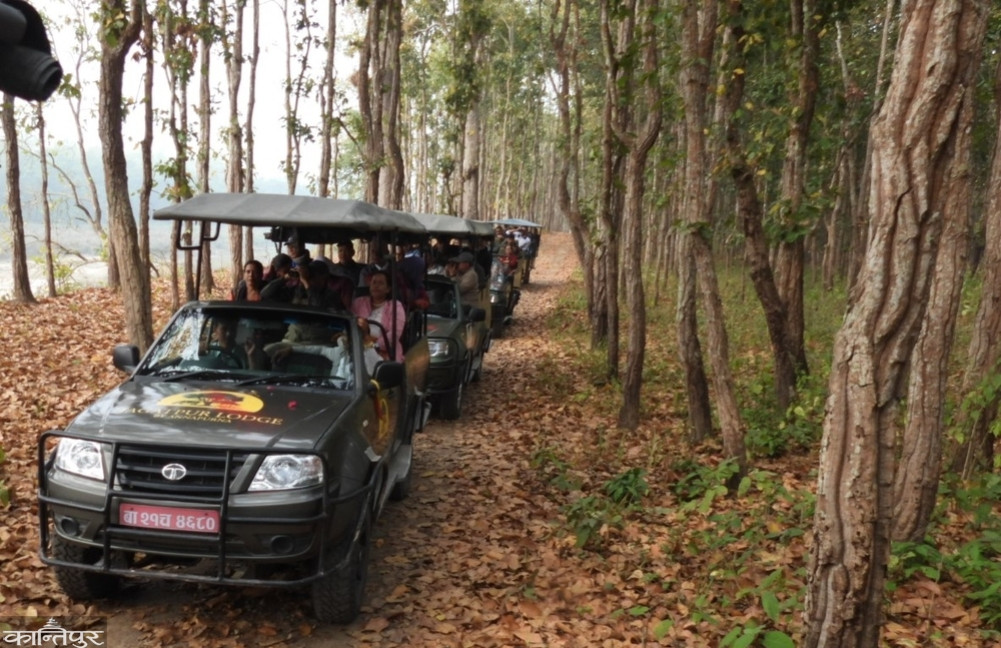
A tourist jeep safari has started from Patihani's Ghatgai to Dudhaura via East Belsahar Forest from Sunday. The jeep safari has started covering the buffer and forest areas of Chitwan National Park. The Pahitani Buffer User Committee of the park and Belsahar Buffer Community Forest have operated this service.
Patihani Buffer User Committee Chairman Sajan Mahato, who is the coordinator of the Ghatgai Belsahar Dudhaura Jeep Safari Operating Committee, said that tourism activities in Patihani have been improving recently. He said that the safari was started to provide services to the tourists coming here and to bring the benefits of conservation to the community. The jeep safari was also started from Patihani in 2074 Paush.
Mahato said that the work has been taken forward in a new way by improving the shortcomings of the jeep safari that had not been running for a long time. Patihani Ghatgai area is located near Kasara, the headquarters of Chitwan National Park. Quality hotels and resorts for foreign tourists to stay here were opened in the 1940s. In recent years, more quality hotels have been expanding here. Many foreign tourists come here.
Mahato said that while taking a jeep safari along the banks of the Rapti River in the buffer forest, animals like rhinoceros, chital, and gharial, various birds and tigers can also be seen in the Rapti. The safari jeep moves forward through the forest area. Tourists also have the facility to stop at some place and enjoy the view of the riverbank. Mahato said that a two-hour safari can be done over a distance of about 12 kilometers.
Nepalis going on safari have to pay a conservation fee of Rs 200 and foreigners have to pay a conservation fee of Rs 500. The one-time entry fee for a jeep is Rs 1,000. He said that the safari will be conducted in two phases, morning and evening. Senior Conservation Officer Ganesh Pant, who is the head of Chitwan National Park, said that the procedure has been set by allowing jeeps to go on safari only 24 times a day, at 12 in the morning and 12 in the evening.
The park has a condition that the safari should be conducted without noise and littering. A maximum of 10 people can be accommodated in a jeep. Jeep safaris are also among the main choices of tourists visiting the park. Safaris are being conducted within the park and in the forests in the buffer zone. Although safaris are closed during the rainy season inside the park, they continue to operate in the buffer forests.
According to Avinash Thapa Magar, Information Officer and Conservation Officer of Chitwan National Park, there are 79 buffer community forests in the buffer zone of the park. He said that jeep safaris are being conducted in 17 of them. The buffer zone of the park includes Chitwan, Nawalparasi (east of Bardaghat Susta), Makawanpur and Parsa. Three hundred thousand tourists from home and abroad visit the park every year.