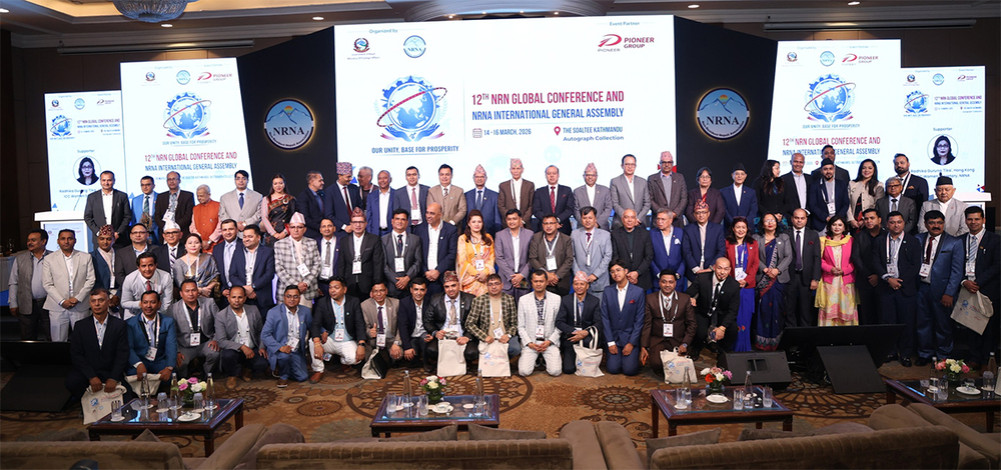
Entrepreneurs and experts participating in the program here on Saturday opined that investment by overseas Nepalis could increase if policy stability, an environment of trust, and institutional mechanisms could be created.
We use Google Cloud Translation Services. Google requires we provide the following disclaimer relating to use of this service:
This service may contain translations powered by Google. Google disclaims all warranties related to the translations, expressed or implied, including any warranties of accuracy, reliability, and any implied warranties of merchantability, fitness for a particular purpose, and noninfringement.
The 12th World Conference of the Non-Resident Nepali Association (NRNA) has called for increasing investment in hydropower, tourism, information technology and other sectors, saying that the investment environment in Nepal has become favorable.
Entrepreneurs and experts participating in the program here on Saturday opined that investment by overseas Nepalis can increase if policy stability, an environment of trust and institutional mechanisms are created.
Investment Board Chief Executive Officer Sushil Gyawali opined that cooperation between the government, NRNA and the private sector is necessary to create a reliable basis for investment in Nepal. Although there were some problems in policy consistency due to unstable governments in the past, now that a government with about two-thirds of the votes is about to come, everyone should unite to instill confidence in investors, he said, adding that the board is committed to facilitating investment.
Nepal Rastra Bank Research Department Executive Director Ram Sharan Kharel said that the issue of connecting the approximately 8 million Nepalis living abroad to Nepal's long-term economic development should be considered. He stressed the need to create a safe environment, market and basis of trust for investment.
President of the Federation of Nepalese Chambers of Commerce and Industry Chandra Prasad Dhakal said that since Nepal has now created an environment of political stability, the private sector is ready to attract investment through policy reforms in collaboration with the Nepali diaspora.
Vice President of the Confederation of Nepalese Industries Hemraj Dhakal believed that NRNA investment would be important to make Nepal's economy a $100 billion country.
Vice President of the Chamber of Commerce Deepak Malhotra emphasized on policy stability, investment and trust and believed that an institutional mechanism is necessary for non-resident investment.
Founding President of the NRNA Upendra Mahato urged to invest in Nepal keeping in mind the future of future generations.
Meanwhile, in the 'Second Generation Youth and Cultural Responsibility' session organized under the conference, senior cultural expert Dr. Jagman Gurung said that the preservation of culture is through generational transmission and that the descendants of Nepalis living in the diaspora should be connected to culture and language.
Cultural expert Prof. Dr. Veena Poudel mentioned that culture can be preserved through language, art and festivals.
Nepal Tourism Board Chief Executive Officer Deepak Raj Joshi said that cultural tourism promotion is necessary to connect the second generation living abroad with Nepal. NRNA Vice President Dr. Hemraj Sharma opined that activities like language education, cultural programs and sports would be useful to connect the youth with Nepal.
Various speakers at the program emphasized the need for policy reforms and collaboration to link the investment, skills and knowledge of Nepali expatriates with Nepal's economic development.