Remittance inflows increased by 39.8 percent to Rs 1.261 trillion in the first seven months of the fiscal year 2082/83. Remittance inflows increased by 7.5 percent in the same period last year.
We use Google Cloud Translation Services. Google requires we provide the following disclaimer relating to use of this service:
This service may contain translations powered by Google. Google disclaims all warranties related to the translations, expressed or implied, including any warranties of accuracy, reliability, and any implied warranties of merchantability, fitness for a particular purpose, and noninfringement.
Nepalis who have gone abroad for employment have sent about 1.25 trillion rupees to the country in the last seven months. 1.25 trillion rupees were received in remittances from Shrawan to Magh of the current fiscal year. According to the National Bank, remittances have increased by 39.8 percent this year compared to the same period of the last fiscal year. With this, the total remittances in the country in the seven months are 1.261 billion rupees.
Remittance inflow in the seven months of the fiscal year 2082/83 has increased by 39.8 percent to 1.261 billion rupees. In the same period last year, remittance inflow had increased by 7.5 percent.
Remittance inflow in Magh 2082 is 1.98 billion. In the same month last year, remittance inflow was 1.37 billion. 50 billion rupees. In the review period, remittance inflow in US dollars has increased by 33 percent to 8.86 billion. In the previous year, such inflow had increased by 5.5 percent. Over 100 million remittances have been flowing into the country every month for the past 28 months. Accordingly, the highest ever remittance of 201 million was received in Asoj.
During the review period, the number of Nepalis who received final work permits (institutional and individual-new) for foreign employment was 245,153 and the number of those who received re-work permits was 227,424. In the same period last year, such numbers were 274,622 and 190,886, respectively.
Remittances have been making a significant contribution to Nepal's economy. However, the overall security situation in the West Asian region has been disrupted due to the ongoing war in the region for the past few weeks, which is also affecting Nepal's economy. As tensions increase in Qatar, Saudi Arabia, Bahrain, Kuwait, the United Arab Emirates (UAE) and Oman, it is seen that Nepal's tourism, remittances, trade and foreign employment will be directly affected.
Air services via Gulf countries have been affected. Currently, there are about 1.9 million Nepali workers in the Gulf region. Of the 700,000 Nepalis who go abroad for employment every year, about 65 percent, or 450,000, go to the Gulf countries alone. After the US and Israel attacked Iran, Iran has been retaliating by targeting US military camps in the Gulf countries.
Experts estimate that the overall economy of Nepal will be affected, especially since fuel imports will decline and prices will increase. About 41 percent of the total remittances entering Nepal come from the Gulf region. In the first 6 months of the current fiscal year, remittances of Rs 1030 billion have been received, of which remittances from the Gulf countries are Rs 422 billion.
In the fiscal year 2081/82, remittances of Rs 1722 billion were received. Of that, the share of the Gulf countries was Rs 673 billion. Although a small number of tourists come to Nepal from the Gulf region. According to the Tourism Board, 20,504 tourists came from the Gulf countries in the last fiscal year. More tourists came to Nepal from the Gulf countries last year compared to the previous year (16,648). Last fiscal year, the number of tourists from the Gulf countries accounted for 1.8 percent of Nepal's total tourists. Last fiscal year, 1,158,459 tourists entered Nepal.
If tensions in the West Asian region persist, Nepal's foreign exchange earnings will be affected. Imports of gold, silver and their jewelry, copper wire, plastic, packaging and pipe industries, which are considered essential for Nepali consumers, will also be affected.
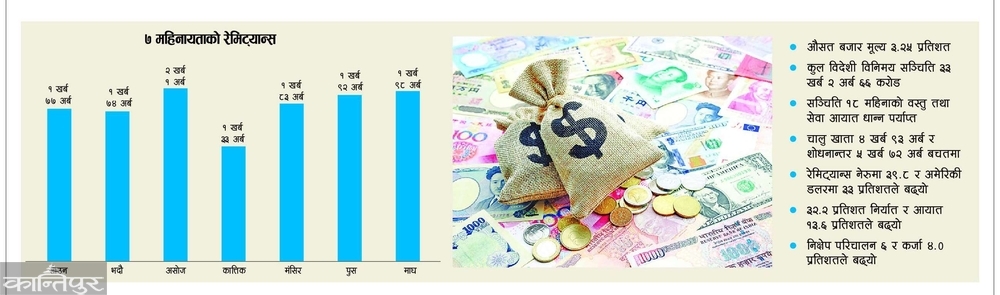
The average market price of goods and services purchased by consumers (consumer inflation) was 3.25 percent in Magh. In the same month last year, such price increase (inflation) was 4.16 percent. In Magh, the inflation of the food and beverage group was 2.50 percent and the inflation of the non-food and service group was 3.66 percent. The inflation rate of these groups in the same period last year was 4.95 percent and 3.74 percent, respectively.
The average inflation rate for the seven months of the fiscal year 2082/83 is 1.92 percent. The average inflation rate for the same period last year was 4.86 percent. Similarly, in the last Magh, the annual point consumer price index of the vegetables subgroup under the food and beverage group increased by 11.63 percent, ghee and oil by 7.61 percent, and fruits by 7.41 percent. However, the annual point consumer price index of the pulses and legumes subgroup decreased by 5.19 percent, food and food products by 2.97 percent, and spices by 2.61 percent.
The annual point consumer price index of the miscellaneous goods and services subgroup under the non-food and service group increased by 21.98 percent, education by 7.46 percent, clothing and footwear by 5.28 percent, tobacco products by 4.15 percent, and alcoholic beverages by 3.85 percent. The annual point consumer price index of the communications subgroup has decreased by 0.08 percent.
The country's foreign exchange reserves have exceeded 33 trillion. Compared to last Ashar, such reserves increased by 625 billion to 33 trillion 2 billion 660 million rupees as of Magh. The total foreign exchange reserves in mid-Ashar 2082 were 2677 billion 680 million rupees. This is an increase of 23.3 percent compared to Ashar. According to the Rastra Bank, such reserves in US dollars were 19.5 billion in mid-Ashar 2082, but increased by 16.7 percent to 22.76 billion rupees in mid-Magh 2082. Based on imports up to seven months of the current fiscal year, the Rastra Bank claims that the foreign exchange reserves of the banking sector are sufficient to cover 21.3 months of goods imports and 18 months of goods and services imports.
Out of the total foreign exchange reserves, the reserves held by Nepal Rastra Bank have reached 2926 billion 990 million. It increased by 21.2 percent in mid-January 2082 from 2414 billion 640 million in mid-January 2082. The foreign exchange reserves held by banks and financial institutions (excluding Nepal Rastra Bank) have increased by 42.8 percent to 375 billion 670 million in mid-January 2082 from 263 billion 400 million in mid-January 2082. It is stated that the share of Indian currency in the total foreign exchange reserves as of mid-January 2082 is 21.5 percent.
In the last January, the country's balance of payments position was in surplus by 572 billion 730 million. In the seven months of the last year, the balance of payments position was in surplus by 284 billion 410 million. In US dollars, the balance of payments position, which was in surplus by 2.11 billion in the same period of the last year, is in surplus by 4.3 billion in the review period. As of mid-January, the current account was in surplus by Rs 493.78 billion. In the same period last year, the current account was in surplus by Rs 184.14 billion. In US dollars, the current account, which was in surplus by Rs 1.37 billion in the same period last year, is in surplus by Rs 3.47 billion in the review period. In the last seven months, direct foreign investment (equity only) has inflowed Rs 10.22 billion. In the same period last year, such direct foreign investment (equity only) was Rs 7.43 billion.

