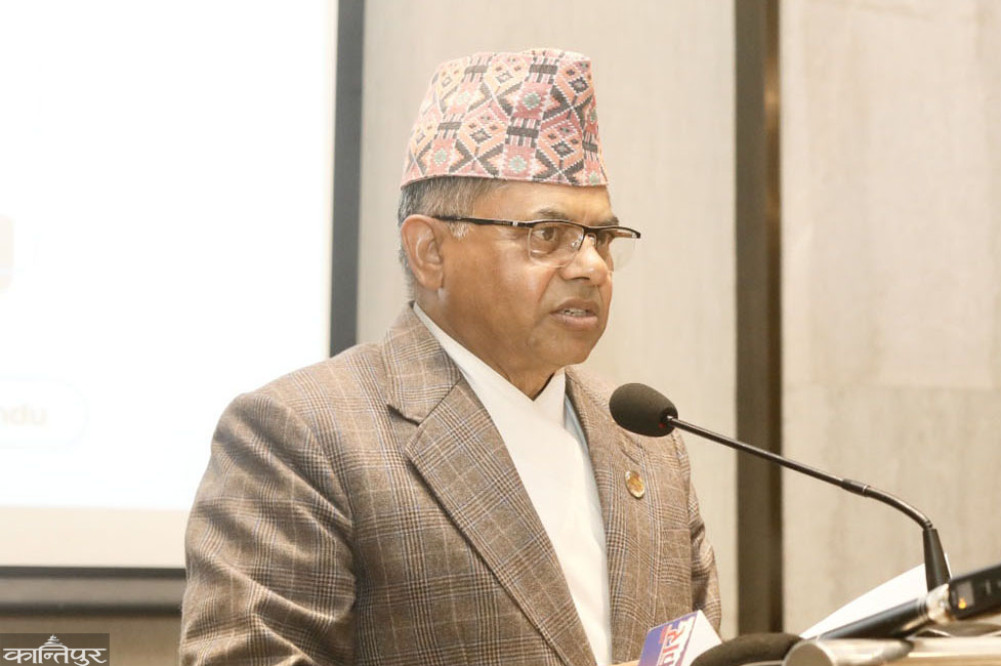
He said that by blending 10 percent ethanol in petrol, 130 million liters of petrol imports could be replaced annually and the 6 billion rupees spent on it could be saved.
We use Google Cloud Translation Services. Google requires we provide the following disclaimer relating to use of this service:
This service may contain translations powered by Google. Google disclaims all warranties related to the translations, expressed or implied, including any warranties of accuracy, reliability, and any implied warranties of merchantability, fitness for a particular purpose, and noninfringement.
Minister for Industry, Commerce and Supplies Anil Sinha has said that it was easy to take a decision after his arrival as ethanol has been studied and discussed repeatedly for 20 years.
Industry Minister Sinha said this at the 'Ethanol Blending Policy in Nepal: Opportunities, Challenges and Implementation Strategies' program organized by the Society of Economic Journalists of Nepal (SEJON) on Sunday. 'Discussions have been going on for years. That is why we did not take much time to discuss. It is in the process of being published in the Gazette,' he said.
He said that ethanol blending will achieve many positive and environmental achievements. He said that after blending 10 percent ethanol in petrol, 130 million liters of petrol can be replaced annually and 6 billion rupees can be saved.
He said that since the main source of ethanol production is sugarcane and other agricultural products, sugar production will be industrialized. He claimed that agricultural products can be produced on barren land that is not suitable for agricultural production and that employment will be created with the establishment of new industries. 'The challenge is how efficient vehicles with ethanol blend will be in the cold weather in the Himalayan region.' There is a pressing question of food security,' he said, 'It is necessary to move forward with food versus fuel in a balanced manner.'
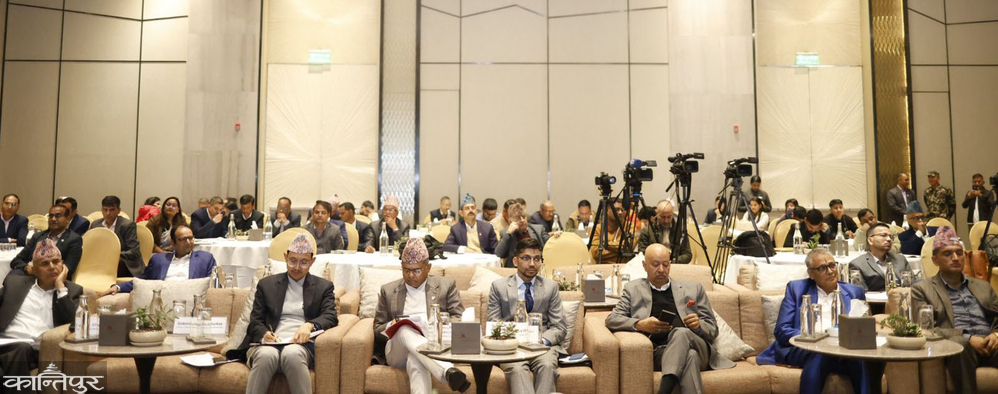
Nepal Oil Corporation Managing Director Dr. Chandika Bhatta said that the ethanol blending policy has been limited to papers and debates for a long time. 'In order to speed up the process, it should not be limited to papers anymore, the interim government has approved Order 2082 on blending ethanol in petrol and bringing it into use within a short period of political change,' he said. He said that since the ethanol blending policy has been implemented even in countries that produce petroleum products, it has become necessary in an import-dependent country like Nepal.
On Mangsir 29, 2060, a notice was issued in the Gazette stating that ethanol will be used as an environmentally friendly fuel by blending it with petrol used in vehicles throughout Nepal from Magh 1, 2060. This has also been included in the policy and program of 2071072. 'The order to blend ethanol in petrol, which will be implemented only after 20 years, has been approved by the Council of Ministers,' he said, 'it will soon be published in the Gazette and implemented.'
According to him, ethanol blending will contribute to fuel security by replacing imports, reducing trade deficit, contributing to industrialization and creating employment, and contributing to the rural economy.
He said that ethanol blending will help reduce pollution by 45 percent by reducing carbon emissions, providing benefits for a clean environment and a healthy life. He said that the question has also been raised whether it will affect the food supply chain as it occupies agricultural land.
India has been promoting 1.5 percent ethanol blending since 2014, but it has reached 20 percent by 2025. He said that only some raw materials required for ethanol have been allowed to be imported. He said that now only sugar mills will produce raw materials. Currently, the order mentions only 10 percent in ethanol blending.
In the session on 'Ethanol Blending Policy in Nepal: Opportunities, Challenges and Implementation Strategies', Joint Secretary of the Ministry of Industry Shivaram Pokharel said that the way has been opened for those who want to produce ethanol after this order came. He said that the situation of producers or investors deciding where and how to sell has ended. 'The policy has been brought only after the industrialists are ready to produce ethanol, production takes place after the place of sale is decided,' he said.
Chairman of Kian Chemical Industries Ved Prasad Kharel said that a request has been made to make a machine for mixing raw materials molasses grain and cassava. He said that agricultural raw materials for ethanol can be produced on land that has been devastated by wild animals. He said that foreign investment of Rs 12 billion has been approved to establish an ethanol industry and the target is to provide 2,000 jobs. 'Even though the order has come, it has not been gazetted yet, there is still a problem, it does not seem like it will be implemented,' he said.
According to Chairman of Nepal Sugar Producers Association Shashikant Agrawal, 240,000 to 50,000 tons of sugar is consumed annually. 70 percent is consumed by industry and 30 percent by households. Sugar production has been continuously increasing in recent years, he said. 'Last year, 200,000 tons of sugar were produced. Molasses is consumed in the grain and alcohol industries, but it is still being wasted. If molasses is consumed, more production can be increased,' he said.
Consumer activist Madhav Timalsina opined that it should be implemented only after studying from scratch. 'Today, we say that ethanol will be blended to reduce the import of petroleum products, but if we have to depend on imports for raw materials later, how will we reduce imports?' he said.