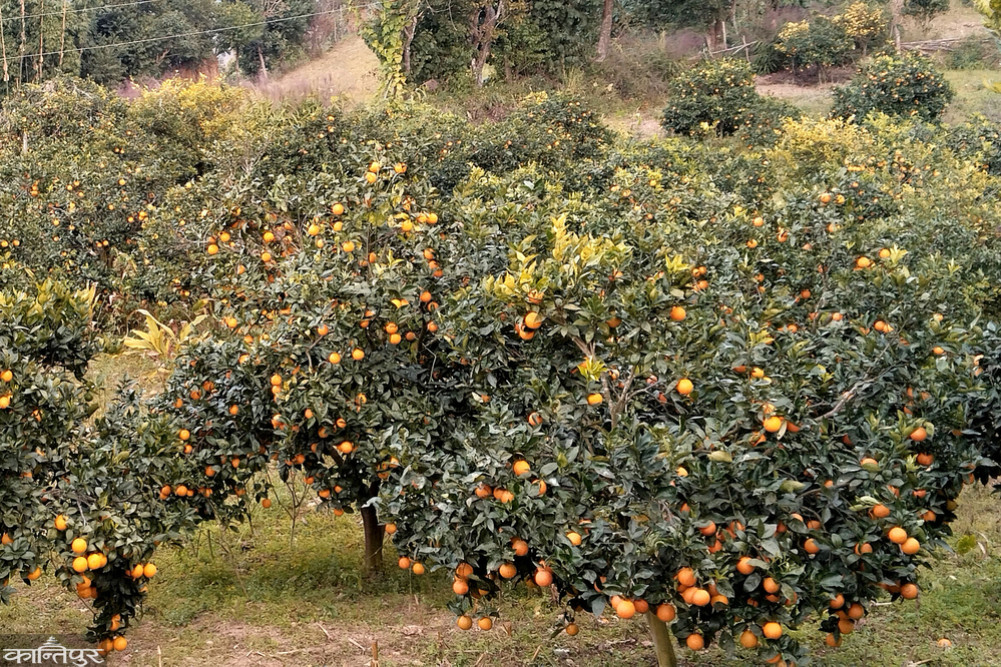
Farmers have not yet harvested the junar, hoping to get a good price during the off-season, but technicians have suggested harvesting it on time.
We use Google Cloud Translation Services. Google requires we provide the following disclaimer relating to use of this service:
This service may contain translations powered by Google. Google disclaims all warranties related to the translations, expressed or implied, including any warranties of accuracy, reliability, and any implied warranties of merchantability, fitness for a particular purpose, and noninfringement.
The country is heated by the election atmosphere, but farmers here are worried about Junar.
Junar farmers in Okhreni, Ramechhap Municipality-7 are worried about when they will get the price of junar. Although junar production has decreased slightly compared to the past, they are hoping to get a good price when selling it during the off-season. They have still kept junar and oranges in the orchard.
Junar is usually harvested between the first week of Mangsir and Magh, but even though some junar farmers have sold their junar, most of the farmers in Okhreni are keeping it in their gardens in the hope of getting a good price.
Local junar farmer Himal Tamang, who has not yet decided to sell his garden's junar, which is grown on about 500 plants, after getting a good price, said. 'We are more worried about when we will get the price of the junar that is ripe on the tree than the excitement of the elections,' he said.
This year, there has been some decline in production due to continuous rains in Asoj and Kartik. Local farmer Dilmaya Tamang said that while she sold the junar from her garden in the last month of December, she got only Rs 50 per kg, but now she sells it for Rs 60 to 90 per kg, depending on the size of the seeds. "We have kept the junar plants in the hope that the later we sell them, the more money we will get, but now we are preparing to sell them for Rs 60-70 per kg," she said.
Junar starts producing two to three years after planting the seedlings. Farmers who also grow soybeans, garlic, onions, cauliflower, and cabbage in the junar garden earn double income. Another farmer, Giriraj Tamang, said that he did not sell junar in the hope that he would get a good price when he sold it after the season was off.
They are also making jam, juice, and other beverages from junar and selling them. Ram Kumar Karki, a farmer from Sukajor, Ramechhap Municipality-7, says that there is no major problem in the market for junar. Although it is natural to get a good price in the off-season, technicians of the Junar Zone Coordination Committee say that it is not good to keep the junar on the plant in the hope of getting a good price since the junar flowers from the last week of Magh to the first week of Falgun. Since keeping the junar on the plant until the junar flowers bloom affects the flowers that will bloom next year, farmers will benefit from picking it on time and keeping it in a humid place instead of selling it, Junar Zone Coordination Committee Chairman Gunj Bahahur Karki suggests.
The National Agriculture Modernization Program Implementation Unit, Ramechhap, has been running various programs to develop Manthali, Ramechhap Municipality and Likhu Tamakoshi Rural Municipality as a junar zone.
In the last fiscal year 2081/82, junar was cultivated on 580 hectares in the district, while in the current fiscal year, junar cultivation is being done on 680 hectares including Ramechhap, Manthali Municipality and Likhu Tamakoshi Rural Municipality. Bhawani Basnet, Deputy Technical Assistant of the National Agricultural Modernization Program, Program Implementation Unit, Ramechhap, informed. 'Technically, it is not good to keep junar on the plant until Magh-Falgun,' she said.
Local Lokendra Shrestha says that if a cold storage facility is arranged in every junar-producing village and an arrangement is made to store junar there during the season and sell it during the off-season, it will benefit the farmers.