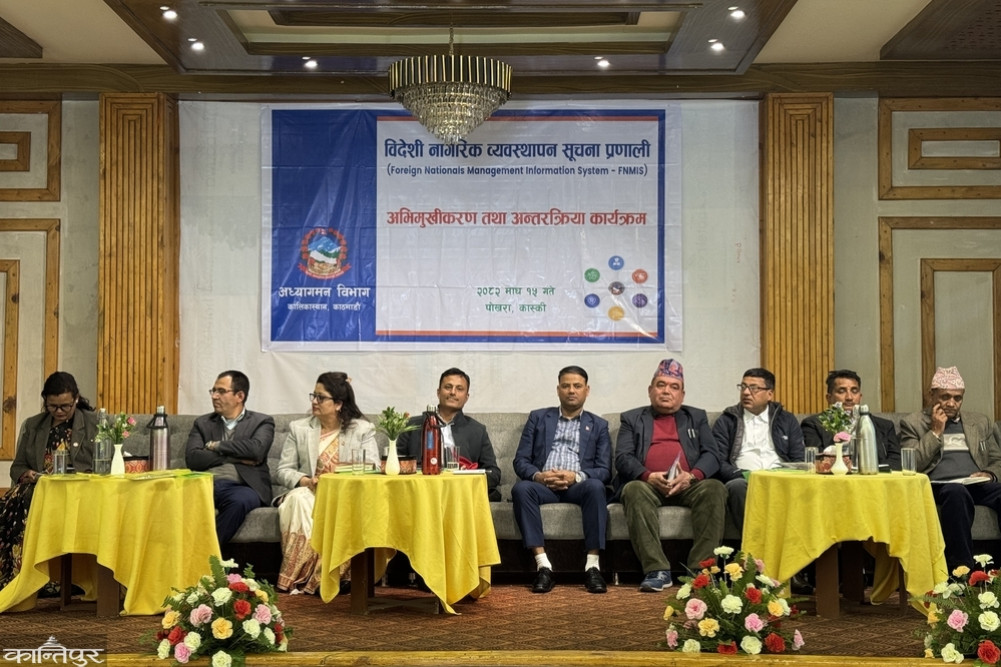
Pokhara's tourism entrepreneurs are committed to implementing the 'Foreign Citizen Management Information System' introduced by the Immigration Department.
We use Google Cloud Translation Services. Google requires we provide the following disclaimer relating to use of this service:
This service may contain translations powered by Google. Google disclaims all warranties related to the translations, expressed or implied, including any warranties of accuracy, reliability, and any implied warranties of merchantability, fitness for a particular purpose, and noninfringement.
Peter Jan Suchecki, a Polish hiker who had set out on a Mardi Himal trek, has been missing since 2 Kartik 2079. A search was conducted for him on the Kaski trekking route in the Annapurna Conservation Area, but nothing was found. 20-year-old Swedish citizen Mitchell Liu Blumberg went missing on 14 Pus 2080 on the Mardi trekking route. On 19 Shrawan 2081, only his skeleton was found in the Mardi forest.
In the fiscal year 081/082, the tourist police and local people's representatives rescued 5 people who went missing on the hiking trail in Kaski. There are examples of tourists going missing not only on the hiking trail, but also in the city. On 14 Chaitra 081, Ismail Zahid from the Maldives went missing from Pokhara. He could not be found even after searching the hotel and other places where he was staying. The next day, he was found leaving Pokhara International Airport for Kathmandu.
The lack of a mechanism to record the activities of tourists entering Nepal had not only caused problems in the safety and rescue of tourists, but also led to an increase in crimes committed by them. Tourists from various countries have been arrested in Pokhara for crimes including drug trafficking, child sexual abuse, overstaying, religious conversion, forged documents, rape, human trafficking, and crypto trading. According to the tourist police, 19 tourists who had overstayed since 081 were handed over to the Immigration Department.
Keeping in mind the safety of tourists and national security, the Immigration Department had implemented the ‘Foreign National Management Information System’ (FNMIS) developed for monitoring and managing the activities of foreign nationals from January 1. The implementation of this system started in the Kathmandu Valley in the first phase. Now, the Immigration Department is going to implement it nationwide from March 1 in the second phase.
On Thursday, the department organized a program in Pokhara and urged tourism entrepreneurs and other stakeholders to connect to the information system. The department has developed this information system for the first time to monitor the activities of foreign nationals in Nepal, manage their travel, and facilitate their travel. The system has been implemented to monitor, regulate, and manage the travel of foreign nationals who have entered Nepal on various visas, and to prevent them from engaging in other activities contrary to the immigration law, informed the program.
In the first phase, this system was implemented in organizations including star hotels, travel agencies, money exchanges, trekking agencies in the Kathmandu Valley. So far, 1,500 business organizations in Kathmandu have been connected to this system.
The Immigration Department has planned to connect hotels/lodges, domestic air service companies, helicopter companies, trekking agencies, public transport services, mountaineering agencies, tours and travel agencies, telecom service providers, banks and financial institutions, foreign exchange centers, tourist guides, tourist police, and other organizations related to tourism to this system. The department has stated that this initiative has been launched to make the migration of foreign citizens legal and systematic by connecting all these organizations to the immigration system.
‘Foreign citizens who come to our borders for whatever purpose, their activities need to be in the state’s knowledge, that’s why this system has been implemented,’ said Director General Tiwari, ‘It has not been introduced to curb the activities of tourists, but to make them feel safe and to make it easier to rescue them.’ He expects that when the message that an information system has been developed in Nepal with attention to the safety of tourists reaches other countries, the arrival of quality tourists will increase.
According to Pawan Gupta, Immigration Officer of the Department, under this system, all information about where foreign citizens live, what they do and whether they have complied with visa laws will be regulated and monitored from the time they enter Nepal until they return. ‘There is a provision to inform the immigration department about the details of foreign nationals staying in hotels and leaving through the system,’ he said. ‘A provision has been made for the service provider to directly enter the information into the department’s system or to connect it to its own system and send the information.’
The department has stated that this system will facilitate the collection of information in ‘real time’ through which foreign nationals staying in Nepal are located, where they are staying, whether they are in accordance with the visa law or not, and taking action accordingly. The department says that this system will help in immediately knowing whether foreign nationals who have come to Nepal on tourist visas have stayed in accordance with the law and taking necessary action.
Since foreign nationals who have entered Nepal on a visa are involved in other activities, overstay and are active in various criminal offenses, an integrated mechanism is being developed to facilitate those who are traveling and to bring them under the purview of action, Director General Tiwari said. The department has developed this system with the aim of providing security to foreign nationals visiting Nepal, facilitating information, controlling potential crimes and assisting in tourism promotion.
It is stated that this system will facilitate the security of foreign citizens and tourists and the facilities and rescue provided by the state when necessary, and the ease of immediate identification of activities in Nepal that are against visas or against prevailing laws, social values, political or economic rules. This system will be able to provide information to the state about the whereabouts of tourists when needed until they return from Nepal. Director General Tiwari said that immigration administration is an important aspect of national security and that it needs to be managed accordingly. Narahari Ghimire, Chief of the Immigration Office of Tribhuvan International Airport, said that the records kept in this way will be used for the rescue, security and policy formulation of tourists in the tourism sector.
Pokhara's industrialists, tourism entrepreneurs and stakeholders have expressed their commitment to implementing the Immigration Department's information system. Hari Sharma Gairhe, President of the Hotel Association Gandaki Province, said that the entrepreneurs will support the campaign brought by the government. Stating that there are 16,000 hotels in Gandaki Province, the government's figures show that there are no more than 5-600, he suggested that a mechanism should be created to bring all of them under the tax net.
Pokhara Chamber of Commerce and Industry President Gokarna Karki said that this system would be useful for the safety of tourists and should be made mandatory for all. Lekhnath Chamber of Commerce and Industry President Januka Parajuli said that the system would play an important role in attracting quality tourists.
Gandaki Province Ministry of Industry and Tourism Deputy Secretary Maharaj Dhakal said that in the context of preparing to develop a mechanism to keep records of tourists entering the province, collaboration with the immigration system could be possible. Kaski Chief District Officer and Foreign Citizen District Monitoring Committee Coordinator Rudra Devi Sharma said that once the information system is implemented, recording in the tourism sector will be easier and implementation will be monitored.
The mechanism for regulating the activities of foreign nationals who entered Nepal on various visas and engaging in illegal activities was not working effectively. It was difficult to identify where foreign nationals had stayed after entering Nepal. This integrated information system has been developed to solve this problem.
In the past one year, 501 foreign nationals have been deported from Nepal. They were deported for violating immigration laws and committing criminal offenses while staying in Nepal. According to the Immigration Department, among those deported, 437 were deported for overstaying their visas and 64 others were deported after serving their prison sentences. Last year, the department deported 404 foreigners, which has increased to 501 this year.
Foreign nationals have been involved in serious crimes including cybercrime, drugs, sexual exploitation, gold and foreign currency smuggling, wildlife smuggling and other activities while coming to Nepal on a tourist visa.
The highest number of deportees in the last one year has been 120 Chinese nationals. Chinese nationals have been found to be involved in various serious crimes. From gangs opening marriage bureaus in Kathmandu and sending Nepali women to China under the guise of getting them married, Chinese nationals have been involved in crimes including gold and foreign currency smuggling, wildlife smuggling, cybercrime and other crimes.
Out of the 501 citizens from 63 different countries deported in 2025, China accounted for the highest number, followed by Bangladesh at 75. Bangladeshi nationals have been involved in crimes including cybercrime, fraud, forgery and other crimes. Citizens from countries including the UK, the US and others, under the guise of social work through NGOs, have been involved in forcible religious conversions and other crimes.
There is a provision for organizations affiliated with this information system to provide information to the department through the affiliated system. All information including where foreign citizens are staying, where they are staying, and whether or not their visas are in accordance with the law will be available in this system. The department believes that if this system is successfully implemented, it will make the activities of foreign citizens systematic and legal, as well as help in national security and tourism promotion.