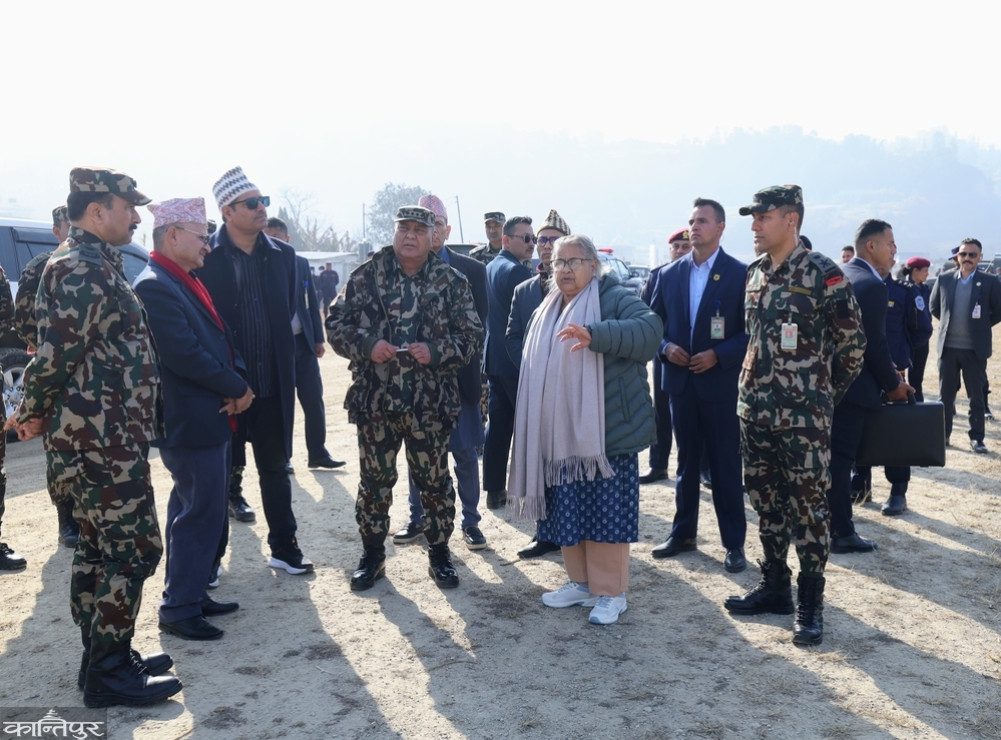
Even after eight years of the military taking over the construction management, no solution has been found.
We use Google Cloud Translation Services. Google requires we provide the following disclaimer relating to use of this service:
This service may contain translations powered by Google. Google disclaims all warranties related to the translations, expressed or implied, including any warranties of accuracy, reliability, and any implied warranties of merchantability, fitness for a particular purpose, and noninfringement.
The dispute over the Khokana section of the Terai/Madhesh Expressway (Fast Track) towards Lalitpur has not yet been resolved. This has affected the progress of the overall project. Eight years after the army took over the construction management, the problem of the 6.5-kilometer section has not been resolved.
Even locals are confused about whether a fast track will be built through this area or not. Prime Minister Sushila Karki conducted an on-site inspection of the Khokana section on Tuesday, where construction has not progressed. She has also given instructions to take the problem seriously and resolve it quickly.
Prime Minister Karki emphasizes that religious beliefs and cultural heritage should not be affected while moving forward with development work, including road infrastructure. ‘We should take the concerns of the locals seriously and find a solution,’ she told government officials. ‘We should be ready to change the alignment and zero point if necessary.’ She said that development work should be carried out in a way that does not hurt the trust of the locals.
Although the Detailed Project Report (DPR) of the Khokana section has been prepared, further work has not been able to proceed due to disputes. 211 ropanis of land in this section has not yet been acquired. Locals have been adamant that projects including smart cities, outer ring roads, and expressways should not be built in the same place, saying that archaeological and cultural heritage will be destroyed if they are built in the same place.
A study report conducted by a professor from Pulchowk Engineering Campus and a technical team from the Road Department on the alternative starting point of the expressway was submitted to the Ministry of Defense, Physical Infrastructure and Transport in Chaitra 2080. The report, which was prepared in 9 months, states that the Khokana area would be suitable. Another option is to build a viaduct (bridge) over the Bagmati River without falling within the Sikalighat area. However, the study has pointed out that this may cause social and cultural problems.
Another option is to build a four-lane corridor road with Bungmati as the starting point and acquire new land for it. This does not fall within the Sikalighat area. For this, new land will have to be acquired on the right bank of the Bagmati River. The study says that two-lane roads can be built along the Bagmati River corridor with Bungmati as the starting point.
It has been said that additional land will be acquired on the left bank, starting from Bungmati. The report mentions that another option is to use the right bank of the Bagmati River, starting from Dukuchhap, and some land can be acquired for that. But none of these options have been implemented. Prime Minister Karki, along with Minister for Physical Infrastructure and Transport Madhav Prasad Choulagain, Minister for Foreign Affairs Balananda Sharma, Chief of Army Staff Ashok Raj Sigdel, Project Chief Dharmendra Jha, and Physical Secretary Keshav Kumar Sharma, participated in the on-site inspection.
The then Prime Minister KP Sharma Oli had also instructed the officials of the concerned ministry in Shrawan 2082 to quickly resolve the dispute over the Khokana section. But the instruction has not been implemented yet. Lalitpur Metropolitan City Ward No. 21 Chairman Rabindra Maharjan said that a decision should be taken quickly on the options finalized through the study. ‘The traditional and religious heritage of this area, monasteries and temples were not destroyed,’ he said, ‘Now we need to decide where to build the fast track, we should not delay it too much.’
Former Secretary Arjun Jung Thapa says that the Khokana section dispute should have been resolved while the construction of the fast track was being started, but it was a weakness that it had not been resolved yet. ‘This is a proud project, the country will benefit immensely once its construction is completed and put into operation,’ he said, ‘Therefore, not only the concerned bodies, but also political parties at the local level should take the initiative in solving the problem, now there is no need to delay the problem too much.’ He says that the fast track should be connected to the ring road.
The Council of Ministers had decided on 21 Baisakh 2074 to give the responsibility of managing the construction of the fast track to the army. Later, the Ministry of Physical Infrastructure and Transport handed over the project to the army on 27 Shrawan 2074. Accordingly, its construction is being managed by the army. The total distance of the fast track is 70.977 km. The total length of the tunnel is only 10.901 km. Out of the 89 special bridges to be constructed on the route, 9 have been completed.
Similarly, 7 tunnels are under construction. In this, the 'breakthrough' of both the Dhedre and Lendanda tunnels, which are built in parallel, towards Kathmandu and towards Nijgadh, has been completed. The longest, Mahadevtar tunnel, is under construction and its length is 3,355 meters. In the second week of December, a team including the Chief District Officers of Kathmandu, Lalitpur and Makawanpur, the Ministries of Defense, Physical Infrastructure and Transport, Finance and Forests and Environment, the National Planning Commission and project heads returned after an on-site inspection of the fast track.
Physical Secretary Keshav Kumar Sharma, who participated in the inspection, said that discussions were held on how to resolve the problems quickly and move forward with the work. "There is a dispute over the 3 km stretch from Khokna to Farsidol," he said. "The Ministry of Defense will inform the Prime Minister about the progress of the entire project and the problems that have arisen." He said that after that, it will be known soon how to resolve the problems of the Khokna section and move forward.
It was said that the work would be completed in Mangsir 2081 after the army took over the management. After it was not completed within that time, the deadline has been extended to Chaitra 2083, but the construction progress so far is only 45 percent. The estimated cost excluding VAT is Rs 175 billion, while including VAT it is Rs 211.93 billion. So far, about Rs 95.83 billion has been spent.