Now, Artha claims that many problems including customs fraud, revenue leakage, and the passing off of one item as another will be controlled.
We use Google Cloud Translation Services. Google requires we provide the following disclaimer relating to use of this service:
This service may contain translations powered by Google. Google disclaims all warranties related to the translations, expressed or implied, including any warranties of accuracy, reliability, and any implied warranties of merchantability, fitness for a particular purpose, and noninfringement.
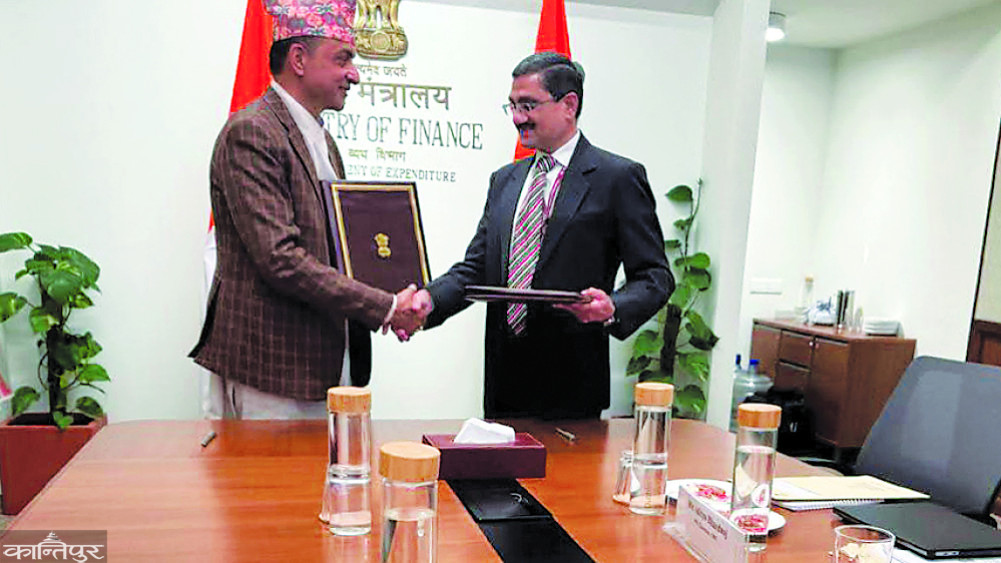
Nepal and India will now have to exchange information before the arrival of goods to be exported between the two countries. An agreement in this regard was signed between Nepal and India on Wednesday in New Delhi, India.
It has been named ‘Memorandum of Understanding on Exchange of Information Before the Arrival of Exported Goods between Nepal and India’. This is the first such agreement between Nepal and India.
The MoU was signed by Shyam Prasad Bhandari, Director General of the Department of Customs, on behalf of Nepal, and Bivek Chaturvedi, Chairman of the Central Board of Indirect Taxes and Customs (CBIC), on behalf of India.
CBIC Chairman Bivek Chaturvedi expressed his commitment for the early implementation of the MoU. The MoU exchange program was attended by four people including the Director General of the Department of Customs from Nepal and the Chairman of the CBIC and other members from India.
The MoU will help further strengthen the relationship between the customs administrations of the two countries and pre-arrival data of exported goods will be exchanged. After receiving export data, potential risks can be regulated and analyzed. This will further facilitate businessmen who do legitimate business and help make customs clearance faster and easier, according to the Department of Customs.
After this agreement, real data on imports and exports will be exchanged, so trade fraud and revenue evasion will be controlled, said Tanka Prasad Pandey, spokesperson for the Ministry of Finance. ‘This is our long-standing demand and effort. Which has now become meaningful,’ he said, ‘This is the concept of exchanging international data. Now many problems including customs fraud and revenue leakage control will be solved.’
Now, distortions such as under-invoicing, showing one item and importing another will be controlled, said spokesperson Pandey. There is an international practice of exchanging data on exported goods in advance between major trading partner countries to facilitate trade through risk management by exchanging information before the arrival of goods.
A draft of the MoU was prepared in collaboration with India’s Central Board of Indirect Taxes and Customs and the Customs Department to arrange for advance exchange of data on exported goods with India, Nepal’s major trading partner. The draft was finalized after discussions with all stakeholders on the draft. The MoU was approved by the Government of Nepal (Council of Ministers) and authorized to sign by the Director General of the Department of Customs. Based on this, the signing was carried out on Wednesday.
‘The MoU stipulates that customs control and trade facilitation will be made more effective through risk analysis, that the time taken in customs procedures will be reduced and that international trade will be ensured, that export data will be exchanged electronically within the limits set by national laws, and that information will be used only in accordance with the MoU,’ said Kishor Bartaula, spokesperson for the Department of Customs.