The Ministry of Energy will submit a proposal to the Council of Ministers after receiving the consent of the Ministry of Finance.
We use Google Cloud Translation Services. Google requires we provide the following disclaimer relating to use of this service:
This service may contain translations powered by Google. Google disclaims all warranties related to the translations, expressed or implied, including any warranties of accuracy, reliability, and any implied warranties of merchantability, fitness for a particular purpose, and noninfringement.
The Ministry of Finance has approved the investment modalities for the 1,200-megawatt Budhi Gandaki Reservoir Hydropower Project. The Ministry of Energy, Water Resources and Irrigation has stated that further processes have been taken forward with the approval of the investment modalities by the Ministry of Finance.
The basic cost of the Budhigandaki Hydropower Project to be built in Dhading and Gorkha is $2.77 billion (about Rs. 374 billion), while the project, including interest during the construction period, will cost Rs. 46 billion, according to Budhigandaki Company Limited.
The proposal for the investment modality of the Budhigandaki Hydropower Project was sent to the Ministry of Finance for approval when the outgoing Energy Minister Kulman Ghising was in office.
The Ministry of Energy will submit the proposal to the Council of Ministers once the Finance Ministry approves the proposed investment model. The company's CEO Arjun Rajouria said that the project will move forward with construction once the Council of Ministers approves the proposed investment model.
The construction period of the project is 8 years. The company has stated that the project will cost Rs. 46 billion, including interest during the construction period. The modality has been prepared with a loan and equity ratio of 70 and 30 percent based on the total cost including interest during the construction period. The Government of Nepal will own 80 percent and Nepal Electricity Authority will own 20 percent of the shares in the Budhi Gandaki Company Limited, the developer of the project.
After the project is completed or in the final stage of construction, taking into account the actual financial indicators, it has been proposed to reduce the debt burden by issuing a certain percentage of shares to the general public based on suitability and feasibility or to restructure the government's shares.
The government will invest a total of 248 billion rupees in the project, including 97.47 billion rupees for equity and 150 billion rupees for concessional loans. It has been proposed to convert the 45 billion rupees invested in the project by the government into shares in the company.
It is proposed that the government should also invest the amount for customs and value added tax in this project during the construction of the project. It has been proposed that 50 percent of the infrastructure tax levied at customs points on the import of petroleum products should be allocated for investment in the project. By reducing the current investment, the government will have to ensure the source of Rs 228 billion for the project. The authority will invest Rs 24.37 billion in equity in the project.
It has been proposed to issue shares of Nepal Electricity Authority, issue energy bonds, take loans from banks and financial institutions, provide concessional loans by the government, raise investment in the project by issuing shares to foreign employed and non-resident Nepalis and the general public.
It has been proposed to issue energy bonds of Rs 30 billion, calculated on the mandatory liquidity ratio, with the facilitation of the government to reduce the financial cost and make the project feasible. The bonds can be purchased by banks and financial institutions, insurance and reinsurance companies and public funds. A loan of Rs 104 billion will be provided by banks and financial institutions. It is proposed to raise funds through co-financing of Employees Provident Fund, Citizens Investment Fund, Social Security Fund, Insurance and Reinsurance Companies, HIDCL, Nepal Telecom and commercial banks. The
project will generate 3.38 billion units of electricity, including 1.41 billion units in the winter season and 1.97 billion units in the rainy season. The electricity purchase and sale rate is proposed to be 12.40 and 7.10 rupees per unit for the winter season and rainy season respectively. Thus, after the project comes into operation, it will generate an annual income of 31.48 billion rupees. The period of the power generation license of the project is proposed to be 50 years. If the project is completed within 8 years, electricity will be generated for 42 years. The detailed project report and tender documents of the
project are under preparation. The progress of land acquisition, which is considered the most complex part of the project, has reached about 90 percent. Rs 42.65 billion has been distributed to landowners for compensation for land, structures, plants and fruits. The project will physically and financially affect 8,117 households in Gorkha and Dhading. Out of these, 3,560 households will be completely displaced.
‘There is no situation where the project cannot be constructed due to land acquisition and compensation distribution,’ said Rajouria. ‘All the documents are ready to tender for the construction of the project.’ Rajouria said that once the Council of Ministers approves the investment modality, the financial management will be taken forward. He said that the main construction work for the project will start from January 2028 by advancing the construction work of permanent camps, access roads and other facilities.
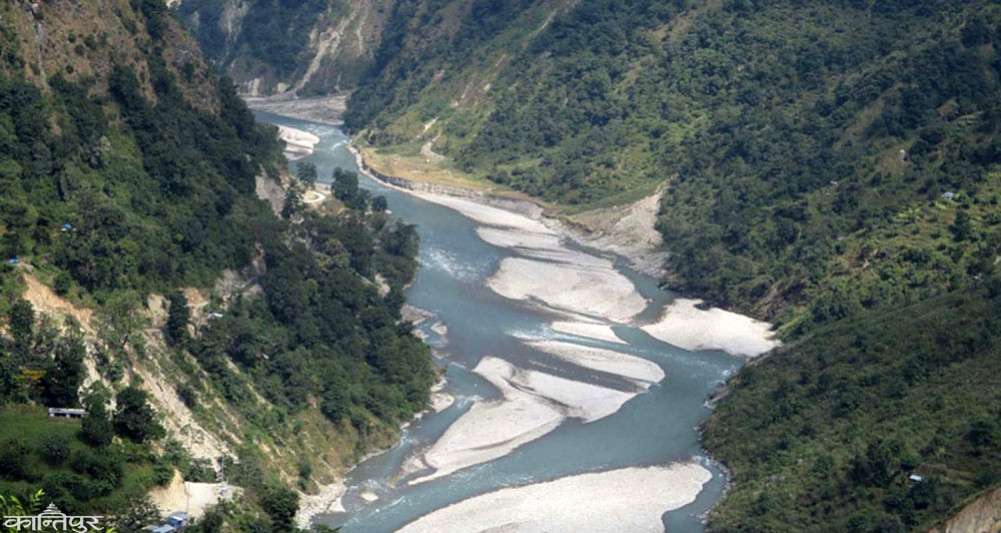
The Budhi Gandaki project is also of strategic importance in terms of energy security due to its proximity to electricity load centers such as Kathmandu, Chitwan and Pokhara. A 263-meter-high curved arch dam will be constructed to block the Budhi Gandaki River flowing through the border of Gorkha and Dhading districts. This will affect the 14 VDCs (currently 4 rural municipalities and 1 municipality) of Dhading and 13 VDCs (currently 4 rural municipalities) of Gorkha.
After the dam is completed, the reservoir of water trapped will spread over 63 square kilometers in the upper coastal area. This will create a situation where employment, business, tourism hub, fisheries and downstream benefits can be obtained. The maximum water level of the project will be 540 meters.
The government had started it as a national pride project in 2069/70 with the target of completing the project in the fiscal year 2083/84. The total cost estimate at that time was 260 billion rupees, according to the 60th report of the Office of the Auditor General. The Cabinet meeting held on 24 Chaitra 2079 decided to construct the project through domestic investment in the company model. As per the same decision, the company was established on 21 Ashar 2079 with the government holding the majority of the shares.
The Cabinet meeting held on 23 Kartik 2080 had decided to issue instructions to determine the investment model of the project. After that, Budhigandaki Hydropower Company Limited proposed an investment modality with two options in Chaitra 2080. However, confusion arose when the Ministry of Finance did not agree to the investment model. At that time, the company had estimated the cost of the project at 300 billion 1047 million rupees when providing the low-viability fund (Vaibility Gap Funding-VGF) and the total construction cost of the project at 300 billion 982 million rupees without VGF.