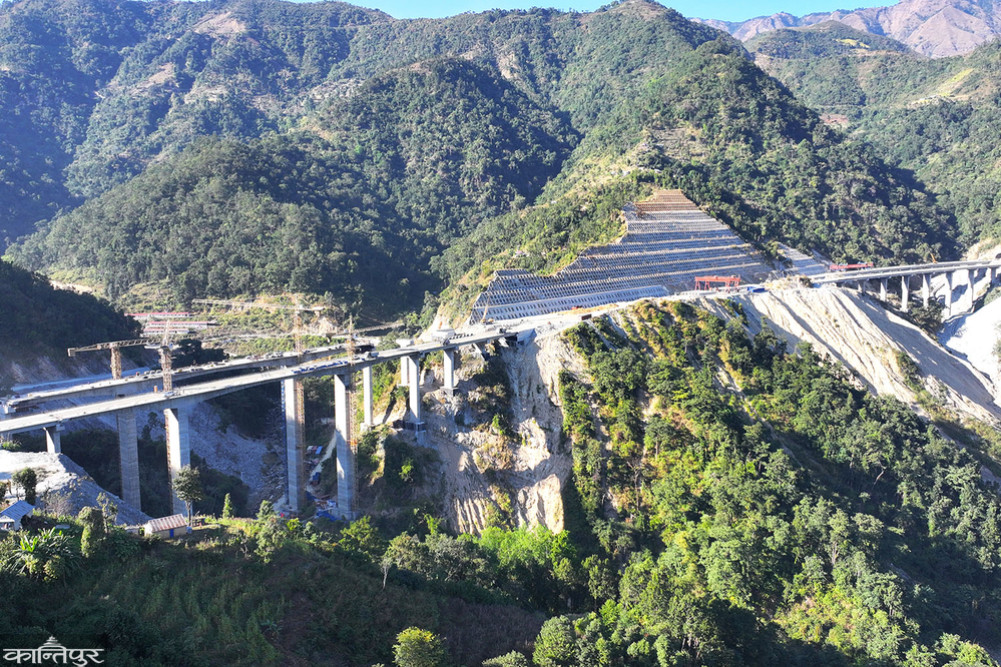
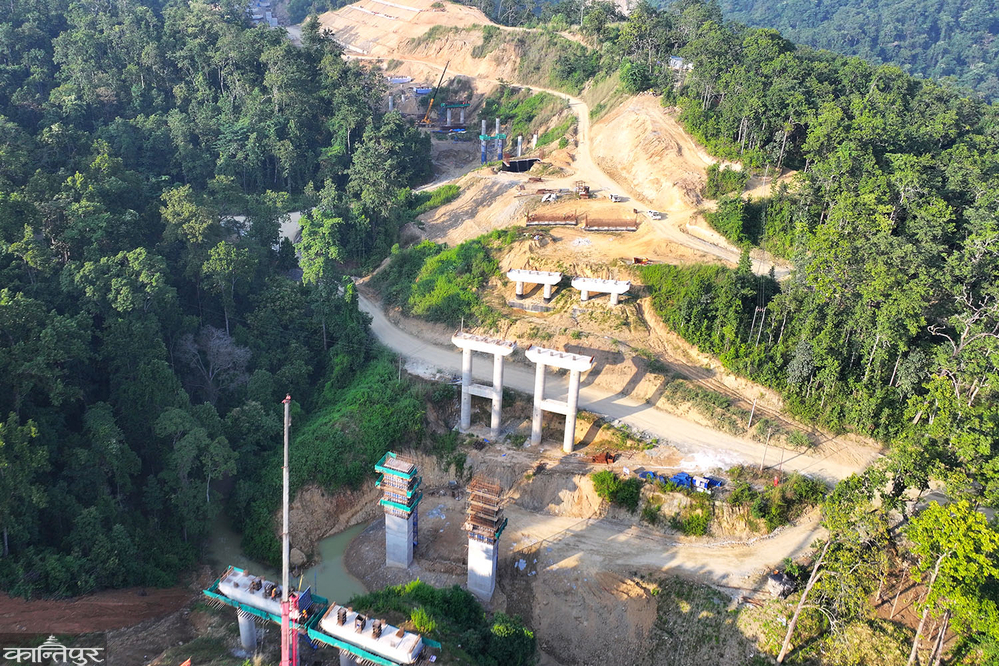
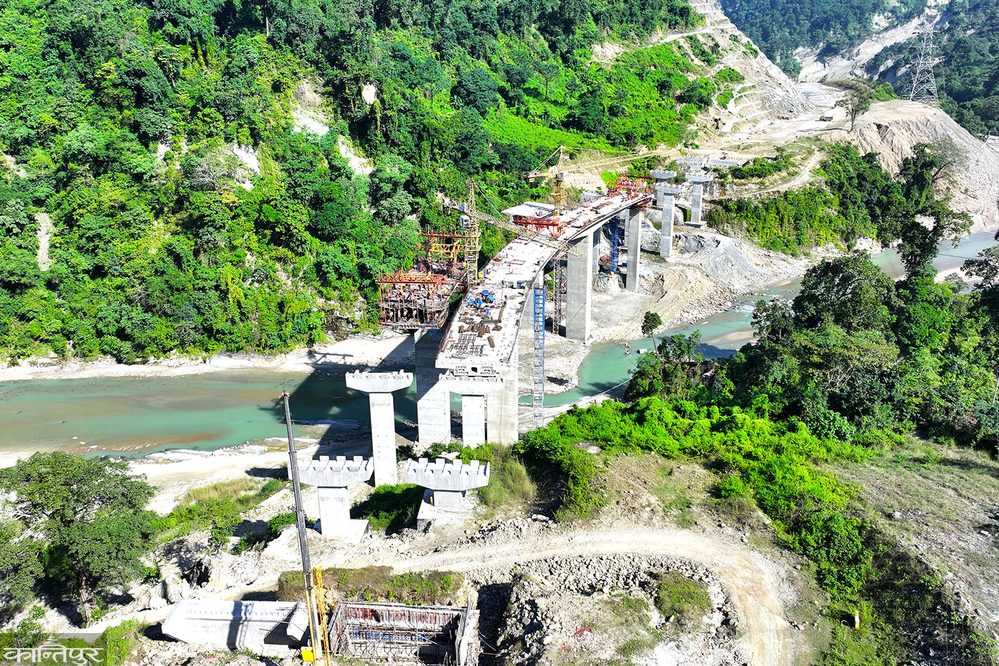
Videos and photos of the high bridge are going viral on social media. All eyes are on the 82-meter-high bridge between Lendanda and Dhedre.
We use Google Cloud Translation Services. Google requires we provide the following disclaimer relating to use of this service:
This service may contain translations powered by Google. Google disclaims all warranties related to the translations, expressed or implied, including any warranties of accuracy, reliability, and any implied warranties of merchantability, fitness for a particular purpose, and noninfringement.
The tall bridges built on the hilly terrain of the Terai-Madhesh Fast Track have now caught everyone's attention. The 82-meter-high bridge, which looks like it is 'touching the sky' over the river, is taking shape rapidly.
Out of a total of 89 bridges to be built on the expressway, nine have been completed. Of these, three out of four are 82 meters high. These bridges, built on the section connecting Lendanda and Dhedre tunnels in Makawanpur, are the tallest structures on the expressway.
Two parallel bridges have been built over the Jitpur River at the mouth of the Lendanda tunnel for vehicles travelling from Kathmandu to Nijgadh and Nijgadh to Kathmandu. One of the bridges, which is 339 meters long, is still under construction. Similarly, both bridges built over the Chalise River leading to the Dhedre tunnel have been completed.
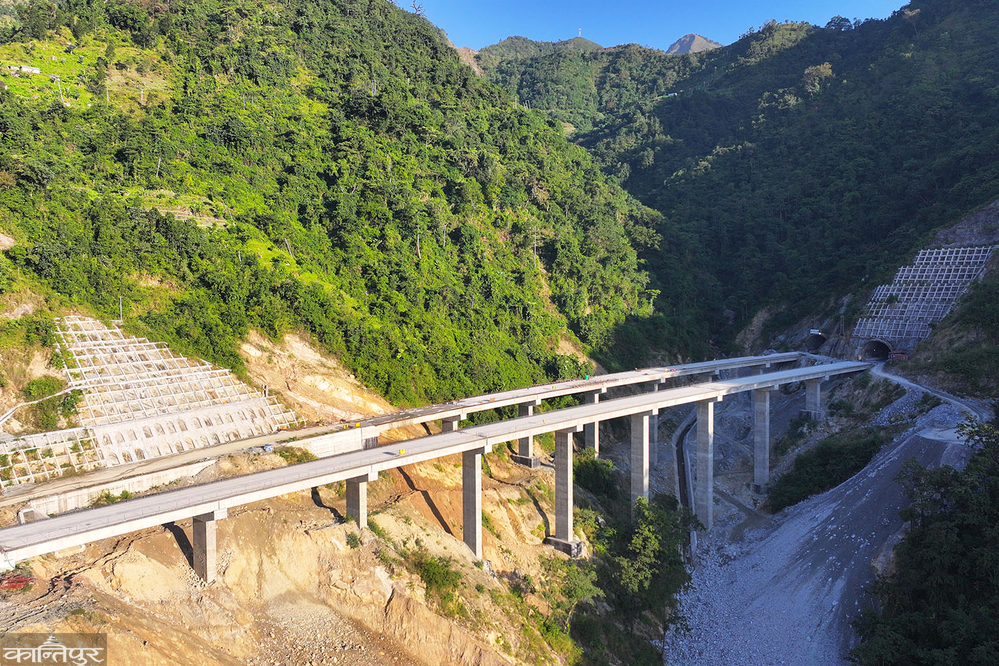
According to Army Spokesperson Assistant Lieutenant Colonel Rajaram Basnet, the work on the bridge, which is in the final stage, has been completed, while the slab prepared by pouring the slope is yet to be placed on it. ‘Out of the 89 special bridges to be built on the said route, 9 have already been constructed,’ Basnet said, ‘The foundation work of most of the bridges has been completed and the superstructure work is underway.’
Recently, videos and photos of the tall bridges being built on the said route have been going viral on social media. All eyes are on the 82-meter-high bridges at Lendanda and Dhodre. Even though the bridge work is underway, the ‘bearings’ used in it have to come from China and the Rasuwagadhi checkpoint has been closed, project sources have said.
Seven tunnels are under construction on the expressway. Of these, the ‘breakthrough’ of both the parallel tunnels built on the Dhedre and Lendanda tunnels towards Kathmandu and towards Nijgadh has already been completed. Currently, the work of the second layer of lining is ongoing in these tunnels. The longest, Mahadevtar tunnel, has not yet been ‘breakthrough’. Its total length is 3,355 meters. Two tunnels are being constructed in parallel in this too, and one is 2,288 meters and the other 2,395 meters have been dug.
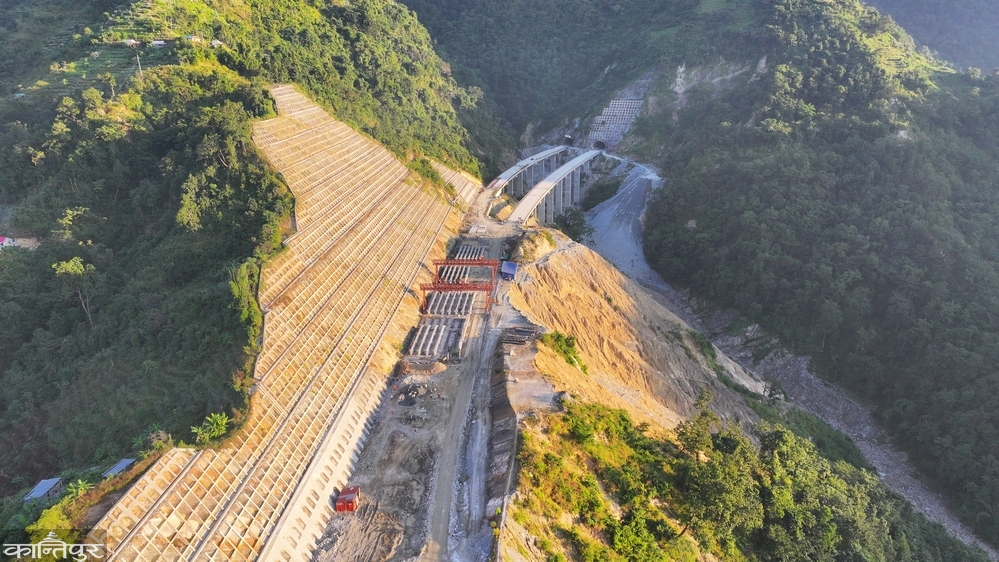
China State Company has been awarded a contract worth Rs 21.61 billion to construct the Mahadevtar tunnel along with the bridge and road. The company has not been able to break through the tunnel for a long time. Military spokesperson Basnet said that there is no problem now and work is underway. The excavation of 370 meters on the left side and 266 meters on the right side of the 2,250-meter Chandram Bhir tunnel, which was added later, has been completed. Work is underway to build a 'portal' at the mouth of the 1,000-meter Devichaur, 390-meter Sisoutar and 594-meter Mauribhir tunnels.
The Council of Ministers had decided on 21 Baisakh 2074 to give the responsibility of managing the construction of the expressway to the army. Later, the Ministry of Physical Infrastructure and Transport handed over the project to the army on 27 Shrawan 2074. Accordingly, its construction is being managed by the army.
The total distance of the expressway is 70.977 km. The total distance of the tunnel route is only 10.901 km. Work has not yet begun on the Khokana section of Lalitpur, which is 5 km out of the total distance. The then Prime Minister KP Sharma Oli had directed the officials of the concerned ministry in last Shrawan to quickly resolve the dispute over the Khokana section. The dispute there has not been resolved yet. Locals have been adamant that the projects should not be built in one place, saying that building many projects, including smart cities, outer ring roads, and expressways in one place would destroy archaeological heritage.
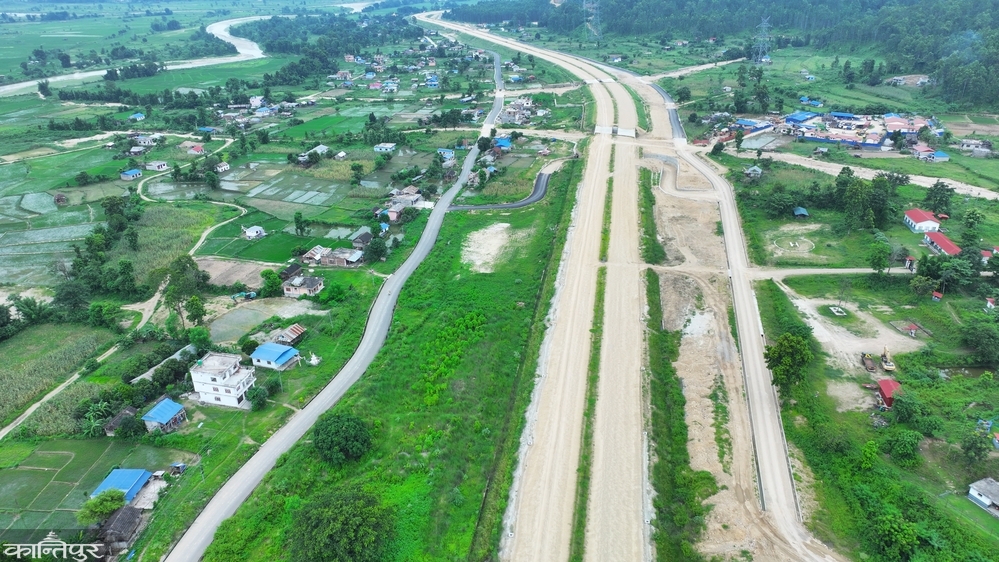
A study report by a professor from Pulchowk Engineering Campus on the alternative starting point of the expressway was submitted to the Ministry of Defense and Physical Infrastructure and Transport in Chaitra 2080. The report, which was prepared in 9 months, states that the Khokana area would be suitable. Another option is to build a viaduct (bridge) over the Bagmati River without falling into the Sikalighat area. However, the study has pointed out that this may cause social and cultural problems.
Another option is to make Bungmati the starting point and build a four-lane corridor road and acquire new land for it. It does not fall into the Sikalighat area. For this, new land will have to be acquired on the right bank of the Bagmati River. The study says that Bungmati can be used as the starting point and two-lane roads can be built across the Bagmati River corridor.
It is said that Bungmati can be used as the starting point and additional land will be acquired on the left bank. The report states that another option is to make Dukuchhap the starting point and use the right bank of the Bagmati River and acquire some land for it. A Defense Ministry source said that they are preparing to choose one of these options and decide soon.
Similarly, a team including the Chief District Officers of Kathmandu, Lalitpur and Makawanpur, the Ministries of Defense, Physical Infrastructure and Transport, Finance and Forests and Environment, the National Planning Commission and project heads returned after on-site monitoring of the Fast Track on Thursday and Friday. Krishna Poudel, Joint Secretary of the Defense Ministry, who returned after reaching the site, said that work is underway in the section except Khokana.
‘Progress is being made in the construction,’ Poudel said, ‘However, there are some problems in each package, mainly problems related to tree felling, land acquisition and compensation for house structures.’ Poudel said that the Chief District Officers of the concerned districts went for on-site monitoring and informed them about the problems. ‘It is not yet certain what will happen regarding Khokana,’ he said, ‘We can suggest what can be done, we can provide support on policy matters, but right now we have only gone to understand the status of the overall project.’
It was said that the work would be completed by Mangsir 2081 when the army took over the management. After it was not completed within that time, the deadline has been extended to Chaitra 2083, but as the construction progress so far is only 44.43 percent, it does not seem that the work will be completed within that time. The cost estimate excluding VAT is Rs 175 billion, while including VAT it is Rs 211.93 billion. So far, about Rs 95.83 billion has been spent.