The government has collected Rs 175.12 billion in debt during the Shrawan-Mangsir period of the current fiscal year. The public debt collected during this period is 29.40 percent of the annual target.
We use Google Cloud Translation Services. Google requires we provide the following disclaimer relating to use of this service:
This service may contain translations powered by Google. Google disclaims all warranties related to the translations, expressed or implied, including any warranties of accuracy, reliability, and any implied warranties of merchantability, fitness for a particular purpose, and noninfringement.
Public debt has increased by about 1.25 trillion rupees in the first five months of the current fiscal year (Shrawan-Mansir).
The Public Debt Management Office released data on Monday showed that Rs 114.48 billion was added in the last five months. With this, the government's outstanding public debt has reached Rs 278.853 billion as of Mangsir. This is 45.66 percent of Nepal's gross domestic product (GDP).
As of last Asad, the public debt was Rs 267.44 billion. Of the outstanding public debt, Rs 131.63 billion (21.31 percent of GDP) is internal and Rs 148.69 billion (24.35 percent of GDP), according to the Public Debt Management Office. In the last five months, Rs 175.12 billion of loans were received, while Rs 167.1 billion of loans have been repaid. Of the total amount paid, Rs 138.30 billion was spent on principal and the remaining Rs 28.70 billion on interest.
The amount used to pay interest on public debt is included in current expenditure. Therefore, the amount of Rs 138.3 billion spent on principal repayment is deducted from the amount of Rs 175.12 billion raised during the period. Adding Rs 77.66 billion due to changes in foreign exchange rates to the amount received in this way, it is seen that about Rs 138.3 billion has been added to public debt in the last five months.
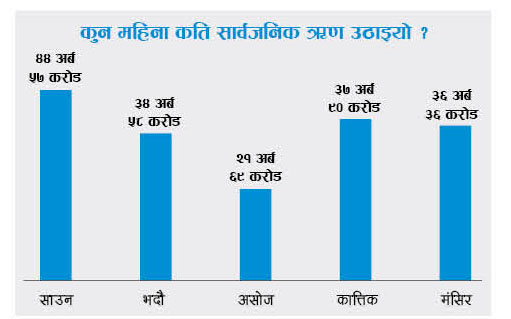
The government has collected Rs 175.12 billion in loans during the Shrawan-Mansir period of the current fiscal year. The public debt collected during this period is 29.40 percent of the annual target. In the last five months, the receipt of internal debt is Rs 147.66 billion (40.79 percent of the annual target) and external debt is Rs 27.45 billion (11.75 percent of the annual target). This year, the government has set a target of raising public debt of Rs 595 billion. Although the receipt of internal debt is good, the external debt is very low, as confirmed by the Public Debt Management Office report.
Till Mansir of the current fiscal year, the government has spent Rs 167.1 billion on principal and interest repayment of loans. This is 40.64 percent of the annual target. Of this, Rs 137.68 billion (40.07 percent) was spent on principal and interest on internal debt and Rs 29.33 billion (43.49 percent) on principal and interest on external debt, according to the office. In this fiscal year, the government has allocated Rs 411.1 billion for debt service expenses.
The report mentions that due to the increase in the value of foreign currencies, including the US dollar, Nepal's outstanding public debt increased by Rs 77.66 billion in last Mangsir as well. Due to exchange rate changes, there has been a deficit in 4 of the last 7 fiscal years, while there has been a profit in the remaining years.
The total outstanding public debt as of last Mangsir is 46.68 percent of the gross domestic product (GDP). The National Statistics Office has projected that GDP will reach Rs 610.7 billion in the current fiscal year. The share of foreign debt in the total public debt as of last Mangsir is 53.32 percent and the share of domestic debt is 46.68 percent.
In the fiscal year 2080/81 and fiscal year 2081/82, the allocation under the heading of financial management exceeded the size of capital expenditure. This means that the government's priority is on paying off the principal of public debt rather than on development.
However, in the current fiscal year, the amount allocated for capital expenditure is more than the budget allocated under the heading of financial management.
With the increasing debt repayment obligation, the gap between the level of capital expenditure and the budget allocated for financial management is widening, which risks shrinking the government's ability to invest in the future. Experts say that the result is also the risk of fiscal imbalance.

