Noting that despite the impact on the economy after the Gen-G movement, the morale of the private sector remains high, Agrawal urged a review, saying that the World Bank's projection of Nepal's economic growth at only 2.1 percent does not seem realistic.
We use Google Cloud Translation Services. Google requires we provide the following disclaimer relating to use of this service:
This service may contain translations powered by Google. Google disclaims all warranties related to the translations, expressed or implied, including any warranties of accuracy, reliability, and any implied warranties of merchantability, fitness for a particular purpose, and noninfringement.
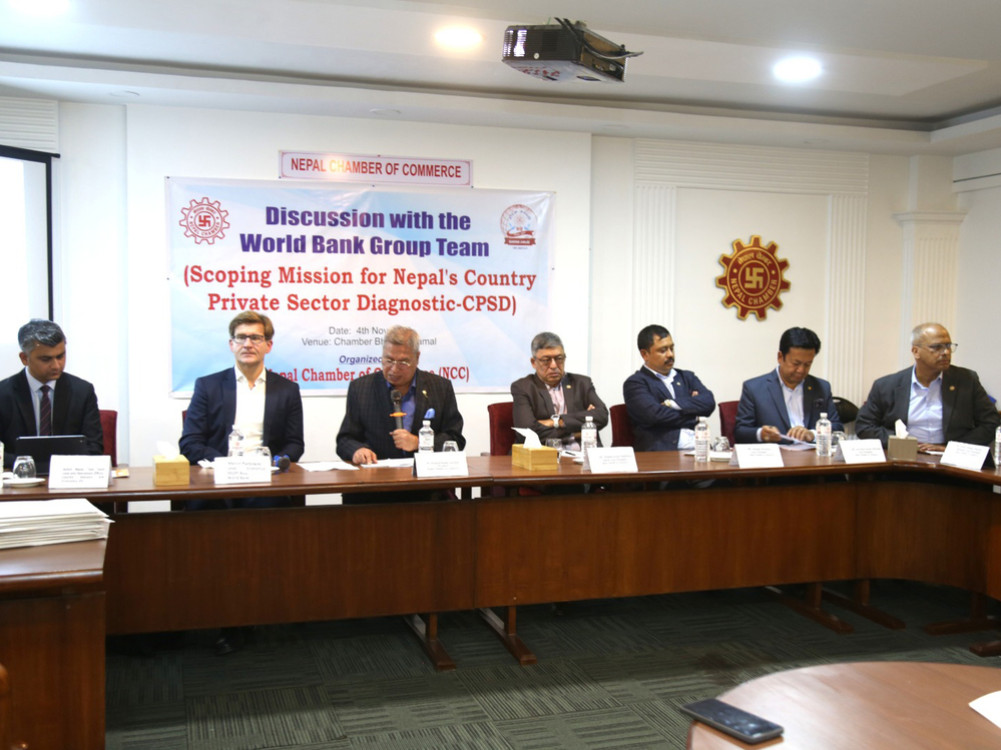
The Nepal Chamber of Commerce and the World Bank Group have held high-level discussions on the state of Nepal's private sector, investment opportunities, and current challenges.
The program organized at the Chamber building in Jamal, Kathmandu was attended by Chamber President Kamlesh Kumar Agrawal, office bearers, chairmen of various committees, industrialists and businessmen, and a team led by World Bank Group South Asia Lead Economist Marcin Piatkowski.
During the discussion, Chairman Agrawal expressed his views on the country's current economic situation, the economic impact of the Gen-G movement, the investment environment, the necessary aspects of policy and legal reforms, and the prospects for sustainable economic development.
Stating that Nepal is the best in South Asia in terms of natural resources, Chairman Agrawal mentioned that the basis for long-term economic prosperity can be set through the exploration and effective utilization of the country's immense natural resources.
Chairman Agrawal said that the goal is not only to bring Nepal out of the list of least developed countries (LDCs), but also to establish it as the country with the highest per capita income in South Asia.
He said that strong aspects such as 57 percent young manpower in Nepal, low production costs, favorable weather, and assured return on investment have made Nepal an attractive destination for foreign investment. He emphasized that there is a huge potential for investment in sectors such as physical infrastructure, agriculture, hydropower, tourism, mining, herbs and medicinal plants and that policy clarity and an investment-friendly environment should be created in these sectors.
Stating that despite the impact on the economy after the Gen-G movement, the morale of the private sector is high, Agrawal urged a review, saying that the World Bank's projection of Nepal's economic growth to be only 2.1 percent does not seem realistic.
In the discussion, the chairmen of various committees of the chamber and industrialists and businessmen presented problems, challenges and suggestions for improvement related to agriculture, information technology, land and housing, energy, tourism and service sectors.
World Bank Group representative Marcin Piatkowski emphasized the need to focus on institutional reforms, investment promotion, policy coordination and innovation to strengthen Nepal's private sector. A working paper on strengthening Nepal's investment opportunities, policy stability and implementation capacity was also presented by the World Bank.