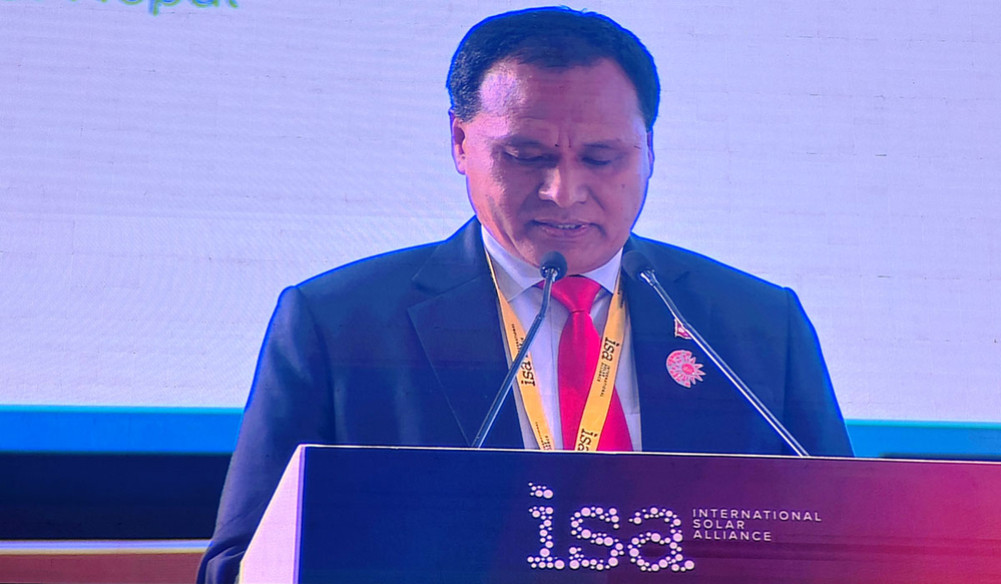
He addressed the thematic session of the assembly on the vision of regional and global interconnection for large-scale clean energy transformation, sustainable development of vast energy potential, and a roadmap for trilateral electricity trade (Nepal-India-Bangladesh) as a keynote speaker.
We use Google Cloud Translation Services. Google requires we provide the following disclaimer relating to use of this service:
This service may contain translations powered by Google. Google disclaims all warranties related to the translations, expressed or implied, including any warranties of accuracy, reliability, and any implied warranties of merchantability, fitness for a particular purpose, and noninfringement.
Minister for Energy, Water Resources and Irrigation Kulman Ghising has called on the international community to invest in renewable energy such as hydropower and solar in Nepal.
Ghising also said that Nepal's clean energy journey has reached a crucial juncture to enter a new era. 'With the immense potential of hydropower, growing solar energy capacity and expanding international transmission lines and energy relations, we have the potential to make the region sustainably energy-rich,' he said, 'I invite our friendly countries and partners to invest in Nepal, invest in renewable energy and be part of a bright and green future for all.'
He addressed the thematic session of the assembly on the vision of regional and global interconnection for large-scale clean energy transformation as the keynote speaker on the topic of sustainable development of vast energy potential and a roadmap for trilateral electricity trade (Nepal-India-Bangladesh).
Energy Minister Ghising said that Nepal's hydropower is a strategic enabler of clean energy transformation in South Asia. He mentioned that Nepal's hydropower is an important source for a resilient and stable grid in the region.
Stating that hydropower generation is not only the country's development but also Nepal's vision to become a major exporter of clean and green energy in South Asia, Ghising said that Nepal and India are jointly identifying and constructing high-capacity transmission line infrastructure with a target of exporting 15,000 MW of renewable energy by 2035.
He said that the energy sources with about 83,000 MW of hydropower potential and about 42,000 MW of pumped storage hydropower potential are clean, renewable and excellently complementary to the solar and wind energy of Nepal's neighboring countries.
He said that as the grid develops regionally and globally, interconnected transmission networks will enable the flow of renewable energy between different regions, balancing electricity demand and supply, reducing costs and expanding access.