The overall economic and financial report of the last financial year released by the National Bank on Sunday showed that the remittance inflow has increased.
We use Google Cloud Translation Services. Google requires we provide the following disclaimer relating to use of this service:
This service may contain translations powered by Google. Google disclaims all warranties related to the translations, expressed or implied, including any warranties of accuracy, reliability, and any implied warranties of merchantability, fitness for a particular purpose, and noninfringement.
Remittances sent by Nepalis outside the country have set a new record in the last financial year. In the last fiscal year 2081/82, 17 trillion 23 billion 27 billion rupees of remittances have entered the country, which has increased by 19.2 percent compared to the previous fiscal year. In the financial year 2080/81, remittance inflow increased by 16.5 percent and reached 14 trillion 45 billion.
The overall economic and financial report of the last financial year released by the National Bank on Sunday showed that the remittance inflow has increased. Experts say that the number of Nepalis going abroad for employment has increased, and the increase in the value of the US dollar has led to a steady rise in remittances in recent months.
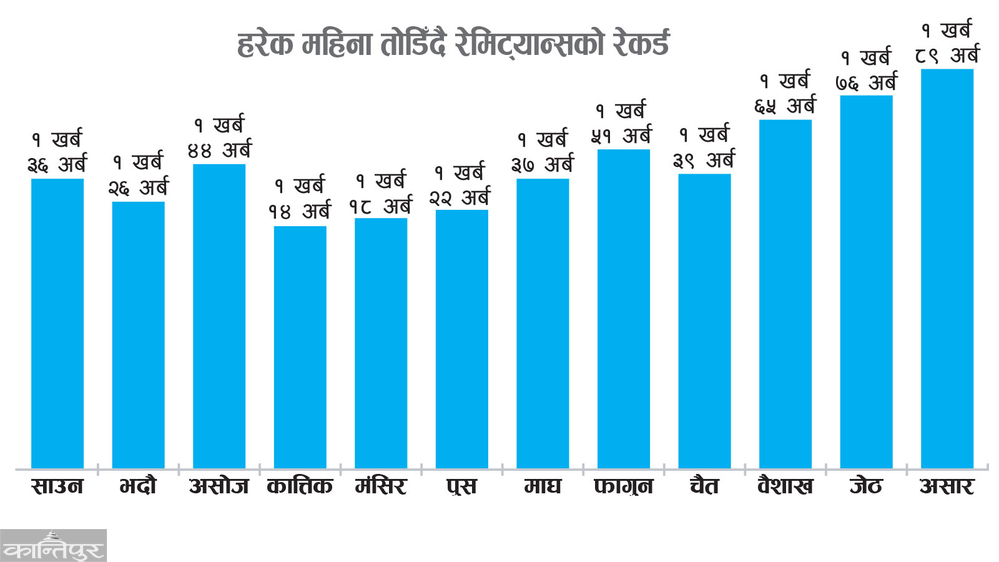
1 trillion 89 billion 11 crore remittances have been received in last June alone. On a monthly basis, this amount is the highest ever. In the same month of the previous year, such inflow was 1 trillion 17 billion 78 crores. Similarly, last May, 1 trillion 76 billion 300 million rupees were received in remittances. Before that, most remittances were 1 trillion 65 billion 30 billion rupees in May, 1 trillion 51 billion rupees in February and 1 trillion 44 billion rupees in October. By the end of last June, the remittance inflow in US dollars increased by 16.3 percent and reached 12.64 billion. In the previous year, such flow had increased by 14.5 percent.
With the increase in the number of Nepalis going for foreign employment in the last financial year, there has been a positive impact on the remittance inflow. Last year, there were 5 lakh 5 thousand 957 people who took final work permit (institutional and individual-new) for foreign employment and 3 lakh 33 thousand 3 hundred 9 people who got work permit again. Last year such numbers were 460 thousand 1 hundred 2 and 281 thousand 195 respectively.
Suman Pokharel, the former president of the Nepal Remittance Association, said that remittances are continuously increasing because educated and skilled people are going to work abroad. "Educated, skilled, financially literate people are also going to foreign jobs," he said, "Nepali people have started going to big and developed countries in America, Japan, Australia, Korea and Europe." In this way, there seems to be diversification in workers and destination countries. The income of Nepali who went to that country is also high. Because of this, the remittance inflow has continuously increased.
Pokharel said that although the contribution of remittances does not directly reach the Gross Domestic Product (GDP), the import and consumption of materials such as mobiles, motorcycles, vehicles, and oil have increased. "Since the direct use of remittances in areas such as infrastructure development and job creation in Nepal is less, its contribution to economic growth may have been very low," he added, "but the import and consumption of oil, mobiles, motorcycles, etc. have increased. Imports of vehicles are increasing. has a direct impact on consumer goods.'
In the past, Nepalis living abroad used to send cash, now there is a facility to send money to a bank account. Pokharel says that this has also increased remittances coming in from the formal system, while informal activities have also been controlled. Even if we look at the data of a decade, it seems that remittances are increasing every year.
In the financial year 2071/72, 6 billion remittances were received, and by 2077/78, it had reached 9 trillion 71 billion rupees. According to the data of Rashtra Bank, in the financial year 2078/79 remittances reached 10 trillion 7 billion rupees, in 2080/81 it reached 14 trillion 45 billion rupees. Although there is no expected improvement in the main sources of foreign exchange earnings including exports, tourism, foreign investment, the external sector of the economy as a whole is becoming stronger as remittances continue to increase. Last year's economic and financial report of National Bank showed that external indicators such as foreign exchange reserves, current account, etc. are getting stronger.
 But economists say that we should not be happy just because remittances have increased. They allege that the government is complacent because remittances have increased without making any effort to keep the economy running. Experts suggest that the state should pay attention to how to make full use of the more liquid state of the economy.
As remittances are continuously increasing, the external indicators of the economy are very strong and the interest rates are low, so there is a golden opportunity for the government and private sector to expand investment now, says Prakash Kumar Shrestha, ex-executive director of Rashtra Bank and member of the National Planning Commission. The government can also increase investment in development and construction including infrastructure. However, instead of the government borrowing money from the market and giving it to public institutions, they can raise money from the market by issuing bonds themselves,' he says, 'by doing this, the burden of debt will not be added to the government, and there will be no procedural hassles like the government.'
As exports have also increased along with remittances, the country has sufficient foreign exchange reserves. According to Shrestha, the government, public institutions and the private sector should make full use of the opportunities created by this. Along with remittances, the country's foreign exchange reserves have been making continuous records for the past 34 months. The country's foreign exchange reserves have reached 26 trillion 77 billion 68 billion rupees. It has increased by 31.2 percent compared to the previous financial year.
In one year, foreign exchange reserves have increased by 6 trillion 36 billion 58 billion. At the end of June 2081, the total foreign exchange reserves were 20 trillion 41 billion 10 million rupees. At the end of last June, foreign exchange reserves in US dollars reached 19 billion 500 million. This was an increase of 27.7 percent compared to the previous June. Total foreign exchange reserves in June 2008 were $15.27 billion. The National Bank claims that if the import of the financial year 2081/82 is taken as a basis, the foreign exchange reserves held by the banking sector will be sufficient to support 18.2 months of goods imports and 15.4 months of goods and services imports. Rastra Bank has set a target of maintaining foreign exchange reserves of at least 7 months for the current financial year.
Likewise, the current account is in surplus by 4 trillion 9 billion 2 crores and the current account (balance of payments) is in surplus by 5 trillion 94 billion 54 crores. During the same period of the last financial year, the current account was in surplus by 2 trillion 21 billion and the current account was in surplus by 5 trillion 2 billion. Despite high remittance inflows and record foreign exchange reserves, the economy as a whole is not doing well. The report pointed out that the expected improvement in capital expenditure, revenue collection and foreign aid and grant collection has not been achieved.
Last year, 12.2 billion foreign direct investment (equity only) came in. This is an increase compared to the same period last year. By June 081, such foreign investment was 8 billion 47 crores. Similarly, the market price increase rate (inflation) of goods purchased by the general public has been maintained at an average of 4.06 percent in the last financial year. In the previous financial year, this growth rate was 5.44 percent.
In the financial year 2081/82, under the food and beverage group, the price increase of vegetable sub-group is 10.71 percent, ghee and oil 8.72 percent, pulses and pulses 7.90 percent and food and food products 6.13 percent. According to the National Bank report, the price index of maramsala sub-group decreased by 2.62 and fish and meat by 0.34 percent.
Similarly, within the non-food and services group, the price increase of the miscellaneous goods and services sub-group was 9.39, clothing and footwear 6.09, alcoholic beverages 5.65 percent, furnishings and household appliances 4.78 percent and tobacco products 4.37 percent.

