Although there were signs of growth in the stock market from the last week of May 2081, the NEPSE growth picked up speed only after the formation of the government in the coalition of Congress and UML was ensured.
We use Google Cloud Translation Services. Google requires we provide the following disclaimer relating to use of this service:
This service may contain translations powered by Google. Google disclaims all warranties related to the translations, expressed or implied, including any warranties of accuracy, reliability, and any implied warranties of merchantability, fitness for a particular purpose, and noninfringement.
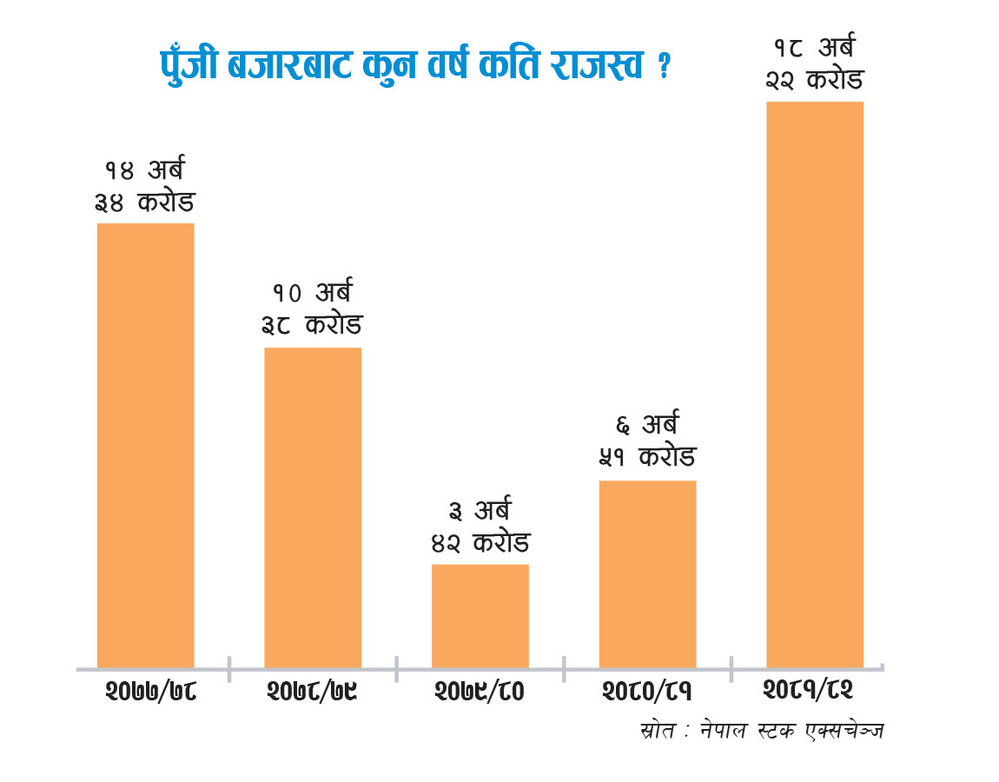
In the last financial year 2081/82, about 18 billion rupees revenue was collected from the capital market. This is the highest annual revenue collection ever. Earlier, in the financial year 2077/78, the revenue was 14 billion 34 crore rupees. As the NEPSE index increased by about 1000 points in the last financial year, the revenue collection also increased.
2081 Although there were signs of growth in the stock market from the last week of May 2081, the NEPSE growth picked up speed only after the government was formed in the coalition of Congress and UML. According to this, a cooperation agreement was signed between these two parties on June 17, 2081.
On that day, the NEPSE index was around 2 thousand 53 points. Since then, NEPSE has increased by more than 900 points. By the first week of August 2081, the NEPSE index had reached 2,974 points. In this way, in a period of about 2 and a half months, the overall NEPSE index increased by more than 1,000 points, and the transaction amount also increased.
After its positive effect on the collection of revenue received by the government, the most revenue from the capital market has gone to the government so far. In the last financial year, a total of 18 billion 22 million 41 lakh rupees was collected from the capital market.
According to this, 16.59 billion 92 million rupees have been collected from capital gains tax (CGT) and 1.63 billion 48 million rupees from advance taxation. The revenue collected last year is almost twice as much as compared to the previous financial year. In the financial year 2080/81, only 6 billion 15 crore 38 lakh rupees were collected from the capital market.
Capital gains tax (CGT) is the amount payable to the government by investors (individuals and institutions) dealing in stock market for the gains made in share trading. Even if the share price rises in the stock market, it will remain at book value unless the investor preserves the profit. But after selling the shares, the investor is taxed in case of profit. That is capital gains tax.
A stockbroker has to pay 15 per cent advance tax deduction (TDS) on the fees he gets for buying and selling shares. It has been analyzed that by adding both the mentioned taxes, the government received only 1.8 billion tax from the stock market in the last financial year.
According to the current law, in case of profit in share trading, the investor has to pay 5 to 10 percent profit tax. Mutual funds do not have to pay tax.
According to this, individual investors who sell shares in more than one year (365 days) must pay 5 percent of the profit and those who sell in less than one year must pay 7 and a half percent of the profit. But institutional investors have to pay 10 percent profit tax. In total share transactions, most of the share is of individual investors, while the number of institutional investors is less.
Since the stock market was falling in the last two years, the turnover was also low and the investors suffered losses. Therefore, the revenue going to the government from this sector was reduced. But in the financial year 2078/79, the government collected 10.38 billion rupees from this market and in the financial year 2077/78, 14.34 billion rupees were collected.
Although the stock market started to rise from the end of the previous financial year, it had risen to around 3 thousand by the first/second month of the last financial year. After that, the market decreased a bit and for a long time it was around 2,400 and 2,500. Especially after the announcement of the monetary policy, the NEPSE index has increased by about 300 NEPSE points. In the same process, on July 13, NEPSE reached 3 thousand 2 points. Since then, the market has continued to decline. According to which, until last Thursday, NEPSE has closed down at 2,788 points.
70 lakh 10 thousand 916 investors have opened demat accounts till last Friday for buying and selling shares. This is about 24 percent of the total population of Nepal. But not all investors who have opened demat accounts have traded shares in the secondary market.
According to the data of Nepal Stock Exchange, currently 41 lakh 89 thousand 677 people have opened accounts for share trading in the secondary market. Among them, there are 26 lakh 51 thousand 20 men, 15 lakh 28 thousand 611 women and the remaining 10 thousand 46 are institutional investors (others), according to NEPSE data.
Even among those who have opened accounts for trading in the secondary market, not all are active. Many are inactive. According to NEPSE, only 12 lakh 48 thousand 855 people are active in the secondary market. NEPSE has been calling investors who have done at least one transaction in the last year as active investors.
At the end of May 2082, the number of companies listed in Nepal Stock Exchange Limited has reached 272. Among the listed companies, there are 132 banks and financial institutions and insurance companies, while 91 belong to hydropower companies, 23 manufacturing and processing industries, 7 hotels, 7 investment companies, 4 trading organizations and 8 other groups. In May 2081, the number of listed companies was 270.
Among the listed companies, banks and financial institutions and insurance companies have a share of 52.1 percent of the securities market capitalization. The share of hydropower company is 16.1%, the share of investment company is 8%, the share of production and processing industry is 5.5%, the share of commercial organizations is 5.3%, the share of hotels is 2.8% and the share of other groups of companies is 10.2%.

