In order to consume domestically produced clean energy and reduce environmental pollution, the government has been taking a policy to promote electric vehicles. This is why the import of EVs has increased rapidly in recent years.
We use Google Cloud Translation Services. Google requires we provide the following disclaimer relating to use of this service:
This service may contain translations powered by Google. Google disclaims all warranties related to the translations, expressed or implied, including any warranties of accuracy, reliability, and any implied warranties of merchantability, fitness for a particular purpose, and noninfringement.
In Nepal, the public's interest in electric vehicles (EVs) is increasing every year. The data of the customs department also confirms this. In the financial year 2076/77, 575 electric vehicles were imported. After that, until the financial year 2081/82, only 13 thousand 569 electric vehicles were imported this year.
According to the department, 4,958 diesel-petrol vehicles were also imported that year. In order to consume domestically produced clean energy and reduce environmental pollution, the government is taking a policy to promote electric vehicles. This is the reason why the import of EVs has increased rapidly in recent years. However, the businessmen have been criticizing the policy taken by the government as unstable.
Although the popularity of private electric vehicles in Nepal is slowly increasing, a trolleybus was operated from Tripureshwar in Kathmandu to Suryavinayak in Bhaktapur in 2032. 22 trolleybuses operated from morning to 10 pm covering a total distance of 13 km. But it was completely discontinued in 2066, 34 years after the service started. In 1993, 'Safa Tempo' was brought into operation by the government, private sector and international cooperation, which vehicles are still operating in the valley.
Around the decade of 2000, Mahindra's 'Reva' model electric vehicle produced in India for private purposes entered Nepal. Since then, Chinese brand vehicles were also imported. But the market could not expand. In recent years, due to noiseless, pollution-free, new technology and design vehicles, the consumer's attraction towards EVs has increased. In addition, consumers have been attracted by the fact that electric vehicle operating costs are cheaper compared to diesel-petrol vehicles. However, consumers and businessmen say that the price of electric vehicles in Nepal is still expensive compared to other countries.
Electric vehicle promotion policy to consume domestically produced energy and reduce environmental pollution, EV import has intensified. "Government's policy is unstable, but there is an understanding that we should eventually go for EVs," he said, "Electric vehicles consume energy produced in Nepal." Shyam Sapkota, president of Electric Vehicle Manufacturers and Importers Association of Nepal, said that compared to diesel-petrol vehicles which are limited in design and limited brands, the attraction of consumers is increasing after the introduction of new brands, technologies and forms in EVs. "For years there were vehicles of the same brand and design," says Sapkota, "but now there is diversity in electric vehicles." That's why the demand has also increased.
The government has set a goal of reaching 25 percent of private electric vehicles and 20 percent of public electric vehicles in total vehicle sales by 2025. According to NADA Automobiles Association of Nepal, the target towards the private sector has been achieved. The government has set a target of making 90 percent of private vehicles and 60 percent of public vehicles electric by 2030.
According to the government's long-term zero-emission strategy, by 2045, Nepal has set a goal of cleanly reducing emissions and achieving net zero emissions. In 2019, Nepal's carbon emissions were 23 million tons. This number is estimated to reach 34 million tons in 2030 and 79 million tons in 2050. The energy sector accounted for 54 percent of total carbon emissions in 2019 and the non-energy sector accounted for 46 percent. By 2050, the share of the non-energy sector is expected to decline to 32 percent.
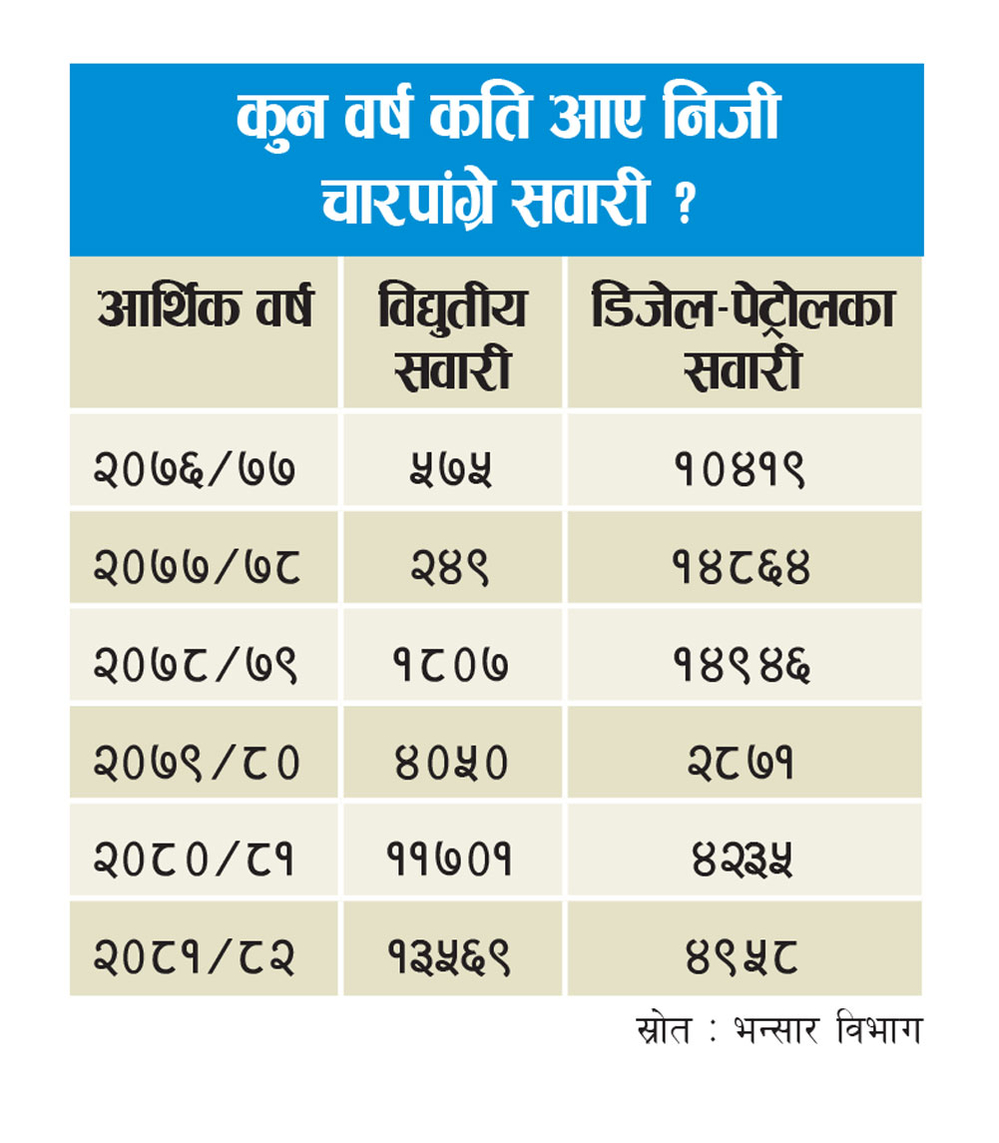
According to NADA, in the fiscal year 2080/81, when 14,800 vehicles were sold, 75 percent were electric and 25 percent were diesel-petrol vehicles. At the same time, the share of electric vehicles in total sales was 61.8 percent, while in 2079/80 this share was only 31.8 percent. Maheshwar Dhakal, Head of the Climate Change Management Division of the Ministry of Forests and Environment, said that switching to electric vehicles is not enough to achieve the zero carbon emission target.
'Adopting electric vehicles is only one part of achieving net-zero emissions by 2045, there is still a lot to be done,' he said. Dhakal says that climate-friendly technology policy should be adopted along with private and public electric vehicles, electric stoves in urban areas.
Since the government has been giving concessions from the import of vehicles to the installation of charging stations, the import of EVs is increasing. But despite the significant increase in four-wheelers used for personal purposes, the import of two-wheelers and large public electric vehicles has not increased significantly.
 According to businessmen, public electric vehicles have not increased due to high costs and lack of infrastructure. According to the data of the customs department, 3 thousand 106 units of public electric vehicles were imported last financial year. "Small vehicles like EVs are cheap, but the price of big vehicles can be up to one crore rupees, so there is not much demand for big buses," said Sapkota.
He says that the growth in two-wheelers is also not as expected. An EV scooter or motorcycle gives a range of 40-50 km. Maybe a little more. But people want to go from Kathmandu to Jhapa by scooter. Therefore, trust has not yet been formed," he said. Environmentalist Bhushan Tuladhar suggests that a long-term clear policy is needed to promote electric vehicles. "The government should come up with a policy for at least 3 years covering customs rates, excise duties, infrastructure, etc.," he says. "Currently, the import of EVs has reached 70-75 percent, which is good."
"In our country, 70-80 percent of vehicles are scooters or motorcycles," he says, "if that part cannot be made electric, the government should pay attention." The Nepal Electricity Authority has emphasized on the construction of charging stations to promote electric vehicles and increase electricity consumption. So far, 62 charging stations have been built and are operating across the country. According to the authority, about 1200 charging stations have been put into operation from the private sector as well.

