493 industries registered in Bagmati, 19/19 in Koshi, Madhesh and Gandaki, 25 in Lumbini and 6 in Far West.
We use Google Cloud Translation Services. Google requires we provide the following disclaimer relating to use of this service:
This service may contain translations powered by Google. Google disclaims all warranties related to the translations, expressed or implied, including any warranties of accuracy, reliability, and any implied warranties of merchantability, fitness for a particular purpose, and noninfringement.
A government study report has shown that in the first six months of the financial year 2081/82, about 600 small, medium and large industries were added across the country. 25 thousand 637 employed in that industry has been shown by the semi-annual economic activity study of Rashtra Bank.
Referring to the statistics of the Department of Industry, the half-yearly economic activity study of the financial year 2081/82 showed that 581 more small, medium and large industries were registered in the country in 6 months. From a regional point of view, the largest number of 443 industries are in Bagmati. At least 6 industries are registered in Sudurpaschim Province. However, the report pointed out that no industry was registered in Karnali during this period.
The total capital of the added industry is 1 trillion 29 billion 63 billion. The total fixed capital of the industries is 1 trillion 12 billion 25 billion rupees and the current capital is 17 billion 38 billion rupees. According to the report, the total proposed foreign investment in those industries is 35 billion 80 million rupees.
Former Secretary Yamkumari Khatiwada said that although there has been some improvement in the industry in recent months, the government still needs to be more flexible in the existing policy. The constitution of Nepal has allowed all three levels of government to collect taxes. Industrialists also agree with this, but industrialists want to pay taxes from one place (through a one-door system) rather than to all three levels of government,' she said.
The government is trying to create an investment environment in the country. Accordingly, some laws have been amended. But it has not reached yet, it seems that the investment environment needs to be improved even if the concept of federalism in the existing laws is simplified,' Khatiwada said, 'Industries are registered in Nepal. But not many are operational. A detailed study is needed on how many industries are operating and how many are closed.'
In the first 6 months of the financial year 2081/82, 19/19 industries were registered in Koshi, Madhesh and Gandaki. It seems that 25 industries were added in Lumbini during that period. According to the number of industries, the situation of job creation is also the highest in Bagmati with 20 thousand 87 people. The report pointed out that 1,030 people were employed in Koshi, 1,540 in Madhesh, 522 in Gandaki, 2,141 in Lumbini and 315 in Sudurpaschim Province.
In the first six months of the last financial year, the average capacity utilization of industries across Nepal is 41.11 percent. In the first six months of the previous financial year, the average capacity utilization of industries was 42.94 percent. In recent months, the government, the National Bank and other government agencies have been claiming that the economy is becoming viable. But on average, the capacity utilization of industries has not increased and the report has pointed out that it has decreased even more.
Among the industries included in the survey, the capacity utilization of electricity is 99.91 percent, the capacity utilization of the tire and tube manufacturing industry is 95.30 percent, and the capacity utilization of the aluminum manufacturing industry is 87.61 percent. During the same period, the capacity utilization of the snacks manufacturing industry is 87%, 72.73% of the processed tea manufacturing industry and 70.32% of the noodle manufacturing industry," the report shows, "Among the industries covered by the study are mustard and soybean oil, processed milk, animal feed, biscuits, noodles, alcohol, beer, soft drinks, yarn, synthetic fabrics, processed leather, plywood, bricks, The capacity utilization of industries that produce cement, household metal products, aluminum products, electric wires and cables, transformers, tires and tubes and electricity etc. has increased.
But during that period, industries that produce vegetable ghee, rice, flour, breadcrumbs, chocolate, sugar, chocolate, processed tea, cigarettes, jute goods, chopped wood, paper, soap, concrete steel products, GI pipes, textile shoes, slippers etc. Capacity utilization has declined, the report said.
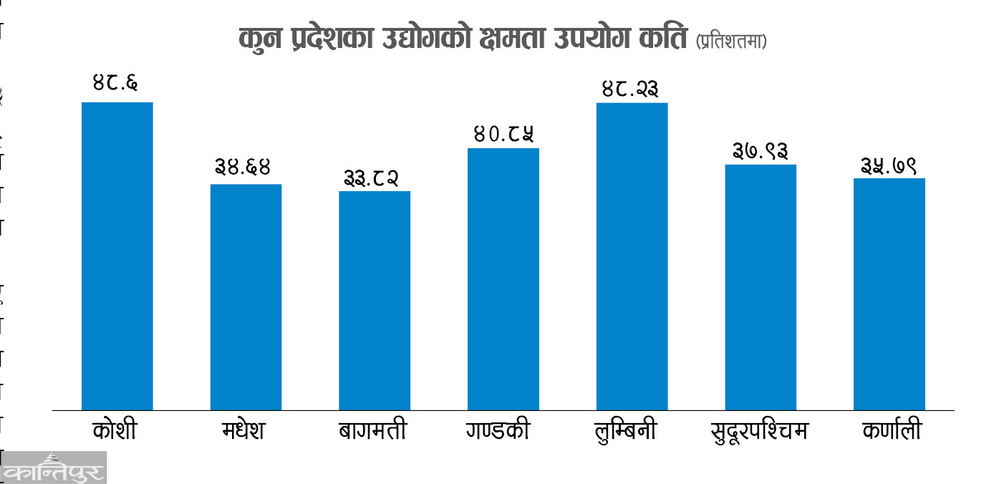
Province-wise, the industry in comparison has the highest capacity utilization of 48.60 percent. The main production here is vegetable ghee and oil, other food items, jute goods, iron rods and leaves, cement, soap. It is said that production of vegetable ghee and oil, soft drinks, clothing, cement, processed leather, medicine, iron rods and leaves, steel products and other chemical substances is the main production in Madhesh.
The capacity utilization of industries located in Bagmati is the lowest at 33.82 percent. This shows that despite the large number of registered industries, the industries in Bagmati are not operating properly. Production of processed milk, animal fodder, noodles, cigarettes, beverages, chemicals, pashmina, ready-made garments, medicines, cement, footwear and Gandaki, biscuits, noodles, beverages, chemicals, cement is major here.
Industry capacity utilization in Lumbini is 48.23 percent. It is said that the production of wheat flour, beer, medicine, cement, concrete, electric wires and cables, iron rods and leaves, animal feed and sawn wood in Karnali, and processed milk are major in this province. The capacity utilization of industries in Far West is only 35.79 percent. Wheat flour, rosin and other products are produced here. Loans provided by banks and financial institutions in the industrial sector have increased by about 17 and a half percent. As compared to the end of January 2080, the loans provided by banks and financial institutions to the industrial sector increased by 17.66 percent to reach 16 trillion 46 billion 70 million in the end of December 2081. During the same period of the previous year, such loans increased by 4.19 percent.
Out of the total loans provided by banks and financial institutions in this sector, the share of loans provided to the industrial sector is 30.31 percent. Among the industrial loans, 0.70 percent was in the mining industry, 20.81 percent in the agriculture, forestry and beverage industry, 37.96 percent in the non-food production industry, 11.56 percent in the construction industry, 24.63 percent in the electricity, gas and water industry and 4.34 percent in the metal products, machinery and electronics industry, according to the report of the National Bank.
In industrial credit, the share of credit in Koshi province is 8.96, Madhesh province is 7.60, Bagmati is 71.60, Gandaki is 1.74, Lumbini is 8.34, Karnali is 0.23 and Sudurpaschim is 1.53 percent. However, the report pointed out that it is challenging to speed up the construction of the infrastructure of industrial zones, special economic zones and industrial villages, to provide proper markets for indigenous products and other physical infrastructure, to increase industrial production and productivity, to increase domestic production of raw materials required for agricultural and other industrial products, and to increase overall industrial production.

