Goods are imported from the US and Europe through the waterway ”Red Sea”. If there is a problem with the war between Iran and Israel, the goods must be imported through Africa, which will increase the cost of goods, according to experts.
We use Google Cloud Translation Services. Google requires we provide the following disclaimer relating to use of this service:
This service may contain translations powered by Google. Google disclaims all warranties related to the translations, expressed or implied, including any warranties of accuracy, reliability, and any implied warranties of merchantability, fitness for a particular purpose, and noninfringement.
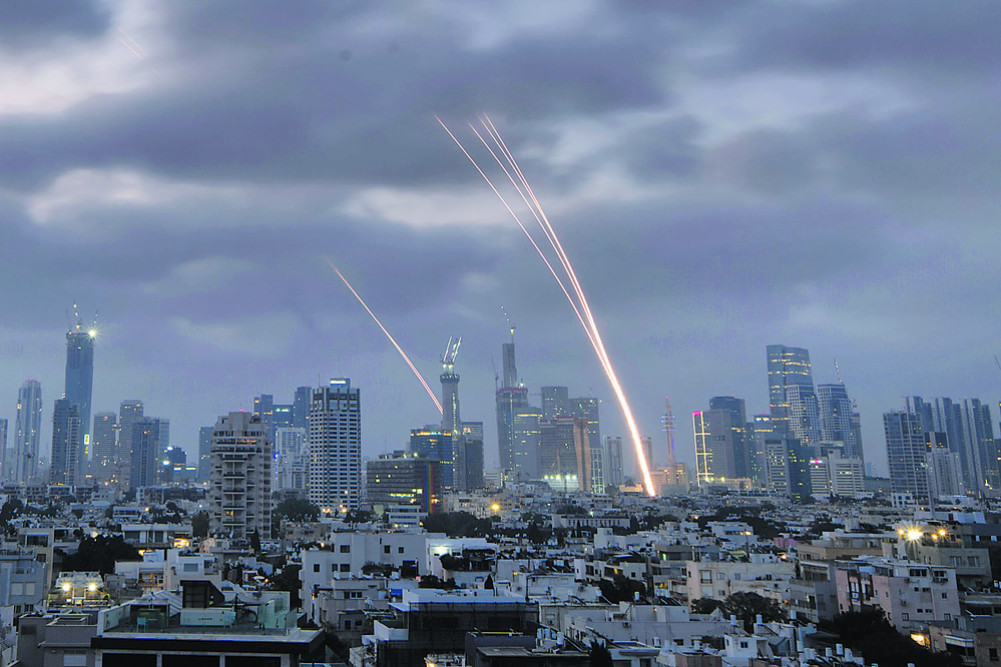
Before Russia and Ukraine could not end the war, the growing conflict between Iran and Israel has recently caused global trade to fluctuate. Crude oil prices rose after the news of Israel's attack on Iran's nuclear facilities.
Experts say that it is having a direct impact on the Nepali market along with the world market. They say that if the war does not stop immediately, it will affect Nepal's foreign aid, from remittances to employment.
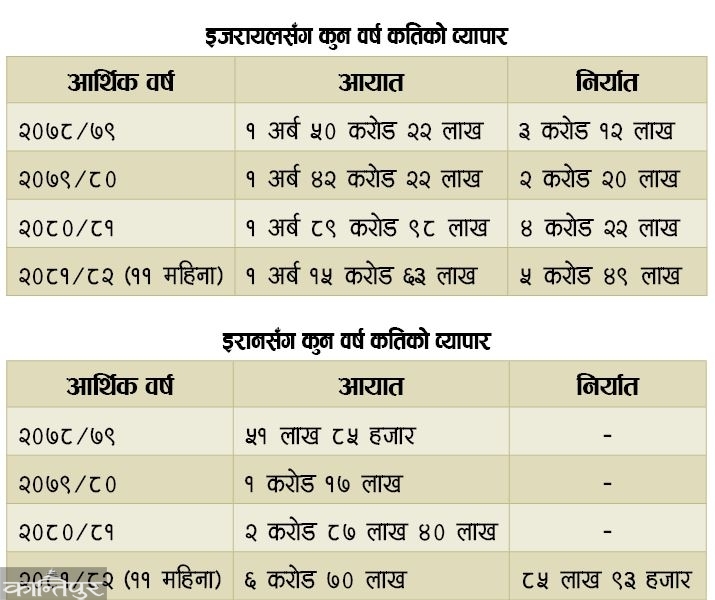
Former Commerce Joint Secretary Ravi Sainju said that the war between Iran and Israel will have a direct-indirect effect on foreign trade. "There is not much trade with Iran in Nepal. But various goods worth billions of rupees are imported from Israel, while exports are worth crores," said Sainju. "As the war escalates, there will be problems in the import and export to America and Europe." Due to the war between Iran and Israel, there is a problem on the way to the "Red Sea" and they have to travel around Africa to bring goods. "The way to import is long, it increases the cost of goods. Not only import, but also export is a problem," he said. "Overall, it seems that the cost and cost will increase." But billions of rupees are being traded with Israel. In the first 11 months of the current fiscal year, goods worth 1 billion 1563 million 88 thousand rupees have been imported from Israel. Exports are worth 5 crore 49 lakh 18 thousand rupees. In the last fiscal year, goods worth 1 billion 899 million rupees were imported from Israel. The export was worth 42 million.
In 11 months of the current financial year, goods worth 67 million 65 thousand rupees have been imported from Iran. According to the data of the department, the export is only 85 lakh 93 thousand rupees. In the last financial year, goods worth 28.7 million 13 thousand rupees were imported. In that year, only 4 million 88 thousand rupees were exported to Iran.
According to the department, especially soft drinks, glasses and other medical materials were imported from Israel. In 11 months of the current financial year, only soft drinks have been imported worth 83 crore 15 lakh rupees. Items such as zarda, khaini, and carpets have been exported from Nepal to Israel. "Though there is not much trade with Iran and Israel, it will also affect the trade with other countries," he said. Experts say that when crude oil increases in the international market, its impact will be felt everywhere.
Nepal Oil Corporation purchases petroleum products from Indian Oil Corporation. India itself does not produce crude oil, it buys raw materials from countries like Iran, Russia and sells them after processing. Officials of the corporation say that when the price increases in the international market, its impact will be felt in Nepal. "On June 1, when the corporation determined the price, the price of crude oil in the international market was 64 to 65 dollars per barrel. News of Israel's attack on Iran's nuclear facilities sent prices up as much as 8 percent on the same day. On Wednesday itself, Brent Crude is trading at $77.38 per barrel," said Manoj Thakur, spokesperson of the Corporation, "As soon as the price of crude oil increases, the cost of transportation increases. The price of refined products increases. The overall market will be affected.'
Countries have become cautious especially about the Gulf of Hormuz. Iran has threatened to close the sea route. India imports 85 percent of its crude oil through the narrow sea route in the Gulf of Hormuz. If that route is closed, the price of oil will skyrocket. India does not buy oil directly from Iran due to US sanctions on Iran. However, Iran is an important country in the global oil market.
The corporation claims that despite the increase in the price of petroleum products in the international market, there will be no impact on imports. To meet the market demand, India imports even if it is expensive. OPEC countries determine the price of oil based on demand and supply," Thakur said. "Though it is not imported from Iran, it comes from other countries. But when supply and demand are not in balance, the price will increase. When the price of crude oil increases, it directly affects the consumers. With the rise in fuel prices, businessmen try to increase the freight rates. With the increase in the cost of transportation and public transport, the prices of food and other commodities also automatically increase.
Economist Nar Bahadur Thapa also said that the war raging between Iran and Israel will have a direct impact on Nepal. He says that foreign aid can be stopped mainly with foreign employment and education. Lately, Nepalis have come to Israel from care givers to education. Israel is a role model in agriculture. If the conflict flares up in this country, it will definitely affect Nepali students and those who have taken labor permits,' he said, 'The war will increase the price of crude oil.'
He also says that the US may not allow the price to increase so as not to benefit Russia. He said that if European countries are included along with the US, the foreign aid that Nepal is getting may be reduced.