Dolakha, Lamjung, Banepa, Bhaktapur, etc. are being planted in places where they have reached the villages
We use Google Cloud Translation Services. Google requires we provide the following disclaimer relating to use of this service:
This service may contain translations powered by Google. Google disclaims all warranties related to the translations, expressed or implied, including any warranties of accuracy, reliability, and any implied warranties of merchantability, fitness for a particular purpose, and noninfringement.
After the onset of monsoon, dry paddy planting has started in the hilly areas. Planting towards Kholsa is going on in full swing along with the central hills and the hilly areas. According to the Nepal Agricultural Research Council (NARC), planting is being done in areas such as Dolakha, Lamjung, Banepa, and Bhaktapur.
"In areas where water is available and towards Madhyapahar, planting starts from June 15 and can be done when it reaches June 15. Planting has been completed in the irrigated areas in Dolakha region," said Sushil Subedi, a scientist of NARC, "Planting will begin in Terai region from the second week of June (June 15)."
The productivity of this paddy is 4.13 tons per hectare. Last year monsoon was active three days ahead of average and rainfall was higher than average. Due to the same reason, the productivity of paddy crop increased. Although there was a lack of fertilizer in some places, the production of paddy increased to 54 lakh 11 thousand 83 tons.
Even now, planting has started in Madhyapahari and Kulo areas. Paddy pocket areas and Terai, considered the capital, are also being planted. What is the status of supply, sale and distribution of chemical fertilizers, which are much needed at the time of planting? Can farmers easily get chemical fertilizers this year? Uddhav Adhikari, the founding president of the Federation of Farmers' Groups, says, "There is a complaint of lack of fertilizer in Bhaktapur area."
Farmers in other districts are also complaining about not getting fertilizer, he says. "Now planting has been done towards Madhyapahar and Kholakholsa. "Planting is yet to be done in the pocket area," said the official, "but there have been complaints of lack of fertilizer in the valley (Bhaktapur). From the second week of June, planting is done in the Terai region, and the demand for fertilizers increases. The government needs to pay attention to that.'
According to experts, if about 1.2 million tons of chemical fertilizers are supplied for all crops, no crop will be in short supply. Despite providing an average of 7 lakh tons of chemical fertilizers, there are no complaints from the general public. But the government has been able to provide only 3.5 to 4 lakh tons of fertilizer on an annual average. As a result, not all farmers have been able to get fertilizer.
Sarita Bhusal, General Secretary of All Nepal Kisan Federation, also said that the government should be serious as there is still a shortage of fertilizers. "Planting is just starting, if the fertilizer supply system is not tightened, there will be trouble again after the second week of June," she said. But it seems that it has not been done as planned.'' She said that even though there is some amount of fertilizer in the government's paper, the farmers have not received it. For this, she said, attention should be paid to the distribution process.
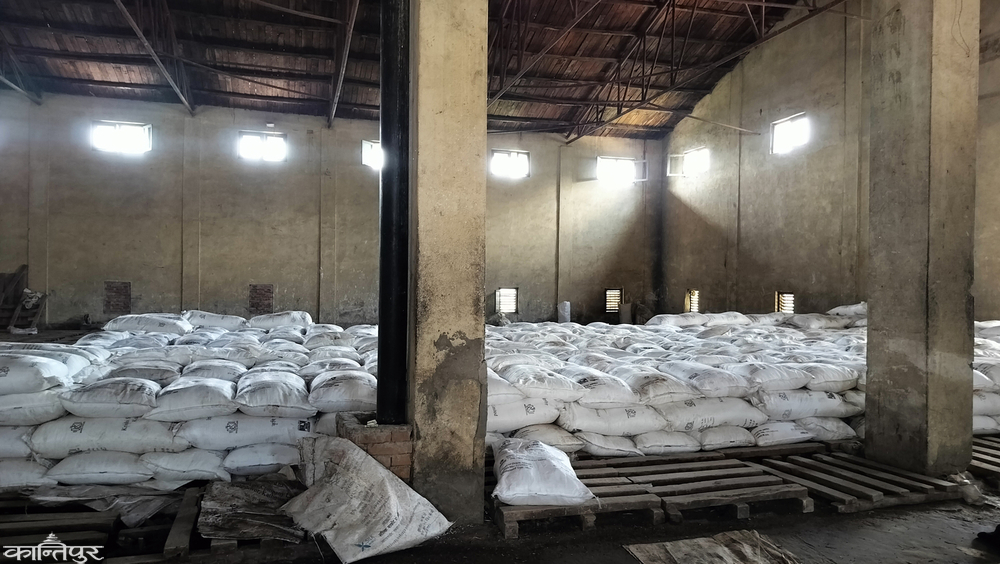
In the current financial year, the Ministry of Agriculture has allocated 27.95 billion budget to buy fertilizers. The target is to purchase 550,000 tons from this amount. Even if the same quantity is tendered, there is no improvement in the supply situation. With only one month left for the end of the current fiscal year, 338,277 tons of fertilizer have been imported, including the volume of the previous fiscal year. Out of this, 211,297 tons of urea, 111,782.1 tons of DAP and 15,265.2 tons of Urea have been imported.
These fertilizers are imported by the agricultural material company and the salt trading company. According to the statistics of the ministry, 382,674.7 tons of fertilizer has been sold from July 1, 2081 to June 28, 2082, including the remaining balance of last year. Out of this, 235 thousand 552.3 tons of urea, 132 thousand 669.1 tons of DAP and 14 thousand 453.3 tons of potash were sold, said Januka Pandit, spokesperson of the Ministry of Agriculture.
She admitted that the import could not be done according to the demand of the farmers. However, Pandit says that agricultural material companies and salt trading are importing fertilizers and some are on the way. According to the data of the ministry, 70 thousand 520.5 tons of chemical fertilizers are available till June 28. Of this, 31 thousand 893.95 tons of urea, 29 thousand 48.7 DAP and 9 thousand 577.85 tons of potash are available.
Fertilizer quotas are determined by the state government according to the subsidy chemical fertilizer vendor arrangement procedure. Municipalities/Villages distribute quotas. Accordingly, fertilizers are distributed to farmers through cooperatives. Due to problems in the distribution process, not all farmers received it on time.
How much chemical fertilizer is available?
Agricultural materials company
Urea 24525.45 tons
DAP 27036.7 tons
Potash 7212.55 tons
Total 58774.7 tons
...
Salt Trading
Urea 7368.5 tons
DAP 2012 tons
Potash 2365.3 tons
Total 11745.8 tons

