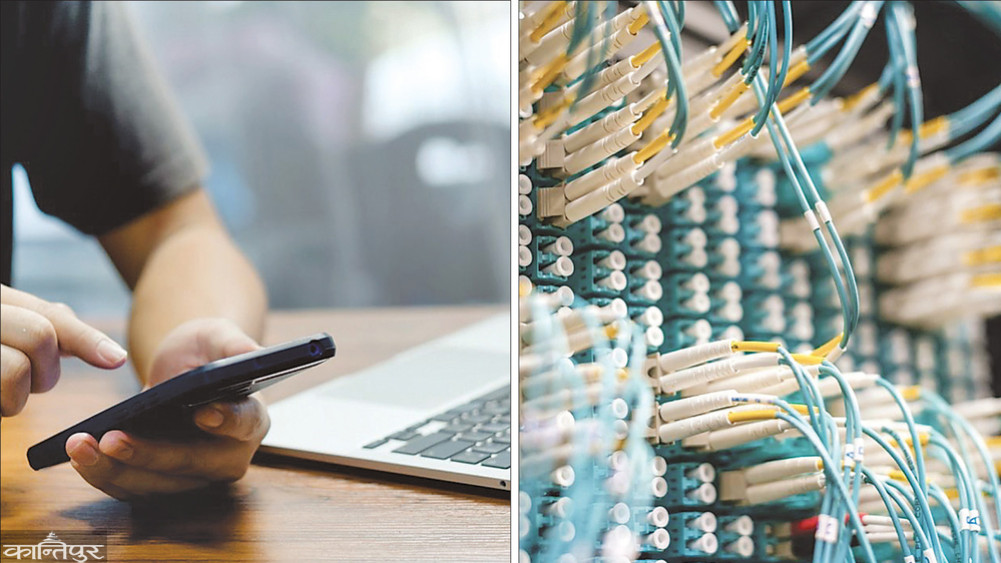
As of 2018, mobile broadband services are three times more accessible than fixed broadband services
We use Google Cloud Translation Services. Google requires we provide the following disclaimer relating to use of this service:
This service may contain translations powered by Google. Google disclaims all warranties related to the translations, expressed or implied, including any warranties of accuracy, reliability, and any implied warranties of merchantability, fitness for a particular purpose, and noninfringement.
Recently, mobile broadband services have become affordable in most countries, but fixed broadband services are still out of reach for many people. According to a recent report published by the International Telecommunication Union (ITU) under the United Nations, since 2018, mobile broadband services have become three times more accessible (affordable) than fixed broadband services.
Globally, the price of mobile internet services will decrease by 14.1 percent of the gross national income per capita in 2022 and by 17.9 percent in 2024, according to the 'Affordability of ICT Services' report. During the same period, the cost of fixed broadband services fell by only 9.4 percent of the gross national income per capita annually. According to the report, the cost of mobile services in Africa ranges from 3 to 7 percent of gross national income per capita, and fixed broadband service is the most expensive at 14 percent of gross national income per capita.
Mobile broadband is an Internet service provided through mobile networks such as 3G, 4G, Fizzy using a smartphone, tablet or WiFi device. This requires a SIM card or mobile data pack. Fixed broadband is internet service connected to homes or offices through optical fiber, ADCL or cable. In this the router distributes the internet to different devices.
While the cost of mobile broadband services in the Asia Pacific region has fallen to less than 2 percent of gross national income per capita, fixed broadband still appears to be above 2 percent. In the US, fixed broadband prices have also dropped significantly. Above 2 percent of gross national income per capita is considered expensive. In this respect, both mobile and fixed Internet services are widely available and in good condition in Europe. There mobile service and fixed broadband charges are 0.5 percent and 1.1 percent of the gross national income per capita respectively.
The ITU-UNESCO Joint Broadband Commission has set a goal of providing basic broadband services in developing countries at less than 2 percent of monthly gross national income per capita by 2025. Although many countries are meeting this goal in terms of mobile services, many countries are still lagging behind in terms of fixed broadband services, Director of Telecommunication Development Bureau of ITU Cosmas Lakisan Javajava has pointed out.
It is seen in the report that Nepal has completed the target in terms of mobile broadband service. Here, mobile internet service with at least 2GB of data is available for less than 2 percent of the gross national income per month. This shows that mobile internet access is increasing and users are getting services at relatively cheap rates. But even though mobile service prices are cheaper than the national average, they are still considered expensive for low-income users. According to the
report, Nepal is one of those countries where, due to unequal income, the service is cheap but expensive for most of the users. Even though the price is relatively cheap, Nepal is placed in the country where internet usage is low. Although the quality of fixed broadband has improved worldwide, speeds in low-income countries are still below 10 Mbps. In 2024, there is no significant improvement in average speed in countries like Nepal. As mentioned in the
report, in high-income countries, fixed broadband monthly fees have fallen to 1 percent of the national income. In low-income countries, the rate is still higher than 29 percent. In low-middle income countries like Nepal, this problem is considered more serious. Because many consumers here cannot afford fixed broadband service.
The quality of fixed broadband service has improved in recent years. "Average download speed has increased significantly and service delivery through fiber or hybrid cable has also expanded," the report said, "However, the expansion of such technology has not been uniform in all countries." Even in Nepal, service providers have increased the use of optical fiber by removing copper wires. Nepal Telecom has said that the conversion of copper based network to fiber to the home technology has reached its final stage. The company had also declared Karnali as a province without copper network on its 21st anniversary last January.
ITU has said that not only the price of Internet service, but also its quality, service access and relative cost of income have been evaluated. It has been emphasized that the price for digital access should not be cheap, but the service should be quality, accessible and accessible.