Only 100 percent risk load in share mortgage loan, mandatory cash balance calculation method is tight, policy rate remains the same
We use Google Cloud Translation Services. Google requires we provide the following disclaimer relating to use of this service:
This service may contain translations powered by Google. Google disclaims all warranties related to the translations, expressed or implied, including any warranties of accuracy, reliability, and any implied warranties of merchantability, fitness for a particular purpose, and noninfringement.
With the appointment of a new governor, Nepal Rastra Bank has become more flexible in its share loans. Four days after Vishwa Poudel was appointed as the governor, the National Bank has released the third quarter review of the monetary policy of the current financial year. In the review, the National Bank reduced the risk weight of share loans and maintained it at 100 percent.
The National Bank has set a risk weight for the sector where banks and financial institutions provide loans. Risk weighting is assigned to high risk areas and low to low risk areas. Banks and financial institutions provide more loans in areas with high risk load and in areas with low risk load. Therefore, it is analyzed that when the National Bank increases the risk burden, it tightens the credit expansion in the respective areas and becomes flexible when it decreases.
Rashtra Bank does not seem to have a stable policy on share loans. Rashtra Bank, which has sometimes been adopting a flexible and sometimes loose policy, has reached the situation it was in four years ago. Nepal Rastra Bank has started issuing integrated instructions since 2067. At that time, the risk weight of all loans flowing into share securities was 150 percent. On December 11, 2075, the provision was amended and the risk weight of share loans was made 100 percent. On February 11, 2078, the risk weight was increased to 150 percent due to aggressive loan expansion after the Covid infection. In 2079, the risk weighting for share loans up to 25 lakh rupees was 100 percent and for all others 150 percent. In 2080, the risk weight was increased to 100 percent for share loans up to 5 million rupees and 125 percent for all others. Now this arrangement has been modified and the risk weight of share loans has been maintained at 100 percent.
"The risk weight of the existing share mortgage loan will be reduced from 125 percent to 100 percent," said the review. The National Bank has stated that the risk weight has been reduced to encourage share lending when there is sufficient liquidity in the financial system. "In 2078, the risk weight of share loans was increased, according to the balanced concept of the policy, it has now been reduced to 100 percent," said Ramu Poudel, spokesperson of Rashtra Bank.
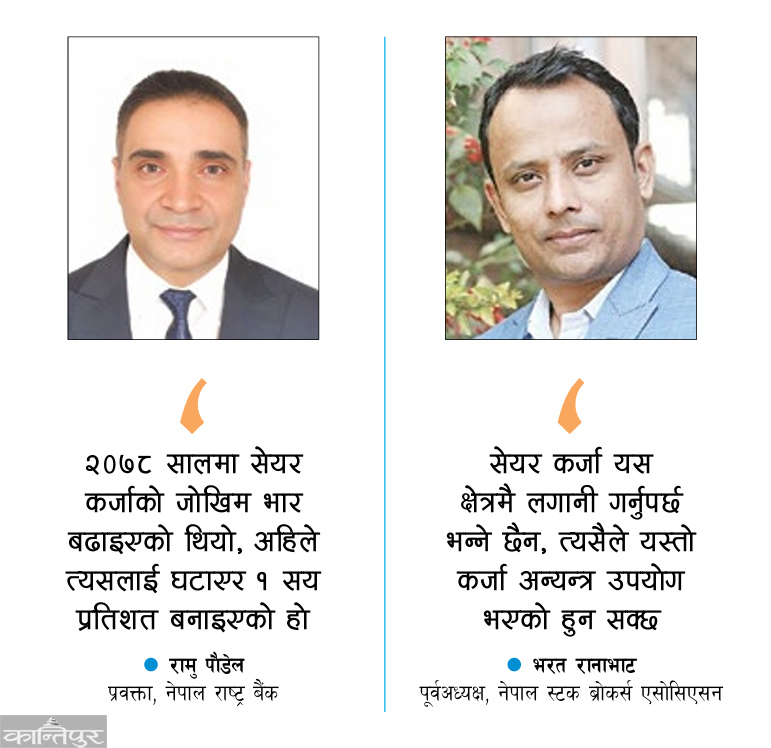
Share loans have been increasing since the beginning of the current financial year. But the increase in share loan has not had a positive effect on the stock market. Therefore, experts suspect that the loan taken on the share mortgage has been used elsewhere. In the nine months of the current financial year alone, banks and financial institutions have provided additional 34 billion 283 million rupees in share loans. Compared to the same period of the last financial year, the share loan flowed in this sector in the nine months of this year is 37.8. percentage is higher. In the nine months of the last financial year, the growth rate of share loans increased by 13 percent. The former president of Nepal Stock Brokers Association, Bharat Ranabhat, said that since there is a high possibility that the loan flowed into share securities will be used in the machinery sector, direct flow may not have been seen in the stock market. Currently, banks and financial institutions give margin loans on share securities. Although it is commonly called margin lending, that loan is of a different nature," he said. Therefore, the loan mechanism taken on the share mortgage may have been used.'
Through the review of the monetary policy, the National Bank has slightly tightened the provisions related to the mandatory cash balance (CRR) calculation of banks and financial institutions. At present, banks and financial institutions have to maintain four percent CRR. This arrangement remains unchanged. But the National Bank tests every 14 days whether the banks have maintained the CRR or not, at which time the banks must maintain at least 70 percent of the 4 percent requirement. Through
review, Rastra Bank increased the limit from 70 percent to 90 percent. Earlier, banks maintained only 70 percent of the prescribed four percent CRR every 14 days, now they have to maintain 90 percent. The new regime is tougher for banks and easier for Rashtra Bank. Because until now, banks used to show 70 percent of cash, while the remaining 30 percent were keeping short-term deposits (SDF) in Rashtra Bank and taking interest on it. The new system has curbed the income received in this way.
"Permitted A, B and C category organizations will have to keep four percent of the total deposit liability in the Rashtra Bank as a mandatory cash balance from August 12, 2079," said the review, "minimum 70 percent of the mandatory cash balance to be maintained in accordance with this provision must be kept in the Rashtra Bank on a daily basis." He said that this decision was taken because there has been excess liquidity in the financial system for a long time. In the review, the direction of the monetary policy has been carefully balanced based on the internal economic and financial situation and scenario. "The policy rate has been kept at the existing 5 percent, the deposit collection rate as the lower limit at 3 percent and the bank rate as the upper limit under the interest rate corridor at 6.5 percent," said the review.
In order to improve the investment environment, the National Bank is preparing to issue the 'Nepal Rastra Bank Foreign Investment and Foreign Loan Management Regulations, 2078' incorporating the provisions of the latest amendments made in the Foreign Exchange (Regulation) Act, 2019 and the Foreign Investment and Technology Transfer Act, 2075. According to the amendment of the Banking Offenses and Punishment Act, 2064, a procedure to prove the behavior related to check dishonor will be formulated and issued in the review.
Rashtra Bank claims that the direction of monetary policy has been balanced based on the latest internal and external economic situation and scenario. According to the Rastra Bank, the monetary measures will be modified as needed, keeping in view the domestic economic activity, foreign exchange reserves, ability to support imports and inflation.

