We use Google Cloud Translation Services. Google requires we provide the following disclaimer relating to use of this service:
This service may contain translations powered by Google. Google disclaims all warranties related to the translations, expressed or implied, including any warranties of accuracy, reliability, and any implied warranties of merchantability, fitness for a particular purpose, and noninfringement.
The slope road construction has started on the hilly section of Daunne Road under Mahendra Highway. In the first phase, 500 meters of road in both sections have been sloped.
The Chinese contractor who got the contract for the construction of the highway left 30 percent of the amount when the contract was awarded (under 30 percent was put in the tender) and completed the tender.
30 percent of the loan assistance taken from the Asian Development Bank is in the government fund. Currently, 500 meters of road slope has been done from both sides (from Dumkibas and Bardghat) as a test to be managed from the same fund.

According to Chudaraj Dhakal, Chief Engineer of Road Project Directorate, Kathmandu, permission has been given for the construction of 2 and a half kilometers of sloping road on the lower road section. He said that sloped roads are 6 times more durable than asphalt roads. Although the cost seems to have increased a bit at the beginning, since this highway is 6 times stronger than black paper, there is no need to maintain it every year, he said.
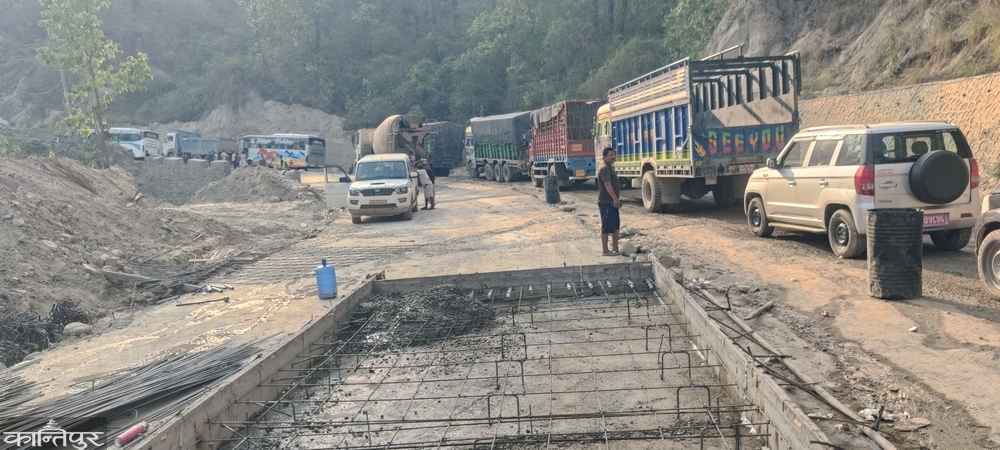
The Chinese contractor company China State Engineering Corporation, which is working on the road construction, is using Chinese-invested Hongsi cement, which has a factory in East Nawalparasim, on the road slope of Daune. The contractor company said that there is a trend of using the products of their own country (cement produced by Chinese cement factories) as much as possible in the construction work done by the Chinese in any country of the world.

Butwal-Narayangadh Road Project East Spokesman Shiv Khanal informed that the road project has already pushed 5 meters of road till Monday in the first phase for testing. He said that slope road construction has been tested on the highway here and it will help in making a long-term plan for the whole country.
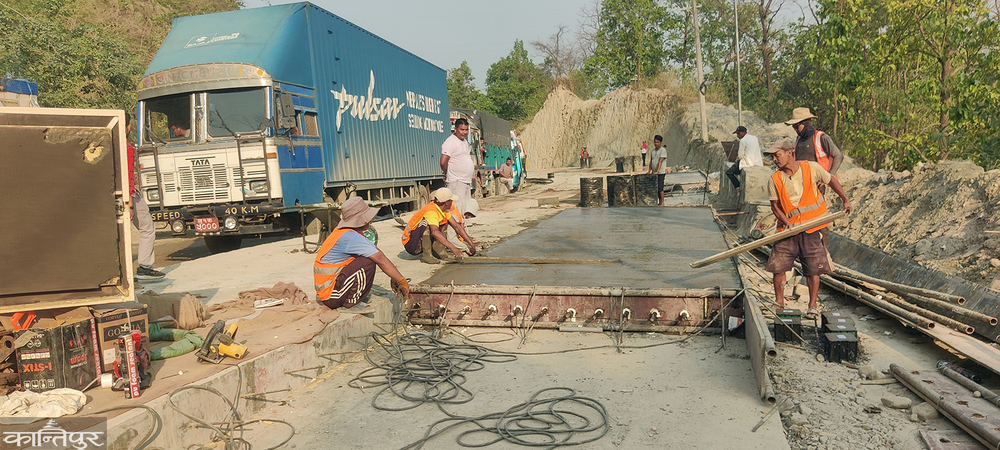
Khanal told that the road constructed with cement slope is more durable for many years than the black-paved road. He said, 'Sloped roads are very strong and the cost of maintenance is not that much, while black-coated roads have to be maintained every year.'

Slope road is 2 and a half times more expensive than asphalt road at the beginning, but it is durable for many years. It is 6 times more durable than black paper. It seems very economical as the amount spent on annual maintenance is very less. Khanal informed that the work of construction of sloping road has started by changing some modality to estimate the cost amount and test the durability of the road like Daunne.

In the next few days, after analyzing the cost and durability of the sloping road, Khanal informed that it will be decided how many roads will be sloped out of the 14 km road section of Daunne. He said that it will be decided soon how many kilometers of slope road will be constructed out of the 14 km road section of Downe. Khanal informed that the test was done by constructing a steep road, a sloping road where water is flowing.

Farakila Ghumti (mode) of Downne Road And the work has started under the plan to make the slopes steeply uphill.
The uphill lane will be towards the mountain wall. Only cargo trucks (climbing lane) will move in that lane. Arrangements will be made for other vehicles to move from the other two lanes.
A 3-lane road is being constructed on the lower hill in the middle of Dumkibas Bardghat section under Mahendra Rajmarg. The road section below
will be 12.5 meters wide. About 3 km of road has been pitched till Monday in the area from Bardghat to East Downe Bazar of Downe Road section.
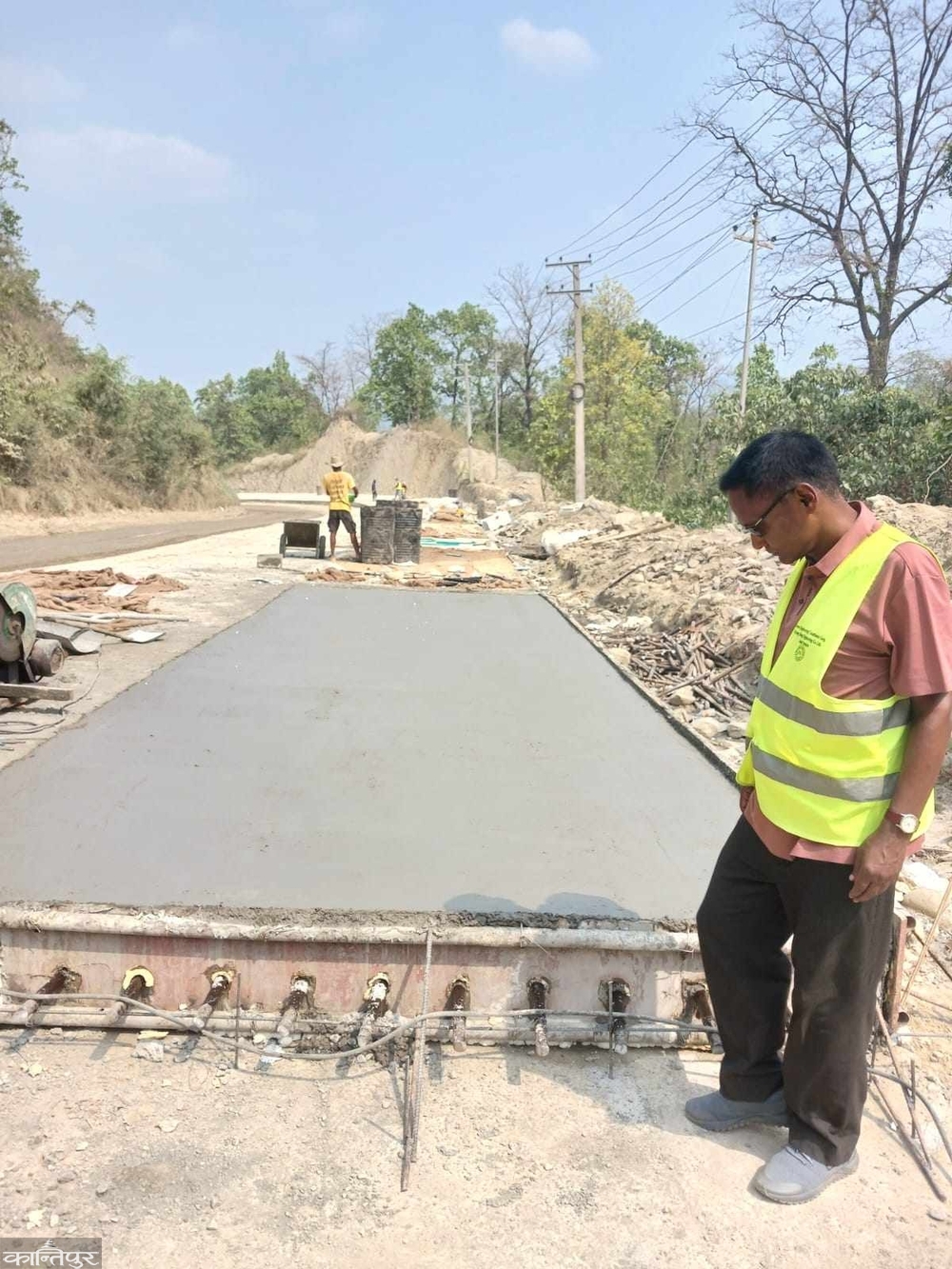
project director Dhakal informed that 3 lakh sacks of cement will be consumed when slope technology is adopted on the 10 km road of Downne. Dhakal claims that it will be more useful because cement, sand, gravel, water, construction materials and even labor are used by Nepalese. There is an obligation to bring all the necessary raw materials from India.


