We use Google Cloud Translation Services. Google requires we provide the following disclaimer relating to use of this service:
This service may contain translations powered by Google. Google disclaims all warranties related to the translations, expressed or implied, including any warranties of accuracy, reliability, and any implied warranties of merchantability, fitness for a particular purpose, and noninfringement.
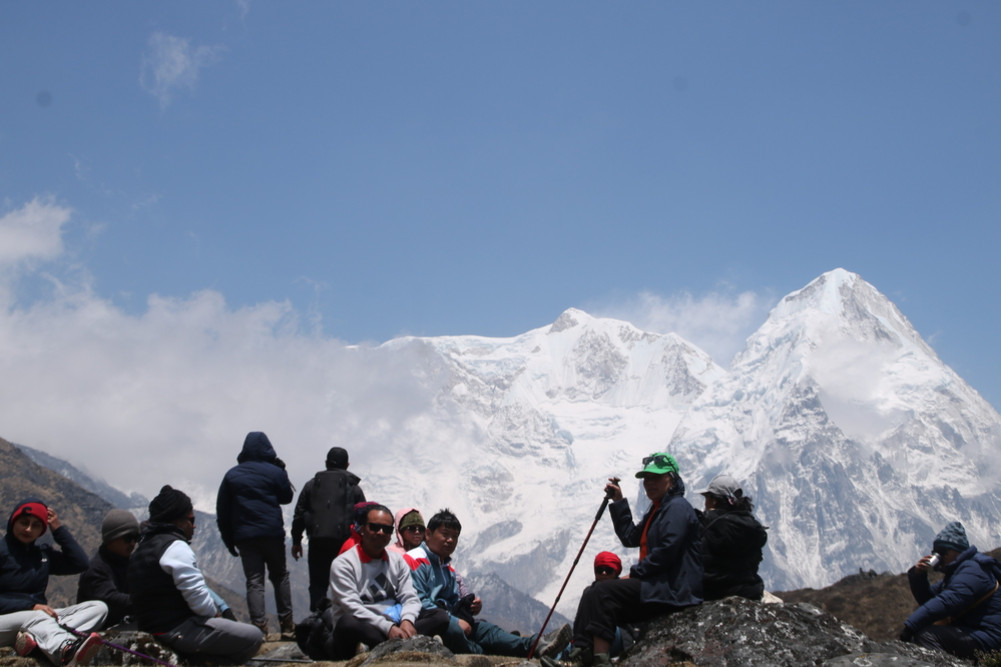
Kanchenjunga, the third highest mountain in the world, has recently become a center of attraction for domestic and foreign tourists. The number of foreign tourists who choose this region especially for adventure travel, trekking and mountain climbing is gradually increasing.
Recently, a team of 10 people, including five foreign nationals, successfully climbed the Kanchenjunga Himal. They completed the climb through Seven Summit Treks. Those who have successfully climbed include citizens of Britain, Iran, Kosovo and Nepalese Sherpas. According to Mingma David Sherpa, director of Elite Expedition Kathmandu, 63 more climbers and guides are currently in the area to climb Kanchenjunga Himal.
The attraction of foreign tourists is also increasing towards the south base camp of Kanchenjunga Himal. According to Suryaman Rai, Tourism Assistant of Kanchenjunga Conservation Area Management Council's Yamfudin office, 16 Americans, 15 Indians, five Russian citizens, four Israelis, two British and two Dutch tourists have visited the South Base Camp since last March alone.
The presence of tourists towards the Kanchenjunga North Base Camp is also remarkable. According to Tasi Tenzing Sherpa, tourism assistant of Ghunsa tourism check post, 360 foreign tourists have visited the northern base camp so far.
In this way, the Kanchenjunga area has started to become a choice not only for foreigners but also for domestic tourists. But the detailed statistics of domestic tourists are not listed in the offices. Kanchenjunga Himal is located at a height of eight thousand 586 meters above sea level. There are mainly two base camps south and north base camp for climbing and observing this mountain.
Northern base camp (Oktang)
To reach Kanchenjunga base camp from the northern route, one has to travel for about four hours from Taplejung headquarters, Fungling Bazar to Japantar. After three days of trekking from Japantar, Ghunsa village is reached.
After three more days of trekking from Ghunsa village, you can reach Oktang located at an altitude of 5,200 meters, which is the last base camp in the northern region of Kanchenjunga mountain. Hotels, homestays, tourist rest areas with basic facilities are operating on the Ghunsa route, which has made the stay of tourists comfortable.
South Base Camp (Pangpema)
Using the southern route, you can reach Yamphudin village in about seven hours by vehicle from Phungling market. After three days of trekking, one reaches Pangpe at an altitude of 4,800 meters, which is the last base camp in the southern region of Kanchenjunga. According to the Kanchenjunga Conservation Area Management Council, there are arrangements for local accommodation, homestays and guides on this route as well.
Mountain climbers do physical acclimatization for a few days at the base camp and then travel to the summit via Camp 1, 2, and 3 respectively. The participation of guides, high mountain workers, doctors and management groups is considered indispensable to make the climb successful.
Kanchenjunga Himal is technically considered to be the most difficult among the other 8,000 meters high mountains of Nepal. Changing climate, thin oxygen, risk of avalanches etc. make it challenging.
Therefore, it is said that climbing here takes longer than usual and requires a high level of preparation. Climbing the mountain only last week A French citizen also died in the process.
The Kanchenjunga Himalaya in the eastern region of Nepal is not only the pride of Nepal but also an area rich in tourism potential at the international level. Natural beauty, biological diversity and cultural heritage have the potential to increase tourism attraction in this area.
If the communication and infrastructure in this area is more organized, the Kanchenjunga area can become an adventure tourism and trekking destination. If there are new homestays on the trekking route, road signs, first aid centers and emergency rescue services are expanded, more tourists will come to visit.
The participation of the local community is remarkable with the development of tourism in the Kanchenjunga area. The community is earning good income through homestay operation, exhibition, porter, khachada service, sale of handicrafts.