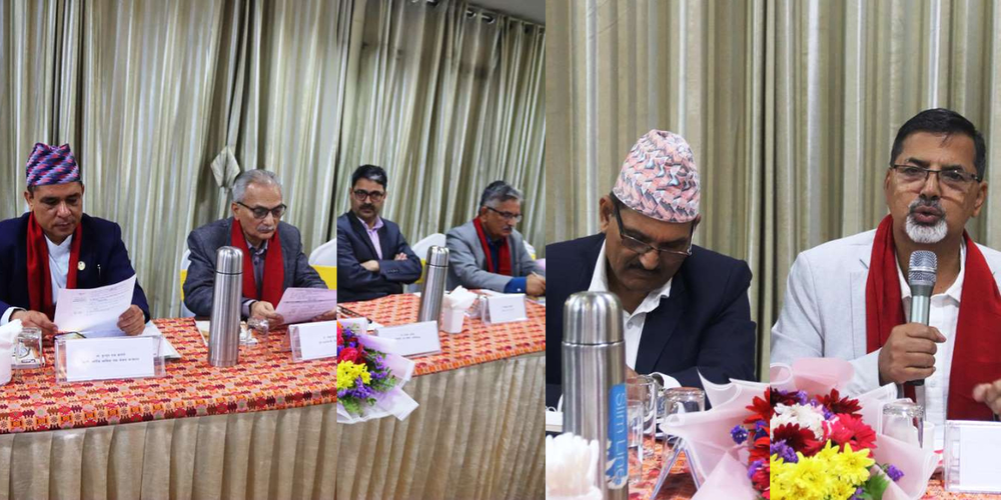
Due to the political leadership, federalism is in danger, if the mentality of centralism is not removed, the provincial and local levels are weak
We use Google Cloud Translation Services. Google requires we provide the following disclaimer relating to use of this service:
This service may contain translations powered by Google. Google disclaims all warranties related to the translations, expressed or implied, including any warranties of accuracy, reliability, and any implied warranties of merchantability, fitness for a particular purpose, and noninfringement.
The former finance ministers have said that the federal system will not be strengthened by piling financial resources in the lion palace. They said in one voice that the political leadership is the most responsible for raising questions about the federal system, "The tendency to send the burden of work to the provincial and local levels but keep the budget and staff in the lion's palace is why development has not been able to accelerate."
Stakeholders opined that the federal government has created obstacles in the planning and program operations by favoring the provinces and local levels in the distribution of revenue in the pre-budget discussion on the Budget of Federalism held in Kathmandu on Wednesday organized by the Ministry of Economic Affairs and Planning of Bagmati Province and in coordination with the Federalism and Localization Center (FLC). The participants in the discussion said that the party is pushing federalism on the path of unpopularity. In the
discussion, former Prime Minister Baburam Bhattarai accused the political leadership of being anti-federalism. He said that the political vision should be clear to strengthen federalism, but after the implementation of the federal system, the responsibility of the work was transferred to the provincial and local levels, but the budget and manpower were kept at the center . Bhattarai, who is also a former finance minister, said that the province should not be insulted by keeping financial resources at the center.
Former finance minister Surendra Pandey, presenting the data that the country's revenue collection situation is very critical in federalism, said that it will have a negative impact on the development program. He said that the expenditure on social security, pension, interest on foreign and domestic loans and employee's salary has reached a state of not being able to bear it. "The situation is not easy if the mandatory obligation of the state increases every year but alternative sources are not sought," former minister Pandey said, "There is a situation in the federal system where the 'demand' is increasing but the resources cannot be increased."
He said that the revenue based on business cannot always be sustained, he said that the financial situation should also be improved to strengthen the federal system . He said that the government does not want to send personnel and financial resources to the provincial and local levels.
Former finance minister Janardan Sharma said that the political parties who fought to bring federalism are the opponents of federalism. He said that as a result of not wanting to transfer the authority of the center, the distaste for the federal system has increased, and Sharma presented the example of returning the big plans sent to the state and local levels in the past. He accused the central government of not giving resources to the provinces and local levels and not implementing them, and it will be the party that weakens federalism.
Former finance minister Gyanendra Bahadur Karki said that the constitution strengthened the rights of citizens in the federal system. Karki suggested that federalism should be taken as a driver of the country's development to increase the revenue. Arguing that only if taxpayers are respected, the revenue will increase due to the increase in investment, he said that there is no alternative to the federal system. The program was organized with the participation of local people's representatives, members of the National Planning Commission, Chief Minister of Bagmati Province, officials of the Finance Commission, MPs of Union and Provinces, Ministers of the Ministry of Economic Affairs, Chairman and members of the subject committees of the House of Representatives and the Provincial Assembly, officials of the Federation of Nepal Chamber of Commerce and Industry, etc.
said that employment will be created by increasing the source of revenue in the program. The Chief Minister of Bagmati Province, Bahadur Singh Lama, opined that it is difficult to work due to the restrictions imposed by the central government even on constitutional rights. He expressed his displeasure saying that the union government did not even give the land to build the administrative building.
He said that it is difficult to work in the system in the country, and he said that the environment for bringing in investors has not been created. He narrated the experience of being rejected by the secretary of the Prime Minister's Office if he came to the union with a job. Chief Minister Lama told the association, "We will demonstrate by running the closed Hetaunda cement and textile factories."
Former Minister of State for Health Umesh Shrestha said that revenue growth is not possible if large investments are not brought in. He said that the investor should go to the country where it is easy and there should be no legal hurdle for this. Chandra Prasad Dhakal, President of the Federation of Industries and Commerce, said that the private sector should be trusted.
He said that without identifying the source, the program cannot be implemented. He asked to create an investment environment. Lakshmidevi Pandey, President of the National Association of Rural Villages, said that it is not possible to move forward by emphasizing the use of resources rather than increasing revenue. She demanded to increase the equalization grant and reduce the conditional grant by saying that the financial transfer to the local and state was not done properly.
Mahesh Baral, head and joint secretary of the Finance Ministry's Financial Federalism Coordination Division, said that the government is trying to reduce the conditional subsidy and increase the equalization subsidy. He said that since the revenue collection has not been as per the target for the past two years, it is natural that the financial transfer will be affected and the provincial and local levels should also help in reducing the general expenses. He said whether some structures of the province are necessary or not should be discussed.
Khimlal Devkota, a connoisseur of federalism and former chairman of the Federalism Implementation Study and Monitoring Parliamentary Committee of the National Assembly, presented a working paper on matters such as financial transfer to the state and local levels, budget allocation, intervention by the central government in the state, staff mobilization, law making, etc.
Devkota suggested that improvements should be made regarding the central government's reduction of subsidies guaranteed by the constitution, non-transfer of resources, haphazard development programs, and partiality in revenue distribution. Stakeholders presented suggestions focusing on the same issue. Kundan Kafle, Minister of Economic Affairs of Bagmati Province, who presided over the
program, said that the provincial government is trying to increase revenue. He said that the province emphasized on production and said that he would try to implement the suggestions. He said that despite the assurance to the citizens that prosperity would come after going to the federal system, the central mentality prevailed in the implementation.