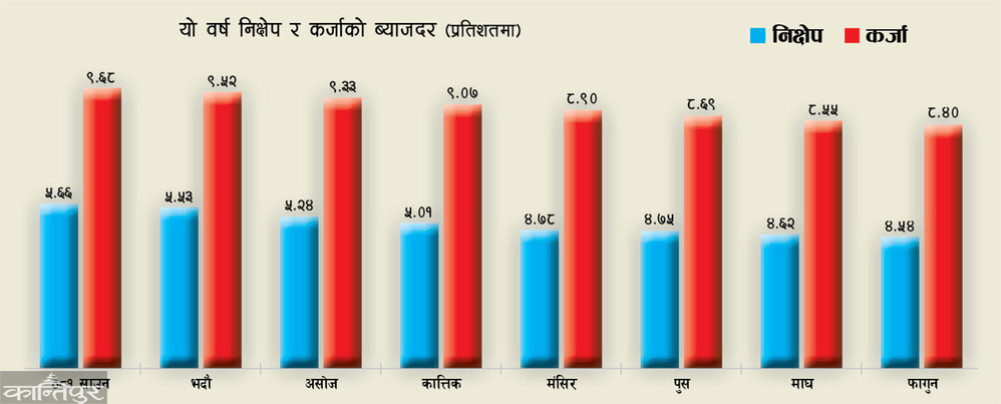
In the financial year 2077/78 June, the average interest rate on loans was 8.43 percent, since then it increased to 13.03 percent, now it has decreased again to 8.4 percent.
We use Google Cloud Translation Services. Google requires we provide the following disclaimer relating to use of this service:
This service may contain translations powered by Google. Google disclaims all warranties related to the translations, expressed or implied, including any warranties of accuracy, reliability, and any implied warranties of merchantability, fitness for a particular purpose, and noninfringement.
For Baisakh, three commercial banks have increased the interest rate of one-year personal fixed deposits and two have decreased it. The remaining 15 banks have kept the interest rate of one-year term deposits fixed.
According to this, in Baisakh, the average maximum interest rate of one-year term deposits has remained at 6.025 percent and the minimum at 4.061 percent. In March, the average maximum interest rate on fixed deposits was 6.014 percent and the minimum was 4.051 percent.
Among the 20 commercial banks, one bank has increased the interest rate on ordinary savings for Baisakh and one has decreased it. According to this, the average maximum interest rate of ordinary savings in commercial banks for Baisakh has been maintained at 4.414 and minimum at 3.013 percent. It is mentioned in the table of monthly interest rates published by banks that this interest rate is 4.464 and 3.013 percent respectively in March.
Banks and financial institutions have been reducing interest rates on deposits every month saying that liquidity has been maintained for a long time. At the same time, banks have also reduced and published new deposit interest rates for Baisakh. Along with the deposit interest rate, the loan interest rate has also decreased to an average of 8.4 percent last February. This was about 4 years (45 months) ago. In the financial year 2077/78 June, the average interest rate of loans in banks and financial institutions was 8.43 percent. Since then, the interest rate on the loan has been on the rise. In February of the financial year 2079/80, the average loan interest rate reached 13.03 percent. Since then the interest rate started to decrease again. At the same time, the average interest rate of loans fell to 8.4 percent last February.
In the financial year 2077/78 June, the average interest rate of deposits in banks and financial institutions was 4.65 percent. Since then, the interest rate has increased to an average of 8.5 percent. According to the data of Rashtra Bank, the interest rate decreased in the last month and remained at 4.54 percent in February.
In February 2081, the weighted average interest rate of commercial banks' deposits was 4.54 percent, development banks' 5.32 percent and finance companies' 6.36 percent, according to Rashtra Bank's monthly data. In February 2080, the weighted average interest rate on deposits of commercial banks was 6.74 percent, 7.93 percent of development banks and 9.13 percent of finance companies. In February 2081, the weighted average interest rate of loans of commercial banks is 8.40 percent, that of development banks is 9.78 percent and that of finance companies is 10.53 percent. According to Rastra Bank, the weighted average interest rate of commercial banks' loans in February 2080 was 10.78 percent, that of development banks 12.52 percent and that of finance companies 13.61 percent.
In the eight months of the current financial year (July to February), 2 trillion 77 billion 33 crore rupees of deposits have been added in banks and financial institutions. This is an increase of 4.3 percent compared to last June. During the same period of last year, such deposits increased by 4 trillion 35 billion 87 crores (7.6 percent). At the end of last June, the total deposits of banks were 57 trillion 55 billion, but by February last, they have increased to 60 trillion 37 billion rupees. In the eight months since the
, 20 commercial banks have extended a total of 3 trillion 4 billion additional loans. This is an increase of 6 percent compared to the end of last June. In the same period last year, such loans increased by 1 trillion 99 billion 500 million (4.2 percent). On an annual point basis, the credit flow from banks and financial institutions to the private sector increased by 7.7 percent at the end of February 2081. The total credit of commercial banks, which was 45 trillion 71 billion rupees last June, has increased to 48 trillion 51 rupees by February.
Santosh Koirala, president of Nepal Bankers Association, said that although the demand for loans has increased in the previous months of this year, the demand for loans has not increased much in the last months. "Even though the interest rate is decreasing, the demand for loans has not increased significantly," he said, "The demand for quality loans has not increased in the last months."
The mentioned data of loans and deposits has shown that the growth rate of loans is higher than that of deposits in the period of eight months of the current financial year. There are only three months left for this fiscal year. This year, the government has set a target of extending credit by 12 and a half percent. According to experts, it will be difficult to achieve the annual target this financial year based on the progress of up to eight months.
As of last week, the credit-deposit ratio (CD ratio) of banks and financial institutions is 79.43 percent. Banks and financial institutions can lend up to 90 percent of deposits as per the instructions of the National Bank. Based on this, now banks and financial institutions have about 6.5 billion loanable funds. Since the last year and a half, an average of more than 5 billion investable funds have been accumulating in banks and financial institutions every month.