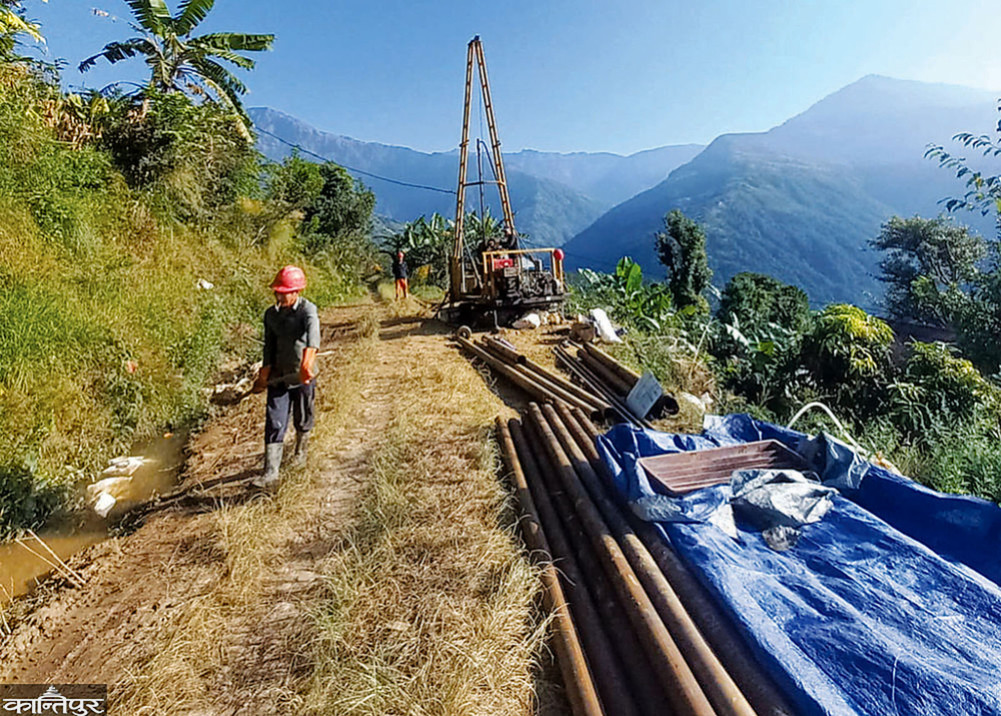
In Kathmandu, Nuwakot and Rasuwa, at 75 out of 80 locations, soil was extracted by 'drilling', and soil testing was also done. 90 percent complete
We use Google Cloud Translation Services. Google requires we provide the following disclaimer relating to use of this service:
This service may contain translations powered by Google. Google disclaims all warranties related to the translations, expressed or implied, including any warranties of accuracy, reliability, and any implied warranties of merchantability, fitness for a particular purpose, and noninfringement.
Geological study of Kathmandu-Kerung railway has reached its final stage. Its study has been started with the technical and financial support of the Chinese government.
Feasibility studies are being conducted in the districts of Kathmandu, Nuwakot and Rasuwa which are touched by the railway. In three districts, 75 out of 80 locations have been drilled and extracted. Railway department sources said that 90 percent of the soil testing work has been completed.
In eight places, the soil has to be excavated up to 400 meters deep, and 7 places have been excavated. Kamal Kumar Sah, Spokesperson of the Railway Department and Senior Divisional Engineer, said that soil, stone, water, and rock samples were collected from the locations where the railways are likely to touch in all the three districts.
After completing the initial study of the first phase, soil testing has been started with a drill machine in the second phase. "But the drilling work is still left," he said. "All possible tests have been done in Nepal's laboratory, only those that have to be done but are not possible here have been sent to China for testing," he said. Sah said that the work was being affected from time to time due to the obstruction of the locals. "During the drilling, the local people obstructed them saying why they were digging a hole on their land," he said, "The work has been done only according to what is in the railway drawing, no work has been done on the land other than that." "There is a problem with the road at the place of study, so there is some delay when we have to build a road to reach that place," he said, "There is no problem now."
It took a year to complete the preliminary study of the first phase. In other words, the Chinese technical team that came to Nepal in January 2079 to study the feasibility of the railway completed the first phase of the study in the first week of January 2080. Its study should be completed within 42 months from the date of commencement. But 27 months have passed since the study started. Now is the time to study till June 2083. Sah claims that the study will be completed within that time. As this is a feasibility study, it will know the cost, time and total distance of the railway to be constructed. The feasibility study will also determine how many tunnels, bridges and stations are required on the railway. After the final report is prepared, the detailed project report (DPR) will be prepared and the construction work will proceed.
"The work of the second phase is also about to reach its final stage," said an engineer of the department, "then the final report will be prepared in the final stage." The Railway Department has been assisting the Chinese technical team in the study. The engineering team of the department has helped in the study.
It is estimated that the construction of the railway will cost 2.71 billion 36.8 million rupees. According to the preliminary study, the railway distance from Rasuwagadhi to Kathmandu will be 72 km. The pre-feasibility study of this railway was done in November 2075. During the visit of Chinese President Xi Jinping to Nepal in October 2016, it was agreed to start the feasibility study.
Similarly, in March 2078, during the visit of Chinese Foreign Minister Wang Yi to Nepal, a memorandum of understanding was signed on the feasibility study. According to the Ministry of Physical Infrastructure and Transport, only preliminary issues have come up in the pre-feasibility study and now the actual distance, tunnel, cost, bridge height, station etc. will be finalized. According to the ministry, the railway department and the ministry have been facilitating in case of difficulties in studies.