Starting to get dividends from 2078, Nepal's population will start aging from 2108
We use Google Cloud Translation Services. Google requires we provide the following disclaimer relating to use of this service:
This service may contain translations powered by Google. Google disclaims all warranties related to the translations, expressed or implied, including any warranties of accuracy, reliability, and any implied warranties of merchantability, fitness for a particular purpose, and noninfringement.
According to a government report, only 27 years of the demographic dividend available to Nepal (more active age groups than children and elderly) remain. The Demographic Dividend Report released by the National Statistics Office has pointed out that Nepal is now in the mid-term of its demographic dividend period and will enter old age after 2108 years.
The 'demographic dividend' refers to the potential for economic growth due to changes in the age-structure of the population, the report explained. In the report, the population aged less than 15 years and 65 or more is considered inactive and the population aged 15 to 64 is considered active.
"A country where the birth rate has decreased and the working-age population has increased, there is a possibility of a demographic dividend," the report says, "the result of that is overall economic growth and qualitative improvement in people's living standards." It is 65.2 in June 2078. During this period, the population under 15 years of age was 27.8 percent and over 65 years of age was 6.9 percent. "According to this, it appears that Nepal has entered the stage of demographic dividend in 2076 and will exit in 2108," said Dhundiraj Lamichhane, Deputy Chief Statistics Officer and Spokesperson of the National Statistics Office. According to the report, it has entered the phase of demographic dividend in the middle and this situation will last for 2108 years. "Based on the ratio of dependent population which was 53.3 in 2078, Nepal entered the stage of demographic dividend around the year 2074 and will remain in this situation until the year 2108, when the ratio will be close to 60," the report pointed out.
Spokesman Lamichhane said that there has been an unprecedented change in the demographic structure of Nepal and that this is an infinite opportunity for the state to realize its vision and resolve. "There is also an opportunity to make a transformative intervention to improve the overall living standards of citizens with an increase in economic productivity, a pioneering step in human capital development, a sustainable increase in national income and an increase in national savings," he said. Lamichhane says that the state's overall policy commitment and effective implementation will be important to realize the results of the demographic dividend while dealing with these problems.
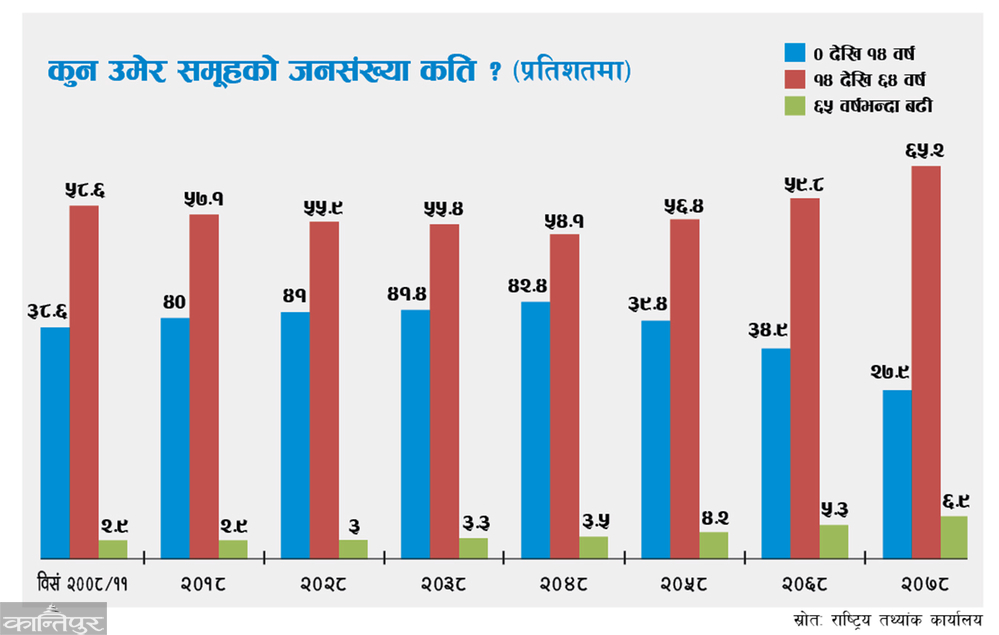
He said that the nation should be able to make full use of this opportunity when the population that can work (active) is more than the (inactive) and the population growth rate is decreasing.
The report has pointed out that the country now has an unprecedented youth workforce and the burden of the dependent population is low.
If this fertile human power can be used, there is a possibility of rapid increase in per capita domestic product.
Undoubtedly, the report mentions that the country faces challenges such as poverty, unemployment, uneven distribution of national income, trade deficit, etc. This has highlighted the need for immediately implementable policies and programs in favor of a transformational policy that promotes an investment-friendly and encouraging environment, an environment for improving the quality of human capital, and inclusive economic promotion.
According to the 2078 census, Nepal's population growth rate is 0.92 percent. During that period, the population growth rate of zero to 14 years is negative by 1.25 percent, while the population growth rate of 65 and above is 3.54 percent. During that period, the growth rate of the population in the age group of 15 to 64 years is 1.75 percent.
"By 2051, citizens aged 65 or more in Nepal are expected to reach 15 percent of the total population," the report said.
In this way, the growth rate of the children is negative, the growth rate of the elderly has increased sharply and the growth rate of the youth is in a declining state, so it is confirmed that the demographic benefits of Nepal are gradually shrinking.
District-wise, the highest active population is 75.4 percent in Manang and the lowest is 55.1 percent in Achham. Regionally, Bagmati has the highest percentage of 70.6% and Madhesh has the lowest percentage of 60.5%. According to the report, 66.5 percent of economically active population is in Koshi, 66.9 percent in Gandaki, 65 percent in Lumbini, 61.8 percent in Karnali and 62.4 percent in Far West.
Regionally, Madhesh has the highest 33.2 percent and Bagmati the lowest 22.2 percent of children (under 15 years). According to this, there are 26 percent children in Koshi, 23.9 percent in Gandaki, 28.5 percent in Lumbini, 33.1 percent in Karnali and 31 percent in Sudurpaschim. Citizens over 65 years of age are highest in Gandaki at 9.2 percent and lowest in Karnali at 5.1 percent. According to the report, it is 6.6 in Far West, 6.5 in Lumbini, 6.3 in Madhesh, 7.2 in Bagmati and 7.5 in Koshi.
In the year 2078, the total population of Nepal was 29.1 million 64 thousand 578. The population growth rate during that period is 0.92 percent. Regionally, the population growth rate in Lumbini and Madhesh is 1.2 percent. Such growth rate is 1 percent in Bagmati, 0.9 percent in Koshi, 0.3 percent in Gandaki, 0.7 percent in Karnali and 0.5 percent in Far West. The growth rate of working active youth is high in Lumbini. According to the report, the economically active population growth rate is 2.2 percent in Lumbini, 1.8 percent in Karnali and Madhesh, 1.7 percent in Bagmati, 1.6 percent in Koshi, 1.3 percent in Gandaki and 1.6 percent in Far West.
The change in the age structure of the population has been measured based on population growth rate, age structure, dependent population ratio, working age population, etc., according to the office.

