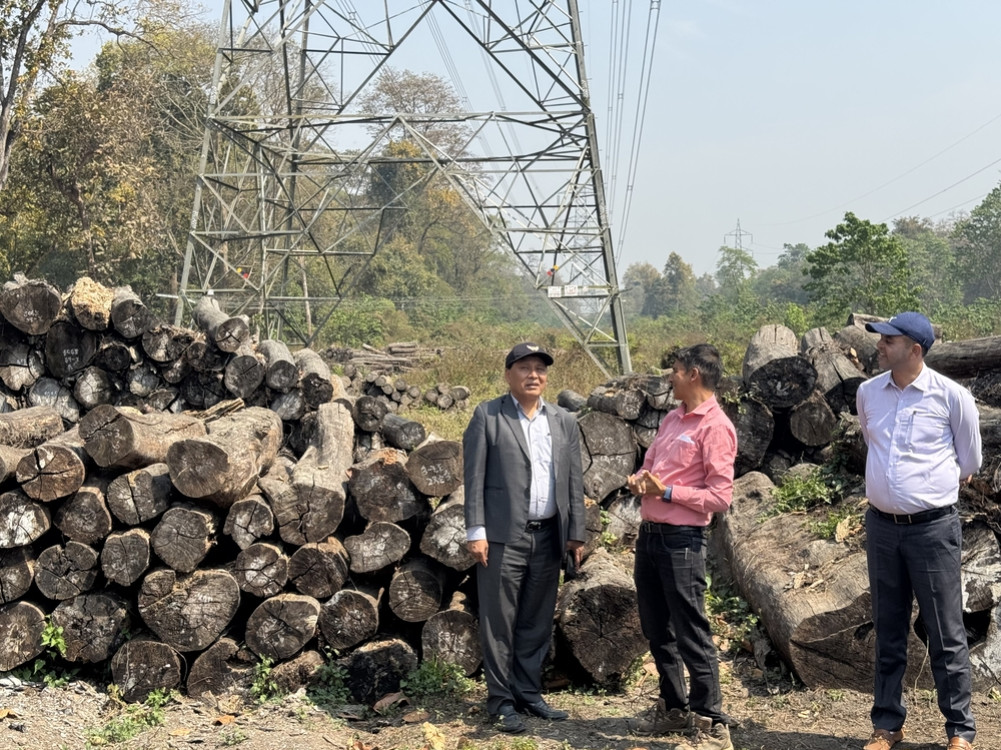
Operating at 132 KV, power supply will be more convenient
We use Google Cloud Translation Services. Google requires we provide the following disclaimer relating to use of this service:
This service may contain translations powered by Google. Google disclaims all warranties related to the translations, expressed or implied, including any warranties of accuracy, reliability, and any implied warranties of merchantability, fitness for a particular purpose, and noninfringement.
The construction of Dhalkebar-Bara section has been completed under the ongoing Hetounda-Dhalkebar-Inruwa 400 KV transmission line project to strengthen and make the electricity transmission system reliable and expand the electricity trade between Nepal and India.
The construction of 100 km transmission line has been completed from Dhalkebar substation in Dhanusha to Saraswati Danda on the border of Bara and Makwanpur through Mahottari, Sarlahi, Rautahat towards the west.
The construction of 154 km 400 KV double circuit transmission line has been completed from Dhalkebar in Dhanusha to the Inruwa Substation located in Bhokraha Narsingh Rural Municipality-4 of Sunsari towards the east and has been operational since last June.
To facilitate the flow of electricity from Dhalkebar to the west, a circuit of 400 KV transmission line, about 60 km to Jangal, near Chandranigahpur (Chapur) market in Rautahat, has been brought into operation (charged) at 132 KV.
The currently running east-west 132 KV transmission line was tapped at that location and the 400 KV transmission line was charged to 132 KV on Thursday in the presence of Kulman Ghising, Executive Director of Nepal Electricity Authority.
Ghisingh, the executive director of the authority, said that the 400 KV was charged at 132 KV to remove the obstacles of the existing infrastructure to send electricity from Dhalkebar to the west and from the west to Dhalkebar.
"In order to solve the current energy shortage in winter, more electricity can be imported from India through the Dhalkebar-Muzaffarpur international transmission line in the afternoon. This will allow water from semi-reservoir projects such as Kulekhani Reservoir, Upper Tamakoshi, Kaligandaki, Masryangdi, and Madhyamrsyangdi to be collected during the day and used for the evening peak and at night. This will make it easier to manage the power supply from Dhalkebar to the west," said Ghising. "After the start of the rainy season, the excess electricity consumed in the country can be transferred from the west to Dhalkebar and the quantity of electricity exported to India can be increased. Also, it has become easier to proceed with the work of increasing the capacity by changing the conductors of the current 132 kV transmission line." In order to increase the capacity of the East-West 132 KV double circuit transmission line, the low capacity old wire in the 136 km section from Hetaunda to Dhalkebar substation is going to be replaced with a new high capacity wire.
Out of this, the wiring of both circuits from Hetaunda to Piluwa substation in Bara has been completed. One circuit from Dhalkebar to Lalbandi in Sarlahi has been completed. Due to the obstruction of the locals, the work of changing the wire has been stopped before Lal Bandi.
The work could not proceed because the line had to be shut down to change the wire and because of this the electricity supply in that area was affected. Now, since 400 KV has been charged to 132 KV, it is possible to continue the wiring work by transferring electricity from that line.
Currently, about 200 megawatts of electricity is flowing from the old 132 kV transmission line, but after changing the conductor, the capacity has increased to about 400 MW flows. This will improve the electricity supply in that area, the electricity produced in the west can be flowed to the east and the excess electricity consumed within the country can be exported to India through the Dhalkebar substation.
Hetaunda sub-metropolis-11 of Makwanpur from Hetaunda substation located in Thanabharyang Upto Inaruwa Substay Construction of the 288 km 400 kV transmission line was divided into two sections and started. The transmission line is divided into two sections Hetaunda-Dhalkebar 134 km and Dhalkebar-Inaruwa 154 km. Out of this, the construction of Dhalkebar-Inaruwa section has been completed and has been put into operation. Hetaunda-Dhalkebar section is under construction.
Under this section, Hetaunda sub-metropolitan wards 15, 16 and 17, some locals of Hatia area have been obstructing the construction for about 8 years, demanding to shift the route of the transmission line. 18 towers are yet to be constructed, 16 in Hatia area and 2 in Hetaunda-11 police station. The remaining 2 towers are under construction.
project Nepal-India electricity transmission and trade project with the investment of the Nepal government and authorities and concessional loans from the World Bank. Started under After the end of the loan period of the World Bank, the rest of the work is currently being done with the investment of the government and authorities.