Pashmina industry has the highest capacity utilization of 97.9 percent, vegetable ghee industry has the lowest capacity utilization of 0.9 percent.
We use Google Cloud Translation Services. Google requires we provide the following disclaimer relating to use of this service:
This service may contain translations powered by Google. Google disclaims all warranties related to the translations, expressed or implied, including any warranties of accuracy, reliability, and any implied warranties of merchantability, fitness for a particular purpose, and noninfringement.
Compared to the previous financial year, the average capacity utilization of the country's industries has decreased by 1.5 percent in the last financial year. The economic activity study report published by Nepal Rastra Bank last Friday showed that the average capacity utilization of industries across the country has decreased.
In the financial year 2080/81, the average capacity utilization of industries was 48.3 percent, it is mentioned in the report. According to the National Bank, the average capacity utilization in 2079/80 was 49.8 percent. Pashmina industry has the highest capacity utilization of 97.9 percent among the industries covered in the
survey. In the financial year 2079/80, the capacity utilization of pashmina industry was only 48.46 percent. In the financial year 2080/81, the capacity utilization of the vegetable ghee industry was the lowest at 0.9 percent, it is mentioned in the report. In the financial year 2079/80, it was 2.59 percent.
Among the industries covered by the National Bank's study, it has been reported that the capacity utilization of the industry that produces processed milk, rice, wheat flour, sugar, processed tea, alcohol, soft drinks, yarn, pashmina, liquid, GI wire, cement, household metal goods, aluminum products, electric wires, tires and tubes, transformers and slippers has increased.
Vegetable Ghee, Mustard Oil, Soyabean Oil, Animal Feed, Biscuits, Chocolate, Noodles, Beer, Cigarettes, Synthetic Fabrics, Garments, Raw Leather, Chopped Wood, Plywood, Paper, Rosin, Dyes, Tablet Medicines, Capsules, Ointments, Dry Syrup, Soap, Plastic Goods, Jute Goods, Polythene Pipes, Bricks, Concrete, Iron Rods and Sheets, The report mentions that the capacity utilization of steel products, GI pipes, textile footwear and power generation industries has decreased.
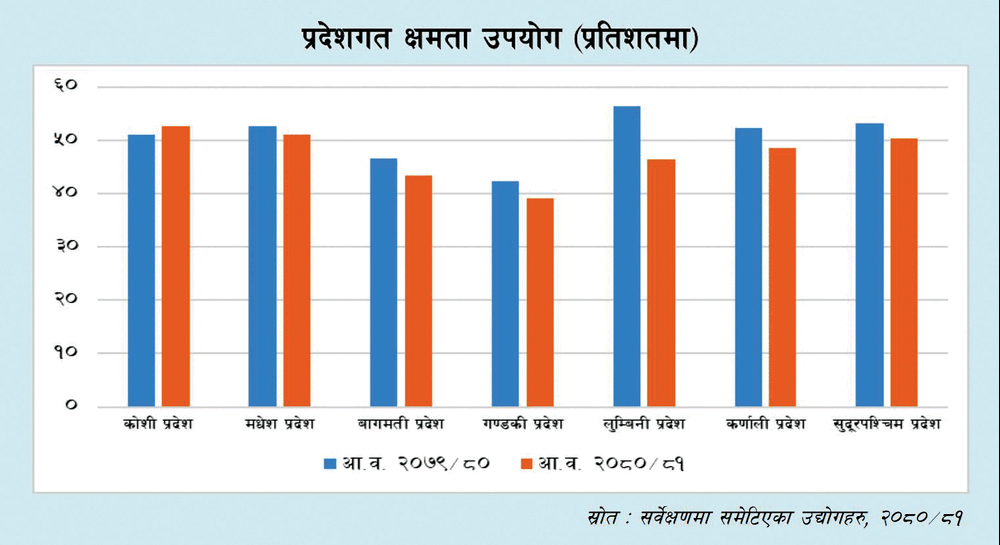
In the financial year 2080/81, only the average capacity utilization of Koshi's industries has increased in the report of Rashtra Bank. The average capacity utilization of industries in Madhesh, Bagmati, Gandaki, Lumbini, Karnali and Sudurpaschim has decreased. According to Rashtra Bank, the average capacity utilization of Koshi's industries in the financial year 2079/80 was 51.1 percent. It has increased by 1.6 percent in the last financial year. The previous fiscal year was 52.60 percent of Madhesh, but last year it was limited to 51.03 percent.
The average capacity of Wagmati industry decreased from 46.7 percent to 43.4, Gandaki industry from 42.4 percent to 39.2, Lumbini industry from 56.4 percent to 46.4, Karnali industry from 52.29 percent to 48.51 and Far West industry from 53.28 percent to 50.42 percent, it is mentioned in the Rashtra Bank report.
Although the average capacity utilization of industries has decreased, the loans provided by banks and financial institutions have increased by 9.4 percent in the financial year 2080/81. According to the report of Rashtra Bank, the amount of credit disbursed to the industrial sector has reached 15 trillion 18 billion 10 million till June 2081.
In the previous financial year, such loans increased by 10.8 percent. Among the industrial loans, Bagmati has the highest amount of 10 trillion 63 billion 94 crores and Karnali province has the lowest amount of 4.11 billion rupees in loan investment.
Rastra Bank has also pointed out the challenges and possibilities of decreasing the average capacity utilization of the industry. According to the report, there are challenges such as reducing the cost of setting up and operating the latest industries, increasing the production and consumption of indigenous industrial raw materials, managing the energy and space required for industrial operations, and making the industrial supply chain effective.
Creating an investment-friendly environment, developing the minimum necessary physical and social infrastructure such as roads, energy, communication, transferring technology by attracting foreign investment in the industrial sector and enhancing managerial capacity, not being able to ensure the availability of skilled labor force by preventing the migration of semi-skilled and skilled manpower that is lacking in the industrial sector, according to the Rastra Bank, is another challenge. It is mentioned in the report that it has not been possible to increase investment in export industries with comparative advantage and competitive ability by creating an investment-friendly environment.
According to the report, there is an opportunity to establish an industry to manage internal demand through import substitution as a high proportion of domestic demand is met by imports, as the interest rate is falling, relatively cheap manpower availability, the government's priority in the production and use of indigenous goods, the use of increasing technology, increasing banking access, subsidies for exports, and import substitution.
Cement, steel, tea, zinc leaf, paint, electric cable and conductor industries are oriented towards self-sufficiency, so there is a possibility of promoting export of these products while the import is decreasing, it is mentioned in the report. The National Bank has also said that there is a possibility that the increase in hydropower production will reduce the cost of production due to the availability of sufficient electricity in the industrial sector.
Rajesh Agarwal, president of Nepal Industry Confederation, says that the effect of contraction in the economy for three years has been the average capacity utilization of industries.
"We have repeatedly said that the capacity of the industry is decreasing, the government data also proved it," he said.
In the financial year 2080/81, the total area covered by major agricultural crops (food and other crops, vegetables and fruits and spices) has decreased by 1.1 percent, according to the National Bank. In 2079/80 such area decreased by 1.2 percent, it is also mentioned in the report. In 2080/81, milk production increased by 3.2 percent.
In 2079/80, milk production decreased by 0.4 percent. Meat production has decreased by 0.5 percent in 2080/81, while meat production has increased by 1.0 percent last year, according to data from National Bank. Egg production decreased by 3.1 percent in the year under review. According to the report, while wool production increased by 1.2 percent, leather production decreased by 2.4 percent.
Inability to provide quality seeds to farmers on time, supply of seeds and chemical fertilizers is not easy, and the area covered by agricultural crops has decreased due to the inability to arrange for easy distribution and marketing of agricultural produce by removing the dominance of middlemen, according to the National Bank. According to the report of the National Bank, there is a lot of potential to produce different types of agricultural products due to geographical and climatic diversity.
The report points out that effective marketing of agricultural produce can be done using transportation, communication and modern digital technology. Rashtra Bank says that there is a possibility of increasing foreign investment in information technology if the policies of cyber security and intellectual property rights are strictly implemented along with agriculture.