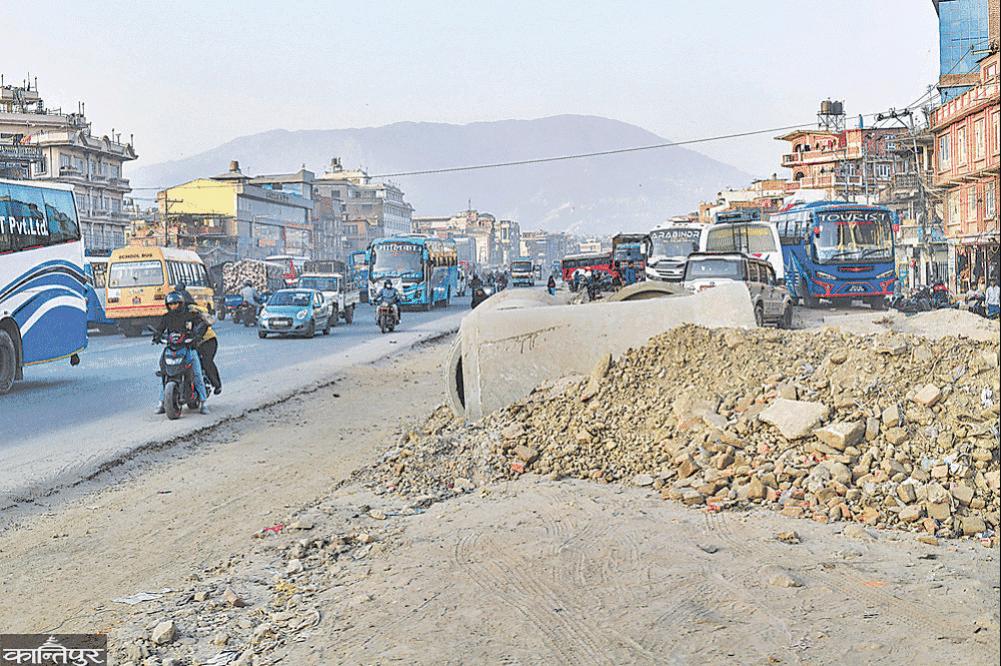
After calling for bids for the design, a representative of an interested Chinese company returned to inspect the construction site on Jan 30
We use Google Cloud Translation Services. Google requires we provide the following disclaimer relating to use of this service:
This service may contain translations powered by Google. Google disclaims all warranties related to the translations, expressed or implied, including any warranties of accuracy, reliability, and any implied warranties of merchantability, fitness for a particular purpose, and noninfringement.
The Chinese government has started the process of calling for bids to select a company for the design of the second section of the ring road. The design company will be decided within one and a half months. Then the company will start designing. The road department estimates that it will take 6 to 8 months.
Krishnanath Ojha, head of the Kathmandu Circular Road Road Extension Planning Office, said that he had received the information that the Chinese government had started the process by inviting bids. "It is known that bids have been called for the design," he said, "there has been no further progress after that." After calling for bids for the design in China, an interested Chinese company came to see the construction site on January 30.
"Among those interested in designing, some people from a company in China came to see the construction site," Ojha said, "The team returned on February 4 after understanding the construction site." The Chinese government selects a consultant from a design competition. After that, the design work will proceed, he said. After the design is completed, the road department will approve it only after conducting necessary studies.
It has been more than 6 years since the discussion of expanding this road section. So far, the construction work has not been able to pick up speed. Even though parliamentarians and public representatives from different areas of Kathmandu have repeatedly drawn the attention of the parliament and the government, the construction has not progressed. For the past few years, the locals are suffering from mud in the rainy season and dust in the winter due to the haphazardly demolished roads in that section. Mud has been piled up on the sides of the road, adding to the problem of daily traffic jams.
Vijay Jaisi, Head of Development Assistance Implementation Division of the Road Department, said that the cost will be known after the completion of the design work. "As bids have been invited to select the design company, it should not be too late," he said, "After the design work is completed, the construction contract will be invited."
At present there is a four-lane road from Kalanki to Sitapaila and a two-lane road from Sitapaila to the circular path section. Now the expansion will make eight lanes including service lane. On August 6, a letter was signed between the representatives of the Nepalese and Chinese governments regarding cooperation, but since then there has been no progress, and the frustration of the general public has increased.
Now the road has been demolished to make a service lane, which has increased the risk of accidents. Ojha, the head of the Kathmandu Circular Road Road Extension Planning Office, claims that the work of the service lane to be built by the Nepalese government has now gained momentum. Due to the bad condition of the road, a situation has arisen in which businessmen flee the section from Kalanki to Bashundhara.
The work of Koteshwar-Kalanki first section started in 2069 and was completed in 2075. In the initial situation, due to the lack of preparatory work by the Nepalese government and later due to the Chinese government, further work could not be carried out in the second section expansion. The second section is going to be extended from Kalanki to Bashundhara culvert with the grant of the Chinese government.
A G2G agreement was signed with China in 2018 for road expansion. The then Physical Infrastructure and Transport Minister Narayankaji Shrestha, the Chinese Ambassador to Nepal Chhan Song and other joint team announced on February 11, 2079 that the design work has been started after the on-site inspection of the road widening section. But then neither China spoke about the design, nor did the Nepal government inform that the design had been completed.
'It should not be too late to start the construction work after the design work is completed,' he said, 'The design will be done in such a way as to go into construction, then the Chinese government will call for the contract.' Earlier, it took China 6 years to build the 10.39 km road from Koteshwar to Kalanki. The road was expanded to 8 lanes with a 5 billion grant from China.