We use Google Cloud Translation Services. Google requires we provide the following disclaimer relating to use of this service:
This service may contain translations powered by Google. Google disclaims all warranties related to the translations, expressed or implied, including any warranties of accuracy, reliability, and any implied warranties of merchantability, fitness for a particular purpose, and noninfringement.
Communications and Information Technology Minister Prithvisubba Gurung has said that he is committed to amend the existing Telecommunications Act 2053 and make it up-to-date. Stating that the regulations have become contrary to the law as they have been amended many times, he claimed that he will amend the law and not the regulations.
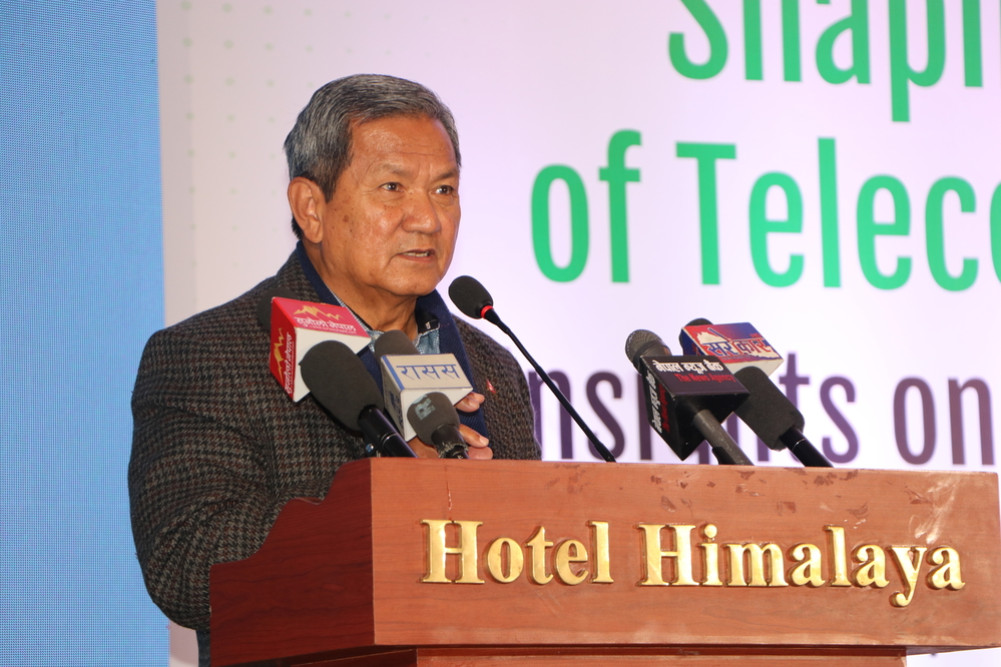
Speaking at the 'Building the Future of Telecommunications: Insights into Policy and Innovation' program organized by Tekpana on Thursday, Minister Gurung said that the old Telecommunications Act will be amended and a new Act will be introduced within this year. "I will draft a new bill on telecommunications this year anyway and deliver it to the House," he said, "the telecommunications sector cannot be transformed without amending policies and laws."
Minister Gurung said that together with the Telecommunication Act, the bills related to broadband policy, Digital Nepal Framework, cyber security will also be made appropriate. The ministry has already prepared the draft bill in these areas in August, but it is of the opinion that it is being delayed due to the bureaucracy and administrative delay. 'The goal is to amend new policies and laws within this financial year,' he said, 'There is no need to go to parliament for policy making. We leave the laws that need to be amended to the parliament.' He also asked to make suitable suggestions for policy making and law amendments.
Minister Gurung suggested the service providers to change their working style as the telecommunication market has changed. He pointed out that telecom operators and Internet service providers are competitors rather than enemies of each other amid complaints that voice income is decreasing due to OTT.
He also suggested the Nepal Telecommunication Authority to regulate the telecommunication sector and not only to penalize the service providers but also to facilitate them. "The authority should not only make sure that service providers have to pay taxes and royalties, they should create a working environment for service providers and facilitate them," he said, adding that service providers should also fulfill their obligations.
Gurung emphasized that operators and regulatory bodies should end the trend of treating each other as enemies and maintaining enmity. "The kind of conflict between the operator and the regulator is the root of the problem in this area," he said, "These two should cooperate, each considers the other as an enemy, they have animosity, they always stand against each other, and there will be lawsuits." As long as all this is happening, the IT sector cannot develop .'
Similarly, speaking in the program, Communications Secretary Radhika Aryal said that it is necessary to amend the Telecommunication Act and Regulations. She asked the service providers to work in an innovative way. Suggesting the implementation of 5G and Digital Nepal, she said that in the next era, the telecommunication regulator should be the regulator of the digital sector.