According to the service provider company Nokia, this system is designed to withstand the harsh environment of the moon, extreme temperatures and radiation
We use Google Cloud Translation Services. Google requires we provide the following disclaimer relating to use of this service:
This service may contain translations powered by Google. Google disclaims all warranties related to the translations, expressed or implied, including any warranties of accuracy, reliability, and any implied warranties of merchantability, fitness for a particular purpose, and noninfringement.
Nokia has finalized its ambitious plan to extend 4G communications service to the moon. By this February, Nokia has completed the work of connecting its 'Lunar Surface Communication System' to the base station named 'Athena' built on the moon in order to launch 4G service on the moon, according to the company's statement. It is expected to usher in a new era in space communication technology.
The project, run under NASA's 'Tipping Point' program, is about to establish the first cellular network on the surface of the moon. According to Nokia, this system, which uses the latest 4G/LTE technology from Nokia Bell Labs, has been designed to withstand the harsh environment of the moon, extreme temperatures and radiation.
Due to the distance between the Earth and the Moon, it takes about one and a half minutes to exchange messages from the Moon to the Earth, according to NASA, the American space agency. It is claimed that this technology of Nokia will provide a reliable service as there are problems in the radio waves of the currently available technology and there are frequent communication interruptions.
For the expansion of 4-G on the moon, about 141 million US dollars will be spent and NASA will bear all the expenses. Nokia has contributed technology to provide reliable communications services to NASA as it prepares to conduct ambitious missions to the lunar surface, including the south pole, and manage a lunar settlement.
Once known as the most powerful brand in the mobile phone market, Nokia has been developing network infrastructure, telecommunications technology and enterprise solutions for the past few years. The company sold its mobile phone business to Microsoft in 2014. Currently, Nokia is considered to be the world leader in 5G network infrastructure development. Nokia said that in 2079, it will also help Nepal in the expansion of 5G.
For the 4G project, Nokia collaborated with an aerospace company called Intuitive Machines to deliver and connect equipment to the moon. In April 2026, NASA is going to send four astronauts to orbit the moon for 10 days through the 'Artemis-2' mission.
 Intuitive Machine's 'Visual Display' of Nokia's 4G communication device carried by 'IM-2 Lunar Lander'.
They will test a spacecraft called 'Orion' and other technologies. This is a 'fly by' mission, i.e. orbiting from above without landing. In the year 2027, NASA is conducting the 'Artemis-3' mission to put a human foot on the surface of the moon after about 55 years. A strong communication service is going to be built for this as well.
For other missions to the Moon, NASA is also planning to build a Lunar Gateway, an Artemis Base Camp for astronauts to stay on the Moon for long periods of time, and commercial cargo transport facilities. Scientists believe that Nokia's 4G feature is important for all these.
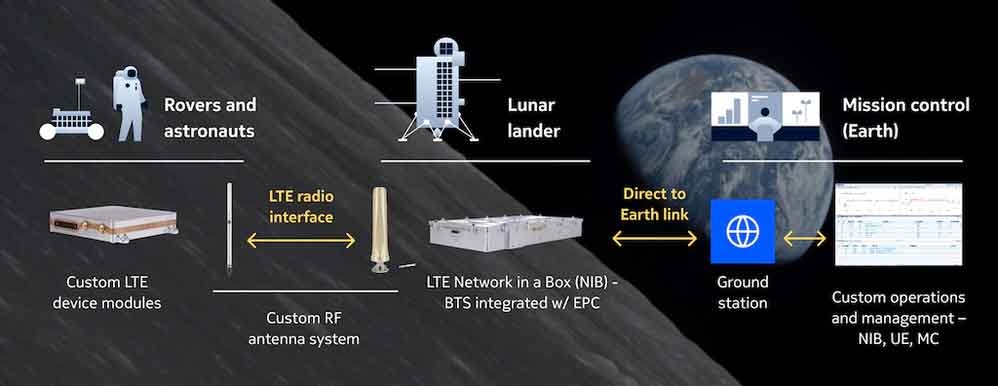
Moon's 4-G/LTE system was installed by Nokia on the Intuitive Machine's 'Nova-C' lander, as mentioned on the company's website. The system will provide seamless communication between the lander and the rover and provide live data and images to mission controllers on Earth.
On February 26 from the Kennedy Space Center in Florida, Nokia Bell Labs has announced that preparations for sending this technology to the moon have been completed by placing it on SpaceX's Falcon-9 rocket. A lander called 'Athena' will help land the technology sent from Earth on the surface of the Moon's south pole and attach it there. After landing on the lunar surface, Nokia and NASA are preparing to activate the communication system in a box with the help of the rover from the lander.
For now, Nokia's 4-G/LTE network will establish communication facilities at 10 to 100 Mbps download and 5 to 50 Mbps upload speeds, the company said. In the initial stage, the communication facility is only available from the south pole of the moon towards the earth, information is kept on the website of Nokia Bell Labs.
Thierry Klein, president of Nokia Bell Labs Solutions Research, said about the importance of this project, "As much as accommodation, food and ease of living are essential, communication facilities will also be essential for future missions to the moon or Mars." We are adopting a new way to extend the same technology used to connect billions of smartphones on Earth to space. It will reduce the distance between Earth and space.
Nokia's project is the latest in a competitive race in the space-based Internet business. Companies like SpaceX, Amazon and OneWeb are also actively involved in this race. These companies are installing and operating satellites in 'low earth orbit' to bring high speed internet to remote and underserved areas of the earth. The Starlink project, which is also trying to come to Nepal, aims to create a global broadband network by placing more than four thousand satellites in space.
Establishing a high-speed 4G/LTE network on the moon will make it easier to connect astronauts to Earth, Russell Ralston, Executive Vice President of Axium Space, told GSMA's Mobile World Live. He believes that this will facilitate the exchange of important data as well as enable high-quality video communication over long distances.
Scientists are working on a long-term stay on the moon and making it a base area to reach other planets and moons, including Mars. Russell concluded that having a 4-G facility on the surface of the moon could be an important achievement for countries like the US and China.
(with agency help)

