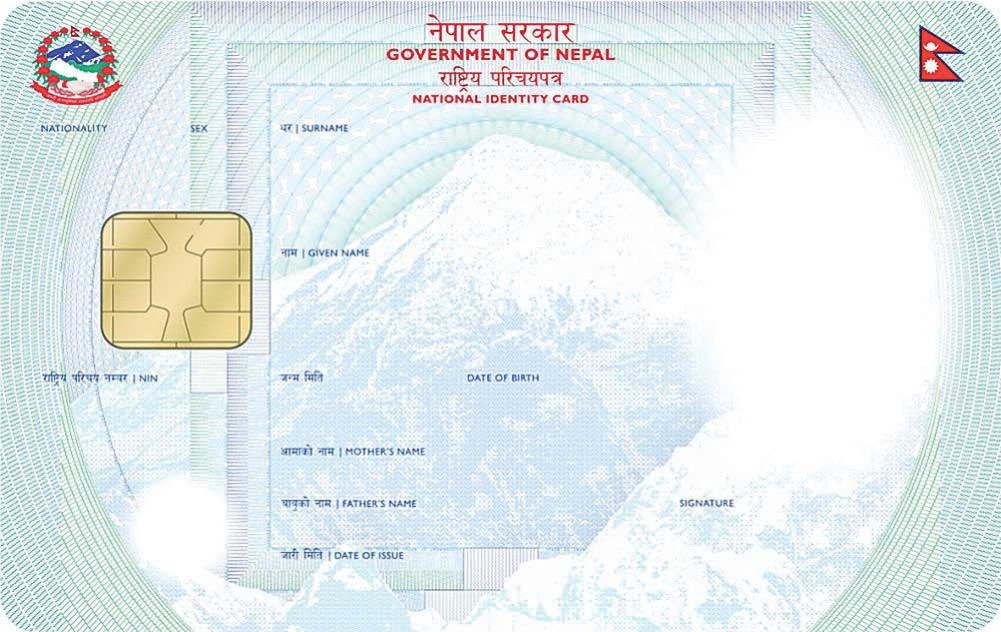
Ensuring that the national identity card will be implemented in public services, spending 7 billion rupees from the government's annual budget for the identity card
We use Google Cloud Translation Services. Google requires we provide the following disclaimer relating to use of this service:
This service may contain translations powered by Google. Google disclaims all warranties related to the translations, expressed or implied, including any warranties of accuracy, reliability, and any implied warranties of merchantability, fitness for a particular purpose, and noninfringement.
The full bench of the Supreme Court has issued a mandate in the name of the government to make arrangements so that citizens do not have to face hassles in public services due to the lack of national identity cards.
A joint bench of Chief Justice Prakashman Singh Raut, Justices Abdul Aziz Muslim and Nripadhwaj Niraula dismissed the writ against the government's decision to implement the National Identity Card on the 6th of last year. With the cancellation of the
writ, the way was opened for the implementation of the government's decision to make identity cards mandatory in public services. But it was ordered through full text on Friday to make the identity card compulsory only so that the citizens do not have to suffer in order to get public services. While addressing some of the questions raised by the
writ, the full text of the mandate states that the hassle, discomfort and difficulty faced in public service delivery due to the absence of identity cards should be put an end to. The Supreme Court has issued a mandate in the name of the Prime Minister's and Cabinet Office, the Ministry of Home Affairs and the Ministry of Law to inform the citizens effectively about obtaining identity cards.
According to the decision of the Council of Ministers on May 24, it was announced that the identity card will be mandatory for citizens to get public service facilities by publishing a notice in the gazette on June 10. Last August, the Supreme Court had ordered the government not to make identity cards mandatory in a petition filed against the government's decision to make identity cards mandatory from last July. At that time, the government had issued a notice to make identity cards mandatory for pensions, social security allowances and other services.
The court dismissed the writ at that time and published the full text. The full three-point text mainly covers the issue of citizens not having to suffer while applying the identity card. Supreme Court has ordered to protect electronic details and privacy of individuals.
The petitioner demanded that the decision to implement the circular should be annulled, saying that the personal details will not remain confidential, giving more attention to its security. In this context, the Supreme Court has ordered to arrange policy, legal and structural arrangements to ensure the protection of personal electronic details and privacy. The order also mentions to strengthen the management side to prevent misuse and unauthorized use of
information. The court has also asked to pay attention to the security of the systems of other agencies that use the identity card number. It has been ordered to collect the biological details of a person by reaching a point near the civilian residence saying that sufficient units and stations should be set up while collecting details for identity cards.
The government started the trial from 2015 and started printing cards through tender from 2017. Under this program, the government has already spent about 7 billion rupees. According to the National Identity Card and Registration Department, the personal details of about 17 million citizens have been collected. 55 lakh identity cards have been printed. Yuvraj Kattel, director general of the department informed that the distribution of identity cards of 2.5 million citizens can be viewed on the citizen app.
He said that the card has already reached 5 lakh citizens. At present, biometrics is being taken from 77 district administration offices, 54 locality administrations, Narayanhiti, Bhrikutimandap, and ward offices in Kathmandu Valley. The problem of taking an identity card number for a passport but not coming to get the card because he went abroad is also increasing.
"It is assumed that some people did not come to get the card because they are not in the country," says the department source. Kattel says that the campaign for distribution of identity cards has been carried out except in Mugu, Humla and Dolpa. He said that 8 to 9 thousand identity cards are printed daily. The government has made the national identity card mandatory for all public services, including the pension system, making passports, receiving social security allowances, opening bank accounts, and registering companies.
The details of the driving license have also been arranged to appear in the identity card. Interconnection has also been made between the identity card and the Citizen app. The full text of the Supreme Court has confirmed that identity cards are mandatory for all public services provided by the government.