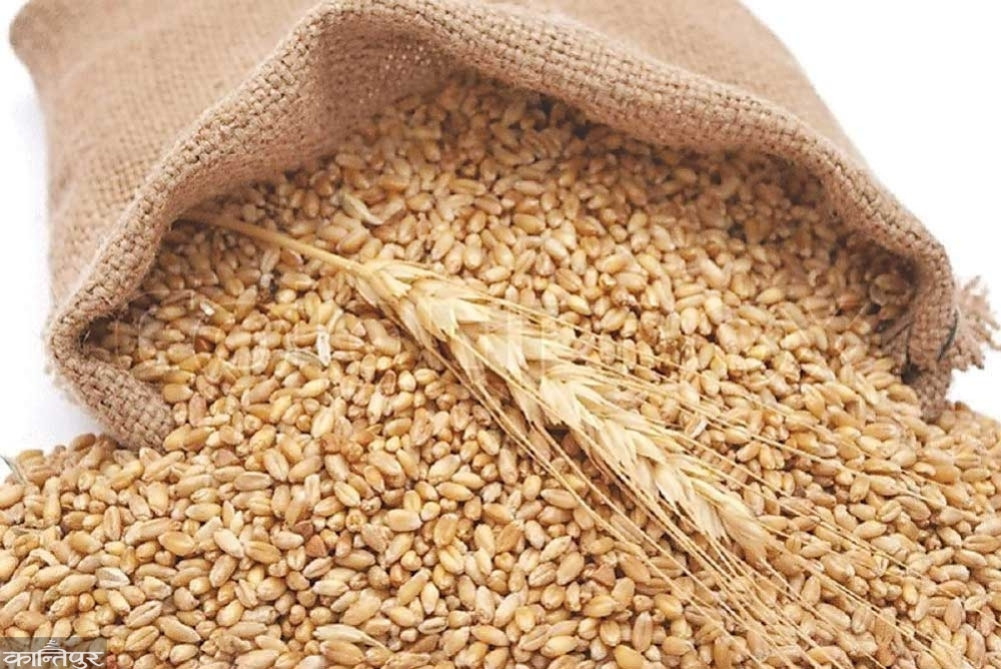
200,000 tons of wheat are being imported from India to control the price, commerce has opened an application to bring 90,000 tons of wheat
We use Google Cloud Translation Services. Google requires we provide the following disclaimer relating to use of this service:
This service may contain translations powered by Google. Google disclaims all warranties related to the translations, expressed or implied, including any warranties of accuracy, reliability, and any implied warranties of merchantability, fitness for a particular purpose, and noninfringement.
After only three months of domestic production, the government is going to import 200,000 tons of wheat from India. Commercial Supply and Consumer Protection Department will import 90 thousand tons, Industry Department will import 100,000 tons and Salt Trading will import 10 thousand tons.
"According to the quota received by commerce, we have already published a notification on Monday for 90,000 tons. Interested firms/companies can apply to the department within 7 days," said Rajan Paudel, Director General of the Department of Commerce, "Interesting companies will be allowed to import a minimum of 100 tons and a maximum of 10,000 tons of wheat.
He said that the paid-up capital of a firm or company that wants to import in this way should be at least 1 crore rupees. The department has said that financial resources should be ensured as 100% advance payment has to be made to National Cooperative Exports Limited for wheat import. Imports should be completed within 3 months from the date of receipt of quota. Commerce will allow imports for commercial use. The Industries Department will import for industrial purposes and Salt will also import for commercial purposes.
According to the Department of Commerce, the price of wheat in Nepal has gone up after India stopped exporting it. Director General Paudel said that they are going to bring wheat from India to control the price. Since February 2078 (after the start of the war between Russia and Ukraine), the price of wheat started to rise. The price is the highest so far," Director General Paudel said, "Swadeshi production does not last even three months. We are importing wheat from India to meet the demand and control the price.'
India banned the export of wheat in 2079. India, the world's second largest producer of wheat, has said that it has banned exports in view of rising prices and food security in the country. India has said that it has kept a 'restrictive' quota on wheat exports for the overall food security management of its country and to help neighboring and vulnerable countries.
According to the Indian media, buyers from all over the world are trying to buy wheat from India after the decrease in shipments from the "Black Sea" region due to the Russia-Ukraine conflict. India has also banned exports keeping food security in mind. After India's ban, it has affected the market price. According to the Retail Trade Association, the price of wheat in February 2078 was Rs 50 and flour was Rs 55. In Chait 2078, the price of wheat increased to Rs 55 per kg and flour to Rs 60 per kg. By January 2081, the price of wheat has increased to Rs 75 and flour has reached Rs 90.
'Now the price is high, even though there is a ban, it has come illegally due to the open border. But the consumer had to pay higher prices, along with the state also lost revenue," Director General Paudel said, "taking all these into consideration, the government got permission to import wheat from India. The main problem is production. Even though India banned exports, Nepal was allowed to import 50,000 tons annually. After the quantity was insufficient, last year it demanded 3 lakh tons. 2 lakh tons out of 3 lakh have been allowed.
According to the Ministry of Agriculture and Livestock Development, compared to the financial year 2078/079 and 2079/80, the area planted with wheat has also decreased along with the production. In 2078/79, wheat was cultivated in 7 lakh 16 thousand 978 hectares. 21 lakh 44 thousand 568 tons were produced from that area. In 2079/80, the area planted with wheat decreased to 697 thousand 762 hectares. It is mentioned that along with the area, the production has also decreased to 2098 thousand 462 tons.
The ministry is yet to release the area of wheat production for 2080/81. But the minimum support price of wheat has been fixed at Rs 3,867.38 per quintal. The meeting of the Council of Ministers held in the last week of January said that the price has been increased by Rs 217.24 per quintal from last year. In December 2080, the price of wheat per quintal was fixed at Rs 3,650.14.
But there is a huge difference between the support price set by the government and the market price. Farmers have received Rs 39 per kg while consumers have to pay Rs 75 per kg while purchasing. Experts say that this is the reason why wheat production has not increased. According to the customs department, in 2078/79, wheat worth Rs 695.2 million was imported. In 2079/80, there was an import of 280.9 million rupees. Likewise, in 2080/81, imports increased to 2.73 billion 31 lakh rupees.