MP asks - 'Who has access to the biometric and other details of millions of citizens, what to do in case of hacking, what are the security arrangements?'
We use Google Cloud Translation Services. Google requires we provide the following disclaimer relating to use of this service:
This service may contain translations powered by Google. Google disclaims all warranties related to the translations, expressed or implied, including any warranties of accuracy, reliability, and any implied warranties of merchantability, fitness for a particular purpose, and noninfringement.
The parliamentarians have expressed apprehension about the security of the details of the National Identity Card, which is mandatory for various services. In the State Order and Good Governance Committee meeting of the House of Representatives, the MPs expressed serious concern about the delay in the national identity card system, security challenges and management weaknesses.
They have a special interest in whether the personal details of citizens are protected.
The parliamentarian questioned the government about who has access to the biometric and other details of millions of citizens that the government is collecting for identity cards, what to do in case of hacking, and what are the security arrangements. After Yuvraj Kattel, director general of the National Identity Card and Registration Department, said that it is difficult to maintain skilled manpower such as engineers in the field of information technology in the department, the parliamentarians were still suspicious about data security.
Nepali Congress MP Hridayram Thani opined that the lack of skilled manpower and resources in the department that gathers all the details of citizens is not good. "Out of 15 employees, 10 engineers will leave their jobs, and only 5 people will work, how can we confidently give the details," he said, "All our details have been taken and put in the identity card, it was heard that the resources are not enough." The attention of the state should go to such sensitive and high-priority technology.'
Stating that the government built a national ID card system through a French company in 2017 and that 7 billion rupees have been spent on it so far, MP Thani raised the question of who is taking charge of the personal data protection of citizens. "The data of the country did not go outside the country, if all the details are kept in one place, what will happen to the country if it gets hacked?"
Member of Parliament of Maoist Center Durga Rai has expressed serious concern about the problem of lack of staff in government IT services and security challenges of citizens' data. "We have given our eyes, all finger details, we have provided all the personal details," she said, "Now the government should be serious about how to protect these details and how to guarantee security to citizens."
Congress MP Dilendra Prasad Badu sought clarity on the government's preparations regarding the need for technological identity cards, data security and its impact in remote areas. He also raised the question of the use of biometric technology and the need for collecting personal details. "In the identity card, from the retina of the eye, all ten fingerprints are taken, it keeps all the details of the person in one chip, which can have a serious effect on the life of the technological risk," he said.
UML MP Raghuji Pant expressed doubt that after going to digital technology, there will be some risks, but if the contract is given to foreign companies for the installation and operation of such sensitive systems, the data will be safe. "China has kept the data of its citizens with itself because of national security problems, we have not been able to do that," he said, "because of this, all our data is not safe." Since all the details from biometrics go to the national identity card, it is a matter of interest to everyone how the security system is.
Rashtriya Swatantra Party MP Chanda Karki Bhandari pointed out that the government should also pay attention to the practical aspects of the process of filling the form for identity cards, such as the inconvenience experienced by disabled and disabled people. 'Who is hosting our data and who has access to it?' she said, 'We need clarity on such basic questions.'
Noting that she has not received the card even after two years of filling the form for the identity card, Congress MP Ishwaridevi Neupane said that the citizens of remote areas are facing difficulties due to the card. "I had filled the form from Kailali, but it became more uncomfortable even though I was told that it would be easy by the district," she said She also drew the attention of the government.
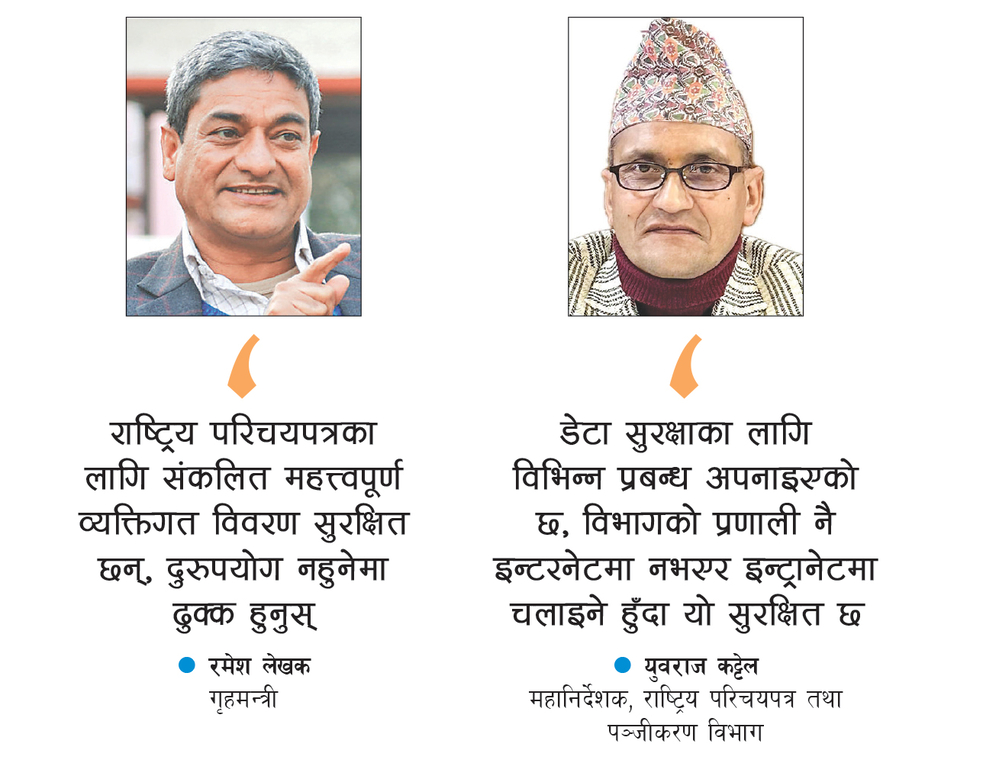
Home Minister Ramesh Akhtar urged to ensure that the important personal details collected for the National Identity Card are protected and not misused. He said that the government has taken responsibility to protect the personal details of the citizens. He explained that the national identity card is mandatory to provide easy and simple services to the people, to control crime and effectively implement the issue of money laundering.
"The government is serious about the problem of data leakage and the problem of access to the server," he said, "The government can keep the citizens' data." If the data is not kept, where is the citizen? What are his parents' names? The government should know where the house is.
Director General of National Identity Card and Registration Department Yuvraj Kattel also claimed that various arrangements have been adopted for data security. He says that it is safe because the department's system is run on the intranet and not on the internet. "We have such an infrastructure that encrypts the details in the system," he said, "The department has its own server system. Data is backed up to its failover server integrated data management center and disaster recovery server at Hetaunda. Even if the whole system collapses, we can recover because the backup is strong. Director General Kattel said that details of more than 16.5 million citizens have been collected through
National Identity Management Information System. He also said that more than 6 million ID cards have been printed so far and 5.5 million cards have been sent to different districts.
He says that only 2 million cards have been distributed so far. He claims that work is being done rapidly in Jhapa, Chitwan, Kanchanpur, Morang and Kathmandu to make the distribution of identity cards effective across the country. He also said that since the settlements are scattered in Mugu, Dolpa and Humla, the work of collecting the details is still pending.

