It is claimed that the voltage of the country's integrated electricity system will be improved and the electricity will be sufficient, reliable and of good quality
We use Google Cloud Translation Services. Google requires we provide the following disclaimer relating to use of this service:
This service may contain translations powered by Google. Google disclaims all warranties related to the translations, expressed or implied, including any warranties of accuracy, reliability, and any implied warranties of merchantability, fitness for a particular purpose, and noninfringement.
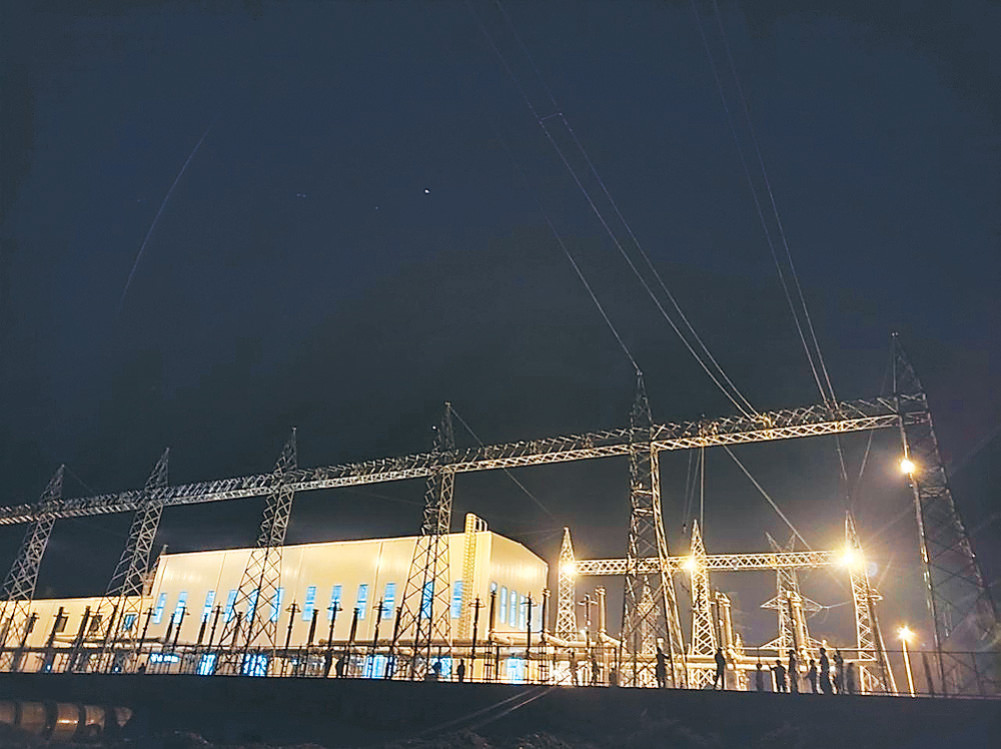
Construction of 220/132 KV substation based on Gas Insulated System (GIS) technology has been completed at Markichok of Ambukhareni Rural Municipality of Tanahun. The Markichoke substation built under the Marsyangdi-Kathmandu 220 KV transmission line project has been put into operation by supplying electricity.
The Marsyangdi-Kathmandu 220kV double circuit transmission line from Markichoke substation to Kathmandu has also been charged at 220kV and put into operation on Tuesday to bring the power of the hydropower project in the Marsyangdi river catchment area to Kathmandu valley.
The 82 km transmission line was charged at 132 kV from 7 June 2079 and put into operation. With Markichoke substation charged, Marsyangdi-Kathmandu transmission line has been put into operation at 220 kV.
In order to supply the power of the hydroelectric projects in the Marsyangdi river watershed area to Kathmandu Valley and to strengthen the integrated power system in the country, a transmission line and a 220/132 kV substation have been constructed in Markichoke and Matatirth of Kathmandu under the Marsyangdi-Kathmandu 220 kV transmission line project.
Matatirtha substation has been completed and has been operational since last May. Two/two power transformers of 160/160 MVA capacity are installed in both the substations. Both the substations have a capacity of 320/320 MVA. Executive Director of Nepal Electricity Authority, Kulman Ghising, said that with the commissioning of Markichoke substation, infrastructure has been created to bring electricity from the hydroelectric projects of the Marsyangdi River Corridor to the Kathmandu valley through the 220 kV transmission line.
According to Ghising, the voltage of the country's integrated electricity system will be improved and the electricity will be more sufficient, reliable and of good quality. He said that after the completion of Markichoke-Bharatpur section which is under construction under the Marsyangdi Corridor transmission line project, electricity can also be sent to Bharatpur. Markichoke-Bharatpur section is being worked on with the goal of completing the construction by next May.
The Marsyangdi-Kathmandu transmission line from Markichoke to Bondbhanjang in Chandragiri municipality and the Trishuli-Kathmandu 220 kV transmission line built to bring the power of the hydroelectric projects in the Trishuli river catchment area to the Kathmandu valley have been interconnected at Bandbhanjang. Trident and
Both transmission lines of Marsyangdi have been connected to multi-circuit (four circuits) from Bandbhanjang and included in Matatirtha substation. MW electricity through multi-circuit transmission line to Matatirtha will be included in the substation.
After the performance of the company that was awarded the contract for the construction of Matatirth and Markichoke substation under the Marsyangdi-Kathmandu transmission line project was not satisfactory, the contract was terminated and a new contract was signed with China Masonry Engineering Corporation in December 2077, and the rest of the construction was moved forward.
The estimated cost of both substations is around 2.5 billion rupees, said project head Laxman Phuyal. The Marsyangdi-Kathmandu transmission line project was started with the investment of the Nepal government and the authority and the subsidy of the Norwegian government and the concessional loan of the Asian Development Bank.