We use Google Cloud Translation Services. Google requires we provide the following disclaimer relating to use of this service:
This service may contain translations powered by Google. Google disclaims all warranties related to the translations, expressed or implied, including any warranties of accuracy, reliability, and any implied warranties of merchantability, fitness for a particular purpose, and noninfringement.
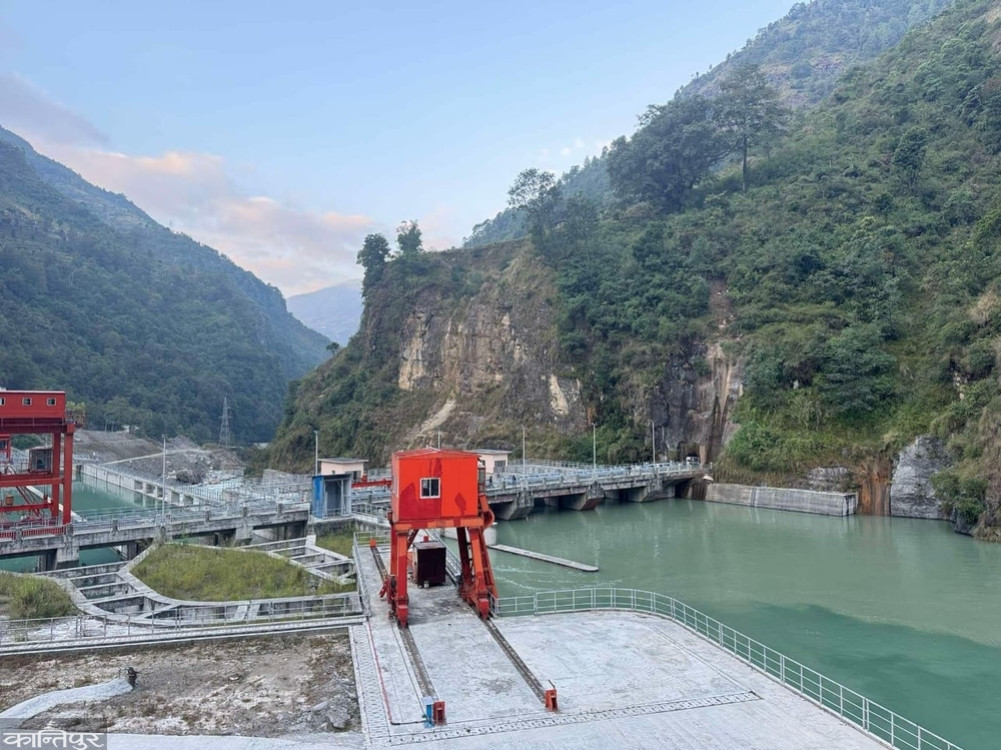
After the water leaked twice during the tunnel test, local investors drew attention to the 102 MW central Bhotekoshi project.
Chilime hydropower project is the main promoter of this project, when the water comes out of the tunnel twice a year during the production test, the company and the general public of the district who have invested about one billion have drawn attention to the project.
On behalf of investors, the Sindhupalchok Chamber of Commerce and Industry has given an attention letter to Ramgopal Sivakoti, Chief Executive Officer (CEO) of Bhotekoshi Hydropower Company on Friday.
Who will take the responsibility of not producing electricity from the project even after 13 years of signing the Power Purchase Agreement (PPA)? The union has asked for the reason for the delay in production. President of the association Buddharaj Basnet handed over the attention letter to CEO Sivakoti at the project's central office in Maharajganj. In the memorandum, who will take the responsibility of constructing the tunnel in such a way that it leaks? The question has been asked.
2080 in December 'West During testing, water came out of the tunnel. Even after repairing and trying to refill the water last October, the production has become uncertain due to water leakage. The project, which aims to earn 3 billion per year by selling electricity, is currently paying only about 5 million interest per day. The project has been saying that not only the tunnel is leaking, but the construction of the transmission line has been delayed due to obstruction by the locals.
After the problem of leakage from the tunnel persisted even during the repair, doubts have been raised about the quality of the construction structure of the project. Since the start of construction, the project has been hampered by problems such as local obstacles, earthquakes, covid and landslides, and now it is suffering from tunnel leaks and transmission line construction problems. Basnet, president of the
association, said that the project has neglected to solve the problems of the project, which has received such a large investment from the state agencies, including the district residents. "No one takes responsibility for the bad work, so no matter what they do, the situation has become a situation," he said.
The technicians of the project say that the daily income of more than 8.3 lakhs besides the interest amount has been stopped due to the inability to produce electricity.
Bhotekoshi is affected by the district residents and has more than 1 billion shares through the district residents' company. The "civil work" of the project is being done by China's Guanxing Hydro Electric Construction Bureau. Chilime, Nepal Electricity Authority, Employee Provident Fund, and local companies are the main investment in this project, which was started with the goal of completing it in four years. The
project has already sold shares to those affected and to the general public. The locals created a 14-month obstruction in the construction of the project's transmission line by making various demands. Although the problem was solved some time ago, the locals are obstructing the construction of the transmission line to be constructed by Shivasree Hydropower for Bhotekoshi. The project says that even if the problem of the tunnel is solved, production will not be possible due to the line. It is estimated that the cost will increase to more than 20 billion because the
was not completed within the specified time. Initially, the total investment was estimated at 12 billion 28 billion. The project has paid more than 5 billion in interest only. According to the technicians, the production cost per megawatt is estimated to be more than 200 million.