We use Google Cloud Translation Services. Google requires we provide the following disclaimer relating to use of this service:
This service may contain translations powered by Google. Google disclaims all warranties related to the translations, expressed or implied, including any warranties of accuracy, reliability, and any implied warranties of merchantability, fitness for a particular purpose, and noninfringement.
Nepal Oil Corporation has prepared to bring diesel along with petrol and kerosene from India's Motihari pipeline from the last week of January. The corporation has been importing diesel from Motihari to Amlekhganj through the pipeline since 2076.
Pralayankar Acharya, head of the Madhes regional office of the corporation, informed that the work of bringing petrol and kerosene from the 'Multi Product Pipeline', which was built so that petrol, diesel and kerosene can be imported, has reached its final stage. The corporation has successfully tested the work of bringing petrol and kerosene through the pipeline under the second phase of the project.
Chief Acharya said, 'We have brought petrol and kerosene from the pipeline to Amlekhganj as a trial, and a new pipeline and tank have been built inside the depot for storage. Currently, the work of 'charging' and testing the quality of the meter is being done in that structure.'
The corporation released 5,500 kiloliters of petrol and 1,000 kiloliters of kerosene from the pipeline on 18th October and 1000 kiloliters of kerosene at Amlekhganj on 26th November. Now, the corporation has reached a position where it can bring diesel as well as petrol and kerosene through continuous pipeline. Considering the sensitivity of petroleum products, detailed testing is currently being done.
'We are closely monitoring whether there may be small 'leakage'. There is a plan to open the second phase of the pipeline project in the last week of this month. After this, petrol and kerosene oil will come gradually through the pipeline,' Acharya said, 'It is considered much safer to import petroleum products through the pipeline as compared to truck tankers . When the fuel starts coming from the pipeline, problems such as truck tanker accidents, fuel theft and adulteration and environmental pollution will end.'
6,000 kiloliters of petroleum products can be brought to Amlekhgunj daily through the pipeline, but due to the lack of demand for petroleum products, the pipeline is not operating at full capacity. "The corporation has not reached the point where it has to import 6,000 kiloliters of petroleum products per day," said Chief Acharya, "Once diesel, petrol and kerosene are imported through the pipeline, it can operate at full capacity."
It is said to be the first inland pipeline project in South Asia, with a total length of 69.2 km. Of this, 33 km towards India and 36.2 km towards Nepal. On 24 August 2076, the then Prime Minister KP Sharma Oli and his Indian counterpart Narendra Modi jointly inaugurated the project.
Nigam's Madhes regional depot Amlekhganj has been supplying fuel to Biratnagar, Bhairahawa, Thankot, Pokhara, Birganj, Janakpur depots. From Amlekhganj, petroleum products are also being sold and distributed for local level pumps.
Amlekhganj depot in full 'automation'
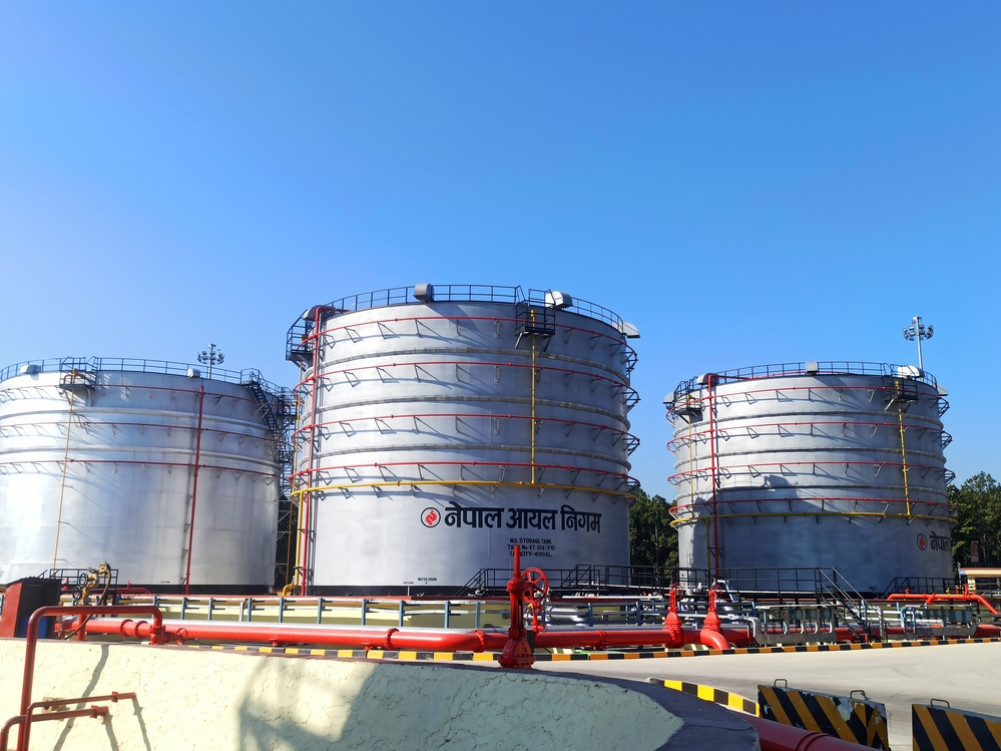
The Amlekhganj depot, which has been operating for nearly five decades, is going into full 'automation' . As part of the second phase of the pipeline project, four new 'vertical tanks' have been constructed at the depot for storing petrol, diesel and kerosene. To maintain the purity of the petroleum products brought from the pipeline, two 'transmix tanks' and a fire control system have been arranged.
Engineer of the project Prashant Bhattarai informed that 24 more fully automatic 'loading-ways', state-of-the-art laboratory and other structures have been built to fill the tanker with fuel. "Top filling and bottom filling have been arranged for filling petrol and diesel tankers in 24 loading ways," he said.
The construction of Amlekhganj depot was started in the year 2030 to ensure easy supply and distribution system of petroleum products in the country. The depot spread over an area of about 67,724 square meters was completed and put into operation from January 2033. It is the largest depot in the country.
The Amlekhganj depot currently has a storage capacity of 15,100 kiloliters of petrol, 24,800 kiloliters of diesel and 2,270 kiloliters of kerosene. The government has put forward a plan to expand the storage capacity to meet the demand of at least three months in all seven provinces. According to the same plan, the Corporation is currently carrying out storage capacity expansion programs in various provinces.
Amlekhganj-Lothar Pipeline Expansion Plan to expand the pipeline from Amlekhganj to Lothar in Chitwan under the third phase of the
pipeline project is under implementation .
Indian Oil Corporation's expert team has come to Nepal to assist in the petroleum pipeline expansion project up to Lothar. "It seems that a survey should be done again for the expansion of the project, the forest and reserve areas on the way to the pipeline are also being studied," said Chief Acharya.