We use Google Cloud Translation Services. Google requires we provide the following disclaimer relating to use of this service:
This service may contain translations powered by Google. Google disclaims all warranties related to the translations, expressed or implied, including any warranties of accuracy, reliability, and any implied warranties of merchantability, fitness for a particular purpose, and noninfringement.
Until production starts from the 456 MW upper Tamakoshi, there will be power cuts in the industrial area during the evening hours (peak) when there is more electricity demand.
With the onset of winter, when the water in the rivers and streams decreases, the production capacity of the run-of-river (ROR) hydropower projects in the country will decrease by one-third.
Due to the cold weather, the demand for electricity will increase at this time, but the production of hydropower projects, which have the largest share in Nepal's electricity system, will decrease . In order to manage the demand and supply of electricity during winter, electricity should be imported from India at this time.
The Executive Director of Nepal Electricity Authority, Kulman Ghising, said that there is a problem in power management during the winter peak period due to the shutdown of production from the largest 456 MW upper Tamakoshi among the hydropower projects that are still operating this year. Executive Director Ghising made it clear that there is no need to cut electricity supply to customers other than industrial during peak times.
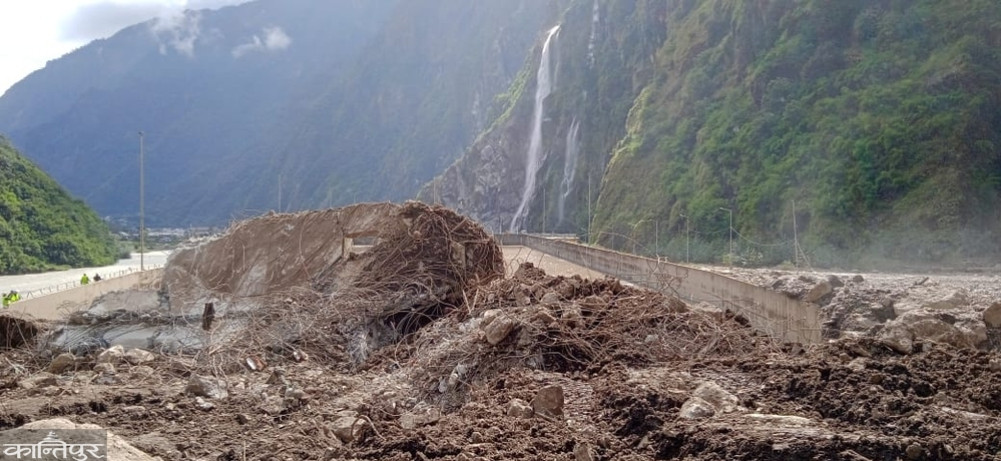
Last October 11th and 12th due to incessant rain, the structure of upper Tamakosi was damaged . Maintenance of upper Tamakosi is being done to start electricity generation within 10th of January and to run it during peak time within 15 days. The project can be run at full capacity for 4 hours during the peak time by collecting water during the time of low electricity demand .
The Central Electricity Authority of India has allowed the Nepal Electricity Authority to import electricity up to 654 MW daily through the Dhalkebar-Muzaffar 400 KV cross-border transmission line and 54 MW through the Tanakpur-Mahendranagar 132 KV transmission line till the next Chait 2 (15 March 2025).  ; However, during the peak time from 5 pm to 9 pm, electricity cannot be imported. After 3 Chait 2081 - 16 June 2082 (16 March - 30 June 2025) permission has been given to import only during solar hours i.e. from 6 am to 6 pm .
Executive Director Ghising said that the upper Tamakoshi is also closed and because they cannot even import electricity from India for 4 hours during the peak time, a forced situation has arisen in which the power of the industrial sector has to be cut.
'We have not received permission to import during the peak time, if the upper Tamakoshi was in operation, we could have imported more water in the afternoon and collected water in the Tamakoshi reservoir and used it during the peak time. There is a situation where electricity has to be cut. Power supply was affected in Bara and Parsa industrial corridors of Chundinda Dhalkebar West. After repairing the line and putting it into operation from Monday afternoon, the electricity supply has been regular.
Under the 132 KV transmission line from Chamelia in Darchula to Attaria in Kailali, a circuit has been damaged due to the fall of a tree at a place called Baitadi Khochlek. The said line is being repaired .