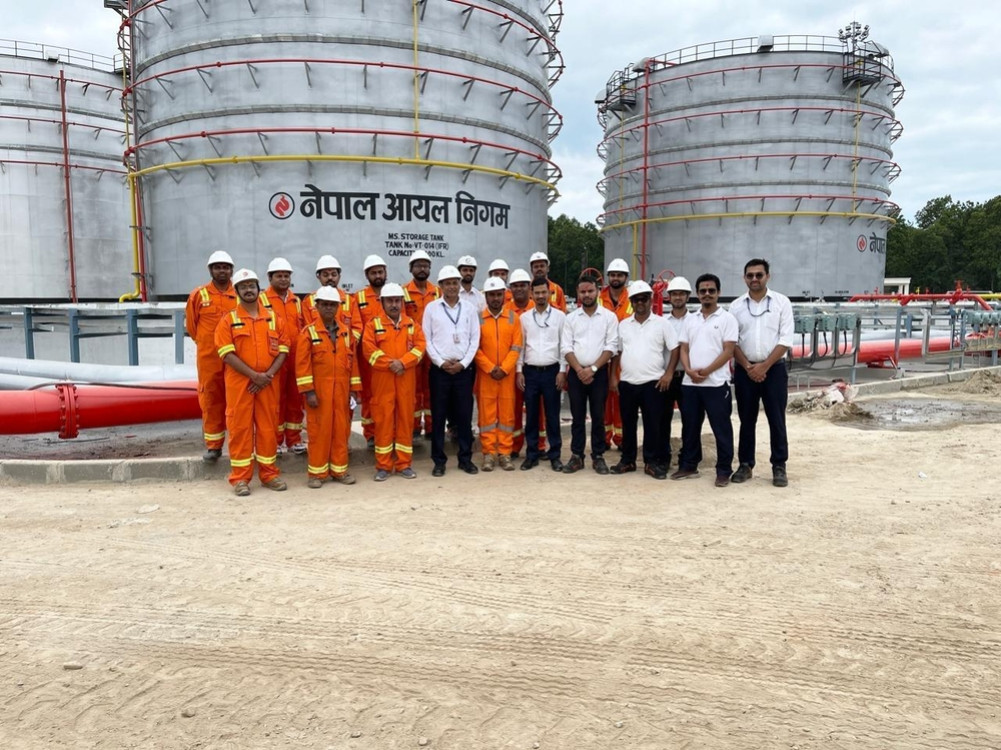
For the first time, we brought petrol from the pipeline and tested it from the loading way. We will open it by December: Chandika Bhatt, Executive Director, Nepal Oil Corporation.
We use Google Cloud Translation Services. Google requires we provide the following disclaimer relating to use of this service:
This service may contain translations powered by Google. Google disclaims all warranties related to the translations, expressed or implied, including any warranties of accuracy, reliability, and any implied warranties of merchantability, fitness for a particular purpose, and noninfringement.
The Amlekhganj fuel depot, which was operational three and a half decades ago, is now going to be fully automated. As part of the second phase, Nepal Oil Corporation has built four more tanks, loading-way, state-of-the-art laboratory and other infrastructure to import petrol and kerosene through the petroleum pipeline, and has moved to depot automation.
Pralayankar Acharya, head of the regional office of the corporation in Amlekhganj, said that 24 'loading-ways' have been constructed for complete automation in loading.
There are 36 filling points in 24 'loading-ways'. Out of this, 7 bottom loading and 8 top loading of petrol can be done. 4 bottom and 14 top loading of diesel can be done. According to Acharya, there is only one top loading of kerosene. With the construction of infrastructure, Amlekhganj depot has become the largest fuel depot in the country. This is also the first depot to go for full automation in loading, said Acharya.
Amlekhganj depot was started in 2030. The construction of the fuel depot spread over an area of 67,724 square meters was completed in 2033. At that time, the storage capacity of the depot was only 4,480 kiloliters. In 2055, the capacity of the depot was expanded to 23 thousand 230 kiloliters.
The capacity of the depot was further expanded with the operation of the much awaited Nepal-India international petroleum pipeline project. The pipeline was officially inaugurated on August 24, 2076. However, under the second phase, construction work including depot construction, loading-way, laboratory, etc. was left. Under the second phase, the goal is to import petrol and kerosene through the pipeline.
An agreement has been reached for the second phase of the project to be jointly invested by the Indian Oil Corporation (IOC) and the Corporation. According to this, there is an agreement that the corporation will invest 1 billion 54 crores and IOC will invest 75 crores. The IOC has entrusted the infrastructure development of the project to the Indian company Likhita International. Although there was an agreement to build the project by March 2024, there was a delay. Chandika Bhatt, executive director of the corporation, said that about 98 percent of the work has been completed to operate
in full automation. The work to go to automation is in the final stage, 98 percent of the work has been completed. For the first time, petrol was brought from the pipeline and tested from the loading way,' said Bhatt, 'now we are waiting for the IOC's time for the inauguration.'
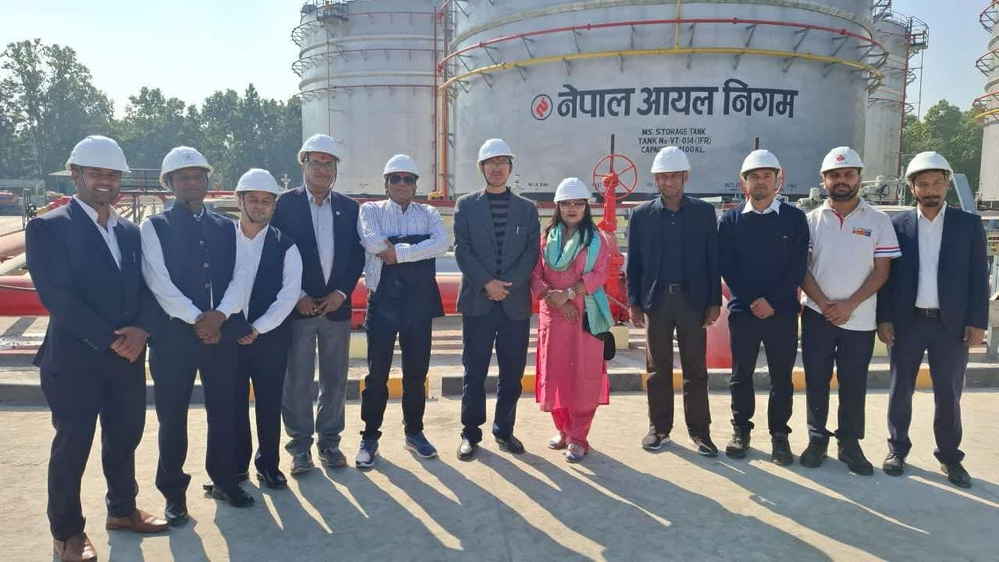
The project under the second phase is being inaugurated by Prime Minister KP Sharma Oli. Bhatt said that if not the last week of December, it would be inaugurated in the first week of January. On Monday also, a team led by Commerce and Supply Secretary Govinda Bahadur Karki along with Executive Director Bhatta inspected the progress of the project. The depots of
corporation are being operated manually. According to the corporation, it is necessary to move towards automation with the development of technology. After going through the automation, the driver gets a gate pass according to the 'loading-way'. After showing the card, they can enter to fill fuel. After that, it is said that you can fill the fuel yourself. In the manual, the employees of the corporation should sit down and open the lid. The staff should sit on the tanker to do the deep test," said Bhatt, "but when going to automation, there is no need to do the deep test. Employees do not have to stay.
After the construction of the 'loading-way', 5,500 kilo liters of petrol was imported through the pipeline for the first time, says Acharya, head of the regional office of the corporation at Amlekhganj. The petrol arrived on October 17. After the arrival of petrol, it has been tested successfully. At present, only diesel is imported through the pipeline. Petrol is also imported from Pus via pipeline. After bringing the diesel through the pipeline, petrol will be mixed with the pipeline commercial kerosene (PCK). PCK is a high quality fuel and can be mixed with both diesel and petrol, according to the corporation.
The corporation has said that the technical loss from the pipeline will be zero, the transportation cost will be saved and it will also help to reduce environmental pollution. Transportation cost saving, pollution control, quantity and quality assurance, time saving will also be beneficial.
Nepal and India under the leadership of Pradeep Yadav, the head of the Nepal project, 5000 kiloliter petrol and 5000 kiloliter diesel tanks have been built in Amlekhganj.
Amlekhjaganj has 15 thousand 110 kiloliter capacity petrol tank, 24 thousand 840 kiloliter capacity diesel tank and 2 thousand 260 kiloliter capacity kerosene tank. There is also a transmix tank with a capacity of 500 kiloliters and a water tank of 8,400 kiloliters. 600 kiloliters of petrol and 1500 kiloliters of diesel are sold daily from Amlekhganj depot.
depot distributes fuel to 26 districts including Chitwan, Tanahun, Makwanpur, Lamjung, Gorkha, Nawalparasi, Bara, Parsa, Rautahat, Dhading. Also, fuel stock is transferred to the corporation's Biratnagar, Dhanusha, Thankot, Pokhara and Bhalwari offices.