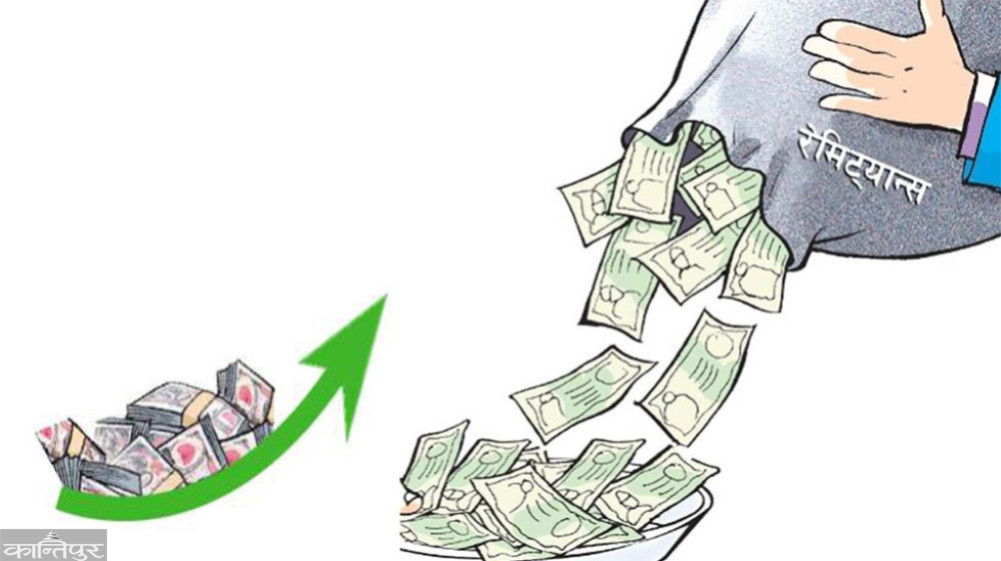
External indicators, including foreign exchange reserves, current account balance, continued to be strong
We use Google Cloud Translation Services. Google requires we provide the following disclaimer relating to use of this service:
This service may contain translations powered by Google. Google disclaims all warranties related to the translations, expressed or implied, including any warranties of accuracy, reliability, and any implied warranties of merchantability, fitness for a particular purpose, and noninfringement.
Although there is no expected improvement in the main sources of foreign exchange earnings including exports, tourism, foreign investment, the external sector of the overall economy is continuously becoming stronger as remittances continue to increase. The monthly economic and financial report released by the Rastra Bank on Thursday showed that external indicators such as foreign exchange reserves, current account, and other external indicators are continuously strengthening.
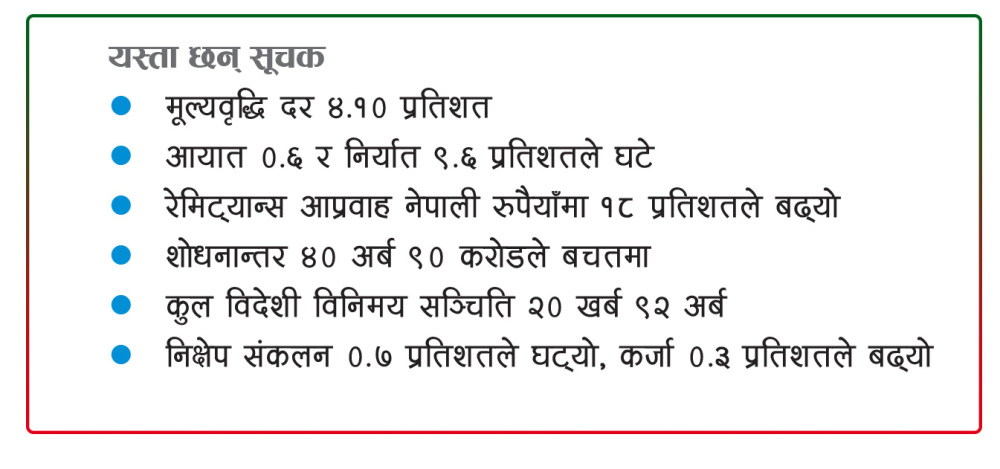
It is mentioned in the report that only 1 trillion 36 billion 93 million remittances entered Nepal last July. Remittances have increased by 18 percent compared to July last year. Remittance inflows increased by 22.8 percent in July 2008. Remittance inflow in US dollars has reached 1.2 billion. Last year, such inflow was 879.8 million," said the Rashtra Bank report.
During this period, the number of Nepalese who took the final work permit (institutional and individual-new) for foreign employment is 36 thousand 928 and the number of those who took the work permit again is 22 thousand 647. During the same period last year, such numbers were 39 thousand 152 and 16 thousand 423 respectively.
In the financial year 080/81, the remittance inflow has increased by 16.5 percent to 14 trillion 45 billion 32 billion entered Nepal. The remittance inflow increased by 23.2 percent last year. For the last one and a half years, more than one billion remittances are coming in every month. For this reason, the external indicators of the economy are continuously becoming stronger even though the situation of other sources of foreign exchange, exports, tourism, foreign investment, foreign subsidies and aid is deteriorating.
 National Bank Research Department Head Gunakar Bhatt said that the economy's indicators have helped to hold the path of economic growth. Indicators such as inflation being controlled, foreign exchange reserves continuing to increase, remittance inflows are good, and interest rates are low show that the economy is on a positive path, he said. In such a situation, he said that if private and government sector resources can be mobilized effectively, it will help in economic growth.
Last July, foreign exchange (currency) reserves reached 20 trillion 92 billion 22 billion. This is an increase of 2.5 percent compared to last June. It was 20 trillion 41 billion 10 crores at the end of 081 June. Such reserves in US dollars increased by 2.0 percent to reach 15.58 billion at the end of July 081, compared to 15.27 billion at the end of June 081.
Based on the imports of the first month of the financial year 081/82, the foreign exchange reserves of the banking sector are sufficient to support 16.7 months of goods imports and 13.5 months of goods and services imports, the National Bank claims. Nar Bahadur Thapa, the former executive director of Rashtra Bank, said that despite the improvement in the external sector index, there was no expected improvement in the overall economy index. "Compared to last year, imports have not increased, revenue has not increased as expected, stock market growth has not been sustainable and has declined again, credit expansion in the private sector has not increased," Thapa said. The cost does not seem to have increased. Therefore, there is little possibility of good economic growth in the current situation.' Thapa says that there is no improvement in the activities of the domestic economy. "The economic activity of the private sector has been critical for the last 2/3 years, there is no possibility of new circulation in the economy until it improves," said Thapa, "the disappointment in the private sector has not improved either." To improve from this situation, the government should pay its obligations immediately. This will help in making the economic activity sustainable. "The government should constantly communicate with the private sector, listen to their problems properly," he said.
Deposits in banks and financial institutions decreased by 43 billion 45 crores (0.7 percent) during the review period. In the same period last year, such deposits decreased by 1 trillion 33 billion 24 crores (2.3 percent). On an annual point basis, deposits in banks and financial institutions increased by 14.9 percent at the end of July 081.
Last July, loans from banks and financial institutions to the private sector increased by 14.11 billion (0.3 percent). In the same period of the previous year, such loans decreased by 4.35 billion (0.1 percent). On an annual point-by-point basis, the credit flow from banks and financial institutions to the private sector increased by 6.2 percent at the end of July 2081.
Also, compared to last year, current expenditure has decreased for two months of this year, while revenue collection and capital expenditure have increased. Finance Secretary Ram Prasad Ghimire also said that the government's expenditure and income have improved in recent months. The economy has become somewhat active. The confidence of the private sector has increased. The private sector has also said that confidence has increased, said Ghimire.
081 In July, the annual point consumer price increase is 4.10 percent. In the same month last year, such price increase was 7.52 percent. During that period, the price increase of the food and beverage group is 6.17 percent and that of the non-food and service group is 2.94 percent. During the same period last year, the price increase of these groups increased by 8.90 percent and 6.62 percent respectively.