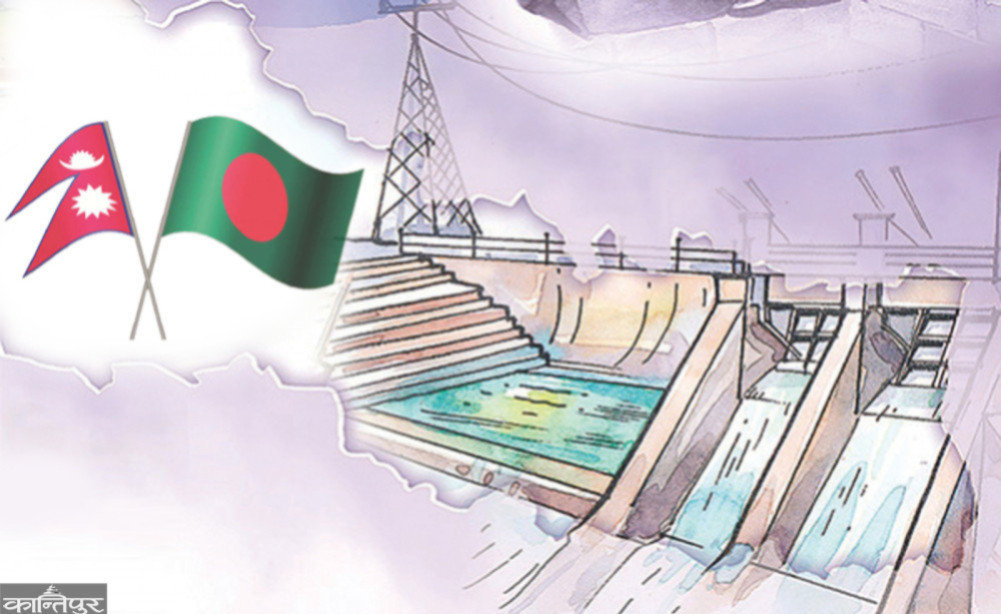
The agreement will be signed between Nepal Electricity Authority on behalf of Nepal, Bangladesh Power Development Board on behalf of Bangladesh and NTP Electricity Trading Corporation on behalf of India.
We use Google Cloud Translation Services. Google requires we provide the following disclaimer relating to use of this service:
This service may contain translations powered by Google. Google disclaims all warranties related to the translations, expressed or implied, including any warranties of accuracy, reliability, and any implied warranties of merchantability, fitness for a particular purpose, and noninfringement.
Nepal has sent a proposal to Bangladesh and India to sign a tripartite agreement on October 17 to sell 40 megawatts of electricity. According to the Ministry of Energy, despite sending a proposal for the date of signing a 40 MW electricity purchase and sale agreement between Nepal, India and Bangladesh on October 3, no response has been received so far.
Spokesperson of the Ministry, Chiranjeevi Chatout, said that the proposed date of the agreement was sent through the Ministry of Foreign Affairs on Wednesday. "We have sent a proposal to hold a meeting at the energy secretary level and joint secretary level of Bangladesh and Nepal on October 1 and 2, i.e. October 15 and 16, and reach an agreement on October 3," he said.
Chatout said that a date has been proposed for the Energy Secretary-level Joint Steering Committee (JSC) and the Joint Working Group (JWG) to meet in Pokhara. After that, on October 3, he said, a proposal was sent to Nepal, India and Bangladesh to sign an agreement on the purchase and sale of electricity.
There will be an agreement between Nepal Electricity Authority on behalf of Nepal, Bangladesh Power Development Board (BPDB) on behalf of Bangladesh and NTP Electricity Trading Corporation (NVVN) on behalf of India for the purchase and sale of 40 megawatts of electricity. Earlier, the contract date for the purchase and sale of 40 megawatts of electricity was set on July 13. But due to the political developments in Bangladesh, Bangladesh sent a letter in the first week of July and requested to postpone the agreement.
Under the leadership of the then Prime Minister of Bangladesh, Sheikh Hasina, the process of buying and selling 40 megawatts of electricity went ahead and the contract date was set, but she resigned on July 22. After Hasina left the country, the process started again after Mohammad Yunus, the head of the interim government of Bangladesh, supported the matter of importing electricity from Nepal.
Ministry spokesperson Chatout said that the proposal was sent informally after discussing the contract date and nothing came in writing. "We sent a proposal for the agreement date after it was suitable for all the three countries," he said, "even though India and Bangladesh have sent letters, the agreement date will be finalised." It said that it is making efforts for a contract to sell electricity to Bangladesh. Last Tuesday, Nepal's ambassador to Bangladesh, Ghanshyam Bhandari, also met the head of the interim government of Bangladesh, Mohammad Yunus.
The authority has an agreement to sell electricity to Bangladesh for 5 months of the rainy season, i.e. from 15 June to 15 November every year. A total of 144,000 megawatt hours of electricity will be exported in 5 months every year. The authority will get 6.40 US cents per unit by selling electricity to Bangladesh. According to the authority, the income will be 92 million 16 thousand US dollars in 5 months.
The authority will get the price of electricity exported to Bangladesh through the first international Dhalkebar-Muzaffarpur 400 kV transmission line between Nepal and India at the Muzaffarpur point in India. In other words, the meter of electricity exported to Bangladesh will be in Muzaffarpur. Technical leakage of the transmission line from Dhalkebar to Muzaffarpur will be borne by the authority itself.
From Muzaffarpur through India's transmission line, electricity will reach Bangladesh through Behrampur (India)-Bhedamara (Bangladesh) 400 kV transmission line.
The authority has prepared to export the electricity produced by the 25 MW Trishuli and 22 MW Chilime hydropower project built by its subsidiary company and built with Indian subsidy to Bangladesh. Both these projects have received approval to export electricity to India. On 16 December 2008, BPDB called for tenders for the purchase of 40 megawatts of electricity produced in Nepal for a period of five years as per the tripartite agreement between the entities of Bangladesh, India and Nepal.
The authority had submitted the tender document with the rate of electricity to be sold in the prescribed format for the sale of electricity in the second week of last January. After that, a meeting was held between the Authority's team and the bid evaluation committee under BPDB in Dhaka on February 10. Nepal proposed a price of 6.70 US cents per unit of electricity. Nepal did not agree on the price in the meeting after taking a stand that it would not be sold to India at a lower price.
But later, in the bilateral discussion held during the SAARC energy secretary-level meeting organized by the World Bank in Singapore, Bangladesh agreed to buy electricity at 6.40 US cents, with a slight reduction in the price offered by Nepal.
Although the price was agreed upon, only on May 29, the Committee on Public Procurement (CCGP) of the Cabinet of Bangladesh approved the price of electricity to be imported from Nepal. On June 23, BPDB informed the authority of its intention to accept the bid after evaluating the submitted bid documents and informing them that they were accepted by the relevant agencies.
The authority had also given a written notice to BPDB that the bid had been accepted. Soon after, BPDB sent the draft power sale agreement to the authority. After receiving the draft, the authority sent a letter with invitation to BPDB on June 26 after setting the contract date.
The Economic Affairs Committee of the Cabinet of Bangladesh approved in principle the proposal to import 40 megawatts of electricity from Nepal on December 20. Accordingly, Bangladesh had sent a letter to Nepal to send a proposal for sale by prioritizing the price. The authority had sent the sales proposal in the second week of January.