The community forest itself has brought duna and tapri making machines to the women
We use Google Cloud Translation Services. Google requires we provide the following disclaimer relating to use of this service:
This service may contain translations powered by Google. Google disclaims all warranties related to the translations, expressed or implied, including any warranties of accuracy, reliability, and any implied warranties of merchantability, fitness for a particular purpose, and noninfringement.
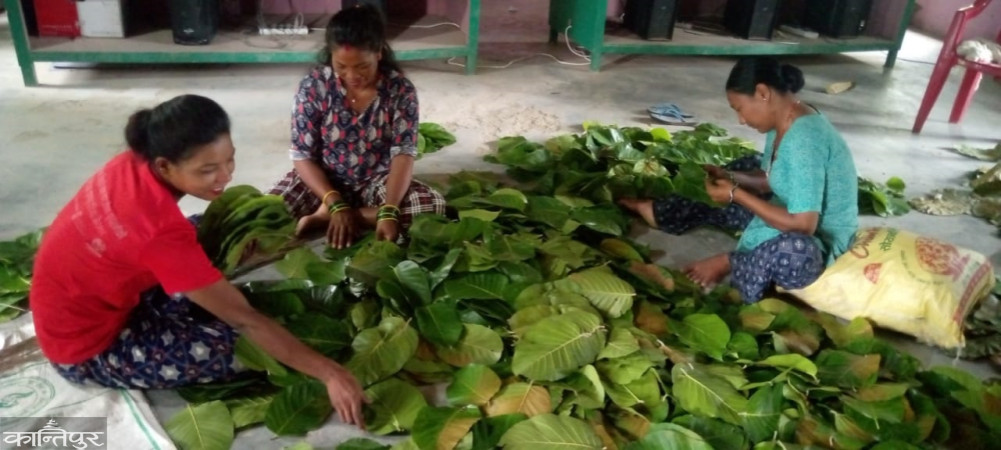
In their spare time, they go to the forest and pick sal leaves. They dry it for a day and keep it together, which is called Lafa. Lafa of different sizes are put in the machine to make duna and tapri.
The women of Vanadevi Community Forest in Krishnapur Municipality-9 Rajghat, located in Lalzhadi Mohana Protected Area, are busy with similar work. They enter the forest en masse. Then they take the leaves from the forest home and dry them and make lafa. Once again, they put it all together in the machine and make duna and topri of different sizes.
'One day we collect leaves, the next day we dry them, then we make many lafas and take them to the machine at once to make Duna-Tapri,' said Phoolkumari Chaudhary, coordinator of Duna-Tapri Construction Group of Krishnapur Municipality-9 Rajghat, 'We work together as a group. Women associated with community forest are doing this work after training.
The duna-tapari produced in the Lalzhadi forest have reached as far as Kathmandu and Pokhara. Chaudhary said that duna-tapri produced in Vanadevi Community Forest was sent to Kathmandu twice. The community forest itself has brought duna and tapri making machines. 5, 6 and 7 inch duna and 10 and 12 inch toppers are made in this machine.
Duna and Topri are sold from 1 to 6 rupees per piece depending on the size. "Currently, consumption is being done in the village, we are not able to meet the demand during the puja," said Chaudhary, "sometimes we are busy at home, we work only during our free time." He has been engaged in making duna-tapri since Baisakh. 8 women as officials and consumers of the community forest made duna-tapri. "We have not sent it outside yet, it is being consumed in the village," said Yashoda Rawal, who is engaged in the construction of duna-tapri along with the fund chairman of the community forest.
After being trained by Community Forest Coordination Committee (an organization of community forests in Laljhadi Mohana Protected Area), the women started making duna-tapari. They have planned to run a shop in the village to sell duna-tapari. Preparations are being made to send it to other places from the same store. "After that, what is not consumed in the village will be sent out," said Rawal, "now there is a lot of consumption in the village as well." Now it is the dry season, and it is not possible to go much inside the forest. Making duna-tapri from the leaves collected in the past is being done. Up to 500 duna-tapari can be made in a day from
prepared lafa. Women also buy the collected leaves. Other users of the community forest have also collected leaves and brought them. The women of Rajghat collected a lot of leaves last February-Chait. Chowdhury said that due to the lack of market at that time, the leaves rotted.
He says that the leaves are rotting because the women are busy harvesting wheat and the demand is also low.
The annual leaves are being wasted in the community forest. By collecting those leaves, women are added to the income. Niraj Bhandari, president of Vanadevi Community Forest Rajghat, said that this will make women self-employed and independent.