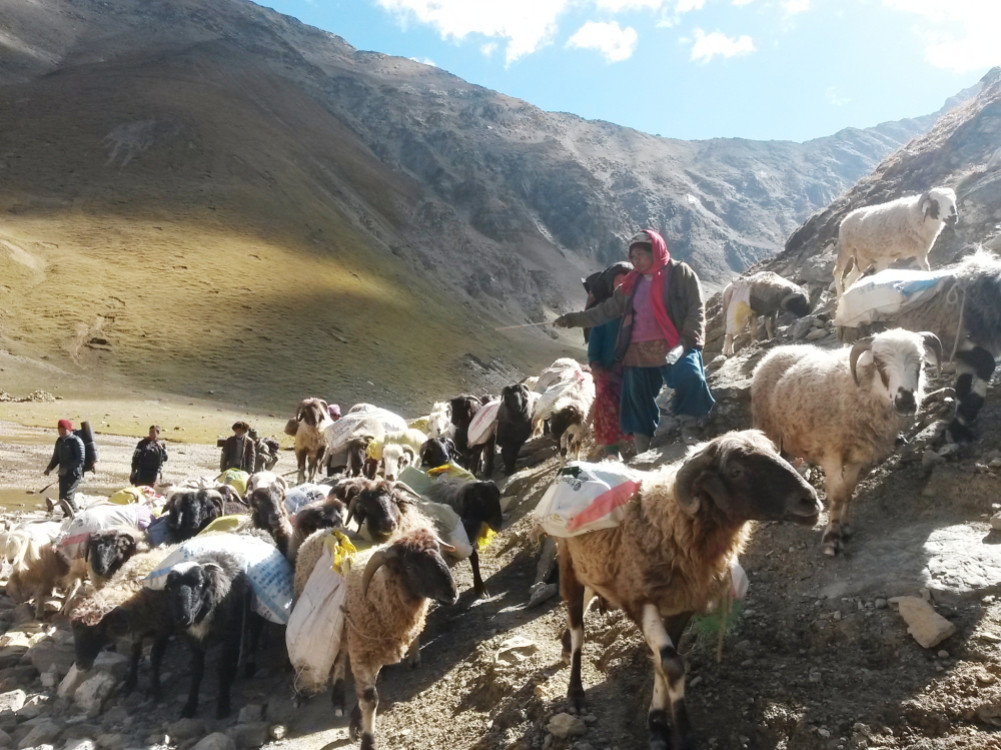
More than 100 people are homeless in Bains, Thadodhunga and Saipal, Chaurapani, Kalanga and other places towards Nepal under Purang County of China.
We use Google Cloud Translation Services. Google requires we provide the following disclaimer relating to use of this service:
This service may contain translations powered by Google. Google disclaims all warranties related to the translations, expressed or implied, including any warranties of accuracy, reliability, and any implied warranties of merchantability, fitness for a particular purpose, and noninfringement.
Chanda Bahadur Singh, Bhakta Singh, Hikmat Singh, Umesh Singh and Mahendra Singh of Jai Prithvi Municipality-1 Kailash have been living in the Tibetan terrain near the border of Nepal and China for 16 days. On July 5, they left home to fetch water from Mansarovar.
They had gone to Tibet to bring Mansarovar water for the Kulpuja of Lord Mashta, which had been stopped for five years after China closed the border due to Corona. On the fifth day of their walk from home, they were sent back by a Chinese guard post at a place called Tizm near Kathan in Tibet. Entry is not allowed now. "The Chinese army sent us back to come after the opening," said Chanda Bahadur Singh, who was in the team.
A team of seven people including Gorakh Lama, Khimlal Lama of Saipal Rural Municipality, who went to sell goods such as Nigaloka Doko, Bhakari, Mandra, etc., were also turned back by the Chinese security personnel in Tizm. They have walked for two days from there to Hilsa Naka in Humla. "Rather than waiting to see when it will open, we have walked there to see if we can enter through Hilsa," Gorakh said on the telephone from Touwen in Humla, "Many other people have pitched tents in places hoping to leave when the gate opens."
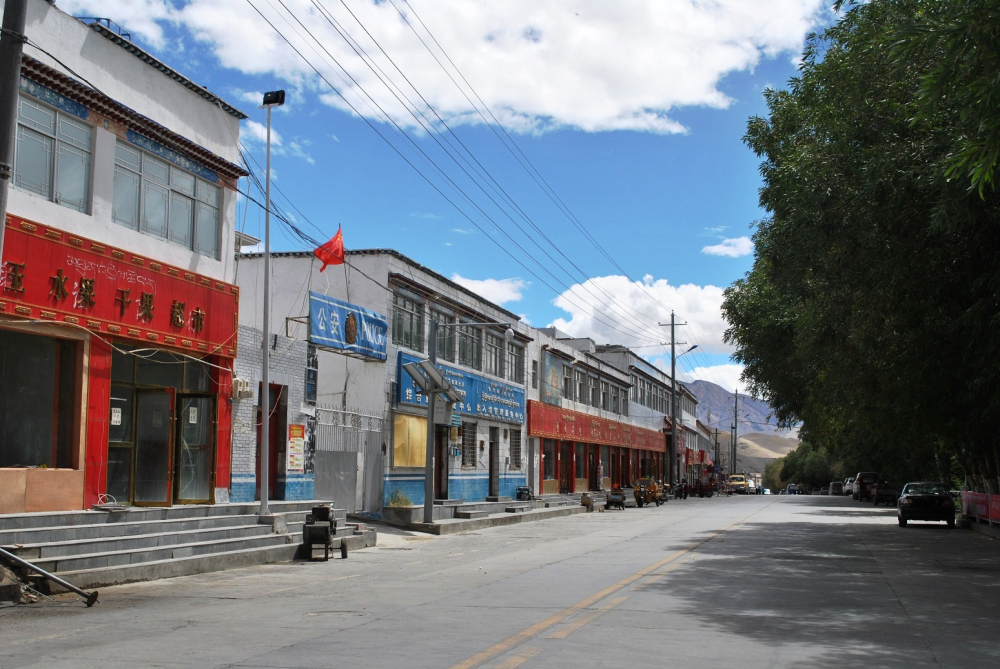 Gorakh said that there are more than 100 people living in Bains, Thadodhunga and Saipal, Chaurapani, Kalanga and other places towards Nepal under Purang County of China. "Many people are stranded on the road. "Manveer Bohra, chairman of bordering Saipal Rural Municipality, said, "The same number of people are also going to China. But not a single person has been allowed to enter there. He said that they have been in constant contact with the officials of the Ministry of Foreign Affairs to coordinate to facilitate entry to China, but they have not been successful.
111 people, including 10 women from Bajhang, have taken China entry permits from the district administration office. Chief District Officer Vishwamitra Kuinkel says that most of them go to fetch water from Mansarovar Lake in Tibet and are local traders. Taklakot is not allowed to enter now. I have informed everyone that they should go after the opening," Kuinkel said. Kuinkel said that he was informed that he would be allowed to enter only on July 24.
On the other hand, Jagat Tamang, a businessman from Bajhang in Taklakot, Tibet, said that he was informed by the Taklakot administration that he would not be allowed to enter until the completion of the bridge and road construction in the Lukpu River at the border crossing towards Bajhang. According to him, the Public Security Bureau, Foreign Affairs Office in Taklakot has given the information to enter through Bajhang border only on the 8th, 9th, 10th and 11th and 20th, 21st, 22nd and 23rd of every English month.
They have said that they will not allow entry even on the opening day until the construction work is completed. It is not possible to say when the work will be completed," Tamang told Kantipur. "After the construction is completed, we will let you come to Taklakot only on the specified day. He told them not to bring water from Mansarovar because the Tibetan administration has a policy of only allowing entry from Bajhang to Taklakot. Tamang said that a few days ago some people from Humla escaped by illegally transporting herbs to Tibet through the Bajhang route and citing the same reason, the Tibetan administration was reluctant to allow people to enter through the Bajhang border. He said that after the incident, more than 2,000 sheep and goats, which were taken to graze in the Tibetan area, were also returned. Now is not like before. They have made it very strict here," he said. Otherwise there will be only sorrow.'
Bajhang's religious, commercial and cultural relations with Tibet have been disrupted after the border was closed five years ago due to the corona virus. More than 200 temples in Bajhang have stopped worshiping due to not being able to bring water from Mansarovar. Similarly, the business of many people who used to sell handicrafts and handicrafts, Timur, Uva, Barley, Gurans, Lentils, Chilli etc. produced in the village and sell the goods brought back from there to the village has also been closed. The friendly relations between the shepherds of Saipal, Diyanot, Mashta, Khaptadchanna, Chhabis, Durgathali Rural Municipality and Bungal and Jayaprithvi Municipalities with Tibetan villages are also in crisis. The relationship of some of the families here is still continuous for seven/eight generations.
After the closure of Urai border, those who are earning seasonal jobs in Tibet have also become unemployed. Before Corona, the locals were earning good income by working as seasonal wage earners. Young people from here used to go to Taklakot and surrounding villages every year to work in loading/unloading goods wagons, spinning wool, carrying heavy loads, cutting banana, Uwabali (a crop grown in high mountains like barley) and construction work. They used to earn from 150 to 300 yuan (about 2500 to 5000 Nepalese rupees) for doing daily labor depending on the nature of work and efficiency. Locals say that those who work here for four to five months of the rainy season earn good money, but after the closure of the border, that way of income has also been closed.
'He used to earn four to five lakh rupees in one season by cutting expenses. That has also stopped after the closure of the checkpoint," said Rajendra Dhami, the former chairman of Saipal Rural Municipality, "When Taklakot was open, no youth in the village was empty-handed. Now everyone is unemployed.
After the border treaty between Nepal and China in 1961, with the agreement to divide the border on the basis of watershed, the large land of Nepal up to Salsuganga (Tibetan Karnali) fell towards Tibet. However, there is a provision in the border treaty that those living in the border area can travel up to 30 kilometers from the other country based on the permit given by the local administration to carry out traditional activities.
Locals and people's representatives of Bajhang are now going to Dainik Singh Darbar to create pressure saying that the checkpoint should be opened and operated. Although they have met the Prime Minister, Minister of Foreign Affairs and informed them about this problem time and again, no solution has been found yet.