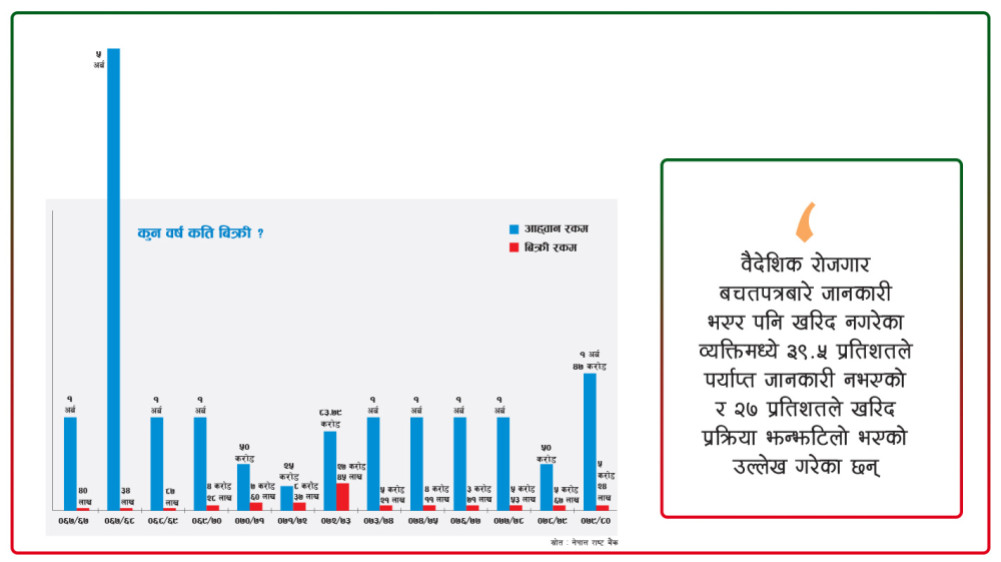
From the financial year 066/67 to 079/80, 15 billion 56 million savings bonds were called for 25 times, but only 762.3 million sales were made.
We use Google Cloud Translation Services. Google requires we provide the following disclaimer relating to use of this service:
This service may contain translations powered by Google. Google disclaims all warranties related to the translations, expressed or implied, including any warranties of accuracy, reliability, and any implied warranties of merchantability, fitness for a particular purpose, and noninfringement.
A study by Rashtra Bank has shown that 95 percent of the foreign savings bonds issued by the government every year are not sold for the purpose of using the money of Nepalese employed abroad in the productive sector. Among the various bonds sold by the government, the foreign employment savings bond has the highest interest. However, due to the lack of awareness among Nepalis abroad, only about 5 percent of foreign employment savings bonds issued during the 13-year period were sold.
A study conducted by the Rashtra Bank Monetary Management Department regarding the status and promotion measures of foreign employment savings bonds has shown that only 4.9 percent of foreign employment savings bonds issued so far have been sold on average.
'From the financial year 066/67 onwards, after the issuance and management of foreign employment savings bonds, it seems that there has been a call for the sale of such savings bonds in all years except the financial year 075/76,' the report says, 'From the financial year 066/67 to 079/80 In the last 13 years, the bank has called for savings bonds worth 15.56 billion 25 times, but only 76.23 billion has been sold.'
The operation of savings paper does not seem to have been as expected since the beginning of the year. In the first year, 1 billion savings bonds were issued, 4 million were sold, while in the second year, 5 billion were issued, only 3.4 million were sold. In most of the subsequent years, the call for savings bonds is less than 500 million. All foreign employment savings bonds issued during this period are for 5 years. During this period, the interest rate of foreign employment savings bonds is higher than the fixed deposits of the same year from 0.01 to 2.42 percent. However, the impact of interest rates does not seem to be as expected on the purchase of savings bonds,” said the report.
The government is currently introducing treasury bills, development bonds, citizen savings bonds and foreign employment savings bonds to mobilize internal debt to compensate for the budget deficit. Among these instruments, treasury bills and development bonds are issued for the purpose of raising loans from banks and financial institutions, and citizen savings bonds and foreign employment savings bonds are issued for the purpose of raising loans from citizens.
The size of internal debt of the government has been increasing for the last five years. In the financial year 2071/72, the government mobilized 43.33 billion rupees of internal debt, and by 2079/80, it has reached 2.56 billion rupees. The report shows that as the size of the government's internal debt is increasing, the size of the foreign employment savings bond is not increasing, so its contribution is gradually decreasing. It is mentioned in the report that only 12.5 percent of the 385 people included in the
survey are aware of foreign employment savings certificates. The report shows that none of those included in the on-site survey have purchased savings bonds. 39.5 percent of the people who did not buy the foreign employment savings bond despite being aware of it, said that they did not have enough information and 27 percent stated that the purchase process was complicated. He has shown reasons including the fact that the savings certificate is not easily obtained and that he has to rush to get the interest.'
The government, foreign employment department and manpower companies have to provide orientation training before sending them to work abroad. However, only 8.5 percent of those surveyed said they had received orientation training. Since 078, people who have gone for foreign employment can buy savings bonds from their home country, the National Bank has arranged. There is no tax on the amount invested in it. Interest is paid in 6/6 months. When necessary, you can sell and borrow from banks and financial institutions.
Although there are these facilities, remittance company owners say that the expected sales have not been achieved due to lack of sufficient knowledge about savings bonds among Nepalese who have gone abroad for employment. They suggest that there will be no problem in the sale of savings bonds if they target Nepali people who are going to work at medium and high level in developed countries. In order to create an environment in which more foreign employment savings bonds will be sold in the coming days, the report suggests that the government should provide concessions through additional exchange rates to non-resident Nepalis and Nepalese employed abroad.