Recently, a new narrative seems to be taking hold in society. Those who can speak without restraint, who can make the loudest and most superficial statements, are the ones dominating the market.
We use Google Cloud Translation Services. Google requires we provide the following disclaimer relating to use of this service:
This service may contain translations powered by Google. Google disclaims all warranties related to the translations, expressed or implied, including any warranties of accuracy, reliability, and any implied warranties of merchantability, fitness for a particular purpose, and noninfringement.
For the past few days, statements made by singer Ibsal Sanjyal during a television interview have gone viral on social media platforms like Facebook and other digital media. During the interview, she had said that Achhamis living in America build separate menstrual huts at home. After that, her remarks sparked a flood of outrage and abuse on social media. On Facebook walls, every Achhami can be seen sharing the video, targeting the singer’s comments with pointed words.
After having to endure harsh criticism and attacks from all sides, the singer finally admitted her mistake, writing a long status on Facebook in her defense and apologizing to the people of Achham. This incident may serve as fodder for social media for a few days. However, it has once again brought the frightening character of our society into debate.
Recently, a new narrative seems to be taking hold in society. Whoever can speak the most nonsense, whoever can be the loudest and most superficial, is the one making the most noise. From the rostrum of Parliament to the walls of social media and the public squares, even some well-known figures can be seen repeatedly making mistakes and slipping up. This is a sad and ironic situation. Once established in the public sphere, a person becomes a public figure, and after that, it is necessary to be serious about where, how, and what one says. Because society is listening to and watching them. Speaking based on rumors without study or grounded knowledge is an inexcusable act of irresponsibility.
Surely, there are no menstrual huts in America like in Achham. It is not even possible. My only comment on Ibsal’s statement is this. Because there was no truth or logic in her remarks. But what does our real face, hidden within this crowd of outrage, look like? Now I want to turn my attention to the main issue and the bitter reality of our own backyard.
On the 16th and 17th of Jestha, a program was organized in Surkhet, the capital of Karnali Province. The ‘Karnali Daughters’ Conference’ saw the participation of girls from all 79 local levels under Karnali Province. I also had the opportunity to participate there. When innocent and suffering girls from the corners of Karnali stood on stage and began to share the painful hardships, humiliation, and mental and physical torture they endured while staying in menstrual huts even in this modern age, the eyes of those present in the hall filled with tears. Listening to their heartrending voices, I myself became emotional many times.
The girls from Mugu, Humla, Jumla, Dailekh, Kalikot, and Surkhet in Karnali clearly shared their experiences of still having to stay in animal sheds during menstruation, and how society legitimizes this in the name of religion and culture. Not only in the Far West, but even in neighboring Karnali Province, it became even more apparent during the conference just how deeply and strongly the harmful practice and superstition of chhaupadi has taken root.
Having mentioned this example, I want to turn back to my own Achham district. When one person, based only on superficial rumors, said that Achhamis living in America build menstrual huts, the entire district was hurt. There was an uproar, saying their self-respect was wounded and they were disgraced at the national and international level. I too found the statement strange and laughable. But now it is too late to seek the answer to the question that arose in my mind.
When outsiders raise the issue, Achhamis are hurt, but why does it not hurt when the so-called menstrual huts, standing and alive in their own homes and courtyards, are seen every day? Why do they remain silent about those huts? Why do they not take the initiative for reform? When they themselves, their mothers, wives, sisters, and daughters are suffocated in huts for 5 or 6 days a month, forced to spend nights in unsafe, cold, and painful conditions, where does Achhami pride and manhood disappear? Shouldn’t we feel hurt at that time?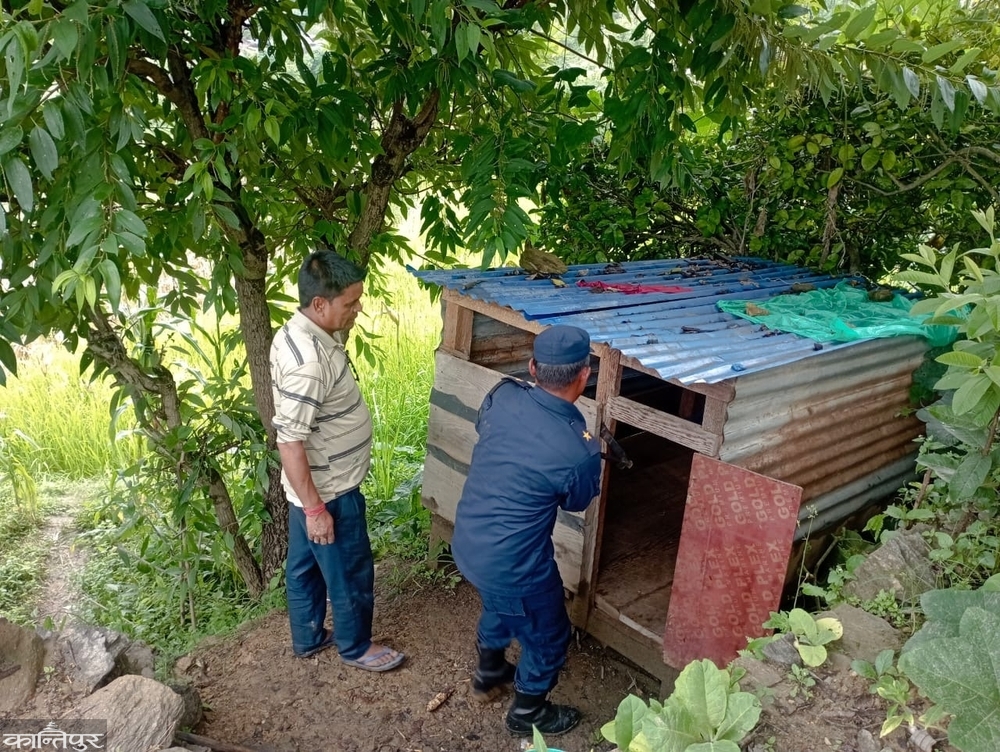
Speaking of Achham, even today, there are menstrual huts in the homes of 9 teachers said to be spreading awareness and leading society towards light, 7 government employees, and 6 ward chairs to executive members elected by the people and sworn to make their areas free of harmful practices.There are still menstrual huts in their homes.In fact, because I have continuously written against the prevalence of chhaupadi in Achham and the disasters it brings, a section of society has labeled me as ‘disgracing Achham and tarnishing the district’s reputation.’ Speaking the truth and showing society’s ugly side in the mirror is the duty of journalism. But here, in fulfilling my professional duty, I have had to regularly endure everything from low-level abuse on social media to threats of physical assault when walking in villages. To those who abuse and threaten, I want to say, ‘Before pointing fingers at others and criticizing them, shouldn’t we look at our own faces in the mirror? What is the point of shouting when someone else points out the filth if we do not clean our own?’
Just how hypocritical and double-faced we are has been clearly revealed by an internal and confidential statistic recently made public by the District Police Office. The district police conducted a sample survey and data collection to find out the state of menstrual huts in the homes of people holding various positions and posts in society, those involved in policy-making, and those who have earned great social prestige. Anyone would bow their head in shame after seeing the police report and the list of names.
Speaking of Achham, even today, there are menstrual huts in the homes of 9 teachers said to be spreading awareness and leading society towards light. This practice still exists in the homes of 7 government employees who enjoy government facilities and are in agencies responsible for implementing the law. Even in the home of a journalist, considered the mirror of society and a voice against social ills, a menstrual hut was found. Even more astonishing, there are still menstrual huts in the homes of 6 ward chairs to executive members elected by the people and sworn to make their areas free of harmful practices.
Most shameful of all, I have proof that some of the very people who colored their Facebook walls, wrote statuses, and protested the most in the name of nationality, regionalism, and Achhami identity regarding the singer’s remarks, still have menstrual huts in their homes. I have in my hands a list with proof that their mothers and sisters are sleeping in menstrual huts. Seeing those who cannot demolish the hut in their own home, who make their female family members stay in huts during menstruation, come to social media and boast about culture and pride, there is nothing left to say but ‘what a pity.’
Now is the time to think seriously. What kind of society are we building, and what kind of generation are we handing it over to? When false and exaggerated things go viral in a video, we create an uproar as if the world is collapsing, but how long will we continue to cover up the inhuman discrimination, suffering, and torture inflicted on women in our own homes every month under the guise of religion, tradition, and culture? This question is directed at you and me. If we feel disgraced when someone speaks or writes about this, then all our attention and energy should be focused on uprooting the problem from society. Not on abusing the person who points out the problem. By abusing, threatening, and suppressing the truth, the ugly reality of society cannot be hidden. There is only one way to avoid disgrace and shame: demolish the menstrual huts in our own homes once and for all, and change the outdated thinking in our minds.

