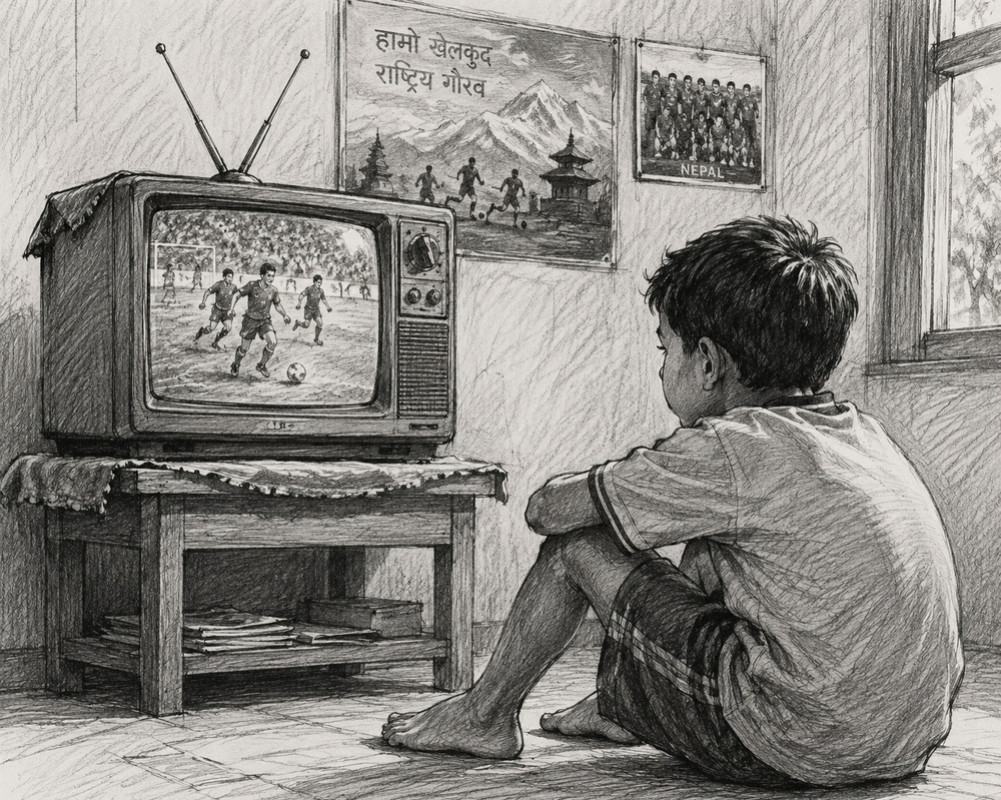
We grew up. Responsibilities increased. Education ended, jobs started, businesses started, family responsibilities came. Earlier, you could stay up all night to watch the World Cup, today, a bad night's sleep can affect the next day's work.
We use Google Cloud Translation Services. Google requires we provide the following disclaimer relating to use of this service:
This service may contain translations powered by Google. Google disclaims all warranties related to the translations, expressed or implied, including any warranties of accuracy, reliability, and any implied warranties of merchantability, fitness for a particular purpose, and noninfringement.
The World Cup is here again. Photos of supporters are appearing on social media, jerseys are being sold, and fans of their favorite teams are speculating in their favor. But this time, while watching the World Cup, a question arises in my mind - are we still as crazy about football as we used to be?
In our childhood and adolescence, football was not just a game. It was a feeling, an identity, a relationship with friends, and sometimes even a small war with family.
At that time, the arrival of the World Cup was like a celebration. Plans to stay up all night would start being made a few days in advance. After everyone at home went to bed, we would turn down the TV volume and watch the game. When our parents found out, we would get scolded, and sometimes even beaten. But still, we would not stop watching the game.
We could not contain our joy when our favorite player scored a goal. When we celebrated by shouting and celebrating, we would have to be scolded again, saying that our night's sleep was disturbed. But the greater joy was the celebration of the goal. Watching football back then was a risk, but we were always ready to take that risk.
During our school and college days, the discussion of football was even more interesting. The next day, the entire class and friends would get heated about last night's game. Some would support their team, some would support the other team. There would be arguments, disputes, sometimes even a complete stop to the conversation. But all those competitions were because of the love of the game.
Why did a pass go wrong, why did the coach not put that player on the field, what strategy would have been better, we considered ourselves experienced analysts on all these matters. In today's language, we were all 'football pundits'. But there was no self-interest in that analysis, only a passion for the game.
But many things have changed with time.
We grew up. Responsibilities increased. Education ended, jobs started, businesses started, family responsibilities came. Previously, one could stay up all night to watch the World Cup, but today, a bad night's sleep can affect the next day's work.
Especially since the current World Cup matches are broadcast in Nepal at midnight or early in the morning, many fans are unable to watch them live. When the game starts, people remember the next day's meetings, office, business or other responsibilities. The mind wants to watch the game, but the mind tells them to rest.
Perhaps this is why the football fever is starting to feel less like before.
Another reason may be the changing lifestyle of society. Earlier, there were football, cricket or some limited entertainment options. Today, there are hundreds of ways to capture people's attention. Mobile, social media, streaming platforms, short videos and countless digital content are dividing our attention.
Earlier, when the World Cup came, it was discussed for a whole month. Now, even in the middle of the World Cup, people seem to be busy with another trending topic.
One more thing, it seems that the healthy competition between fans has also decreased. The jokes between Argentina and Portugal fans, the arguments between Spain and Germany fans, the football discussions that go on for hours in college canteens are now less common. Social media has made the debate digital, but it feels like the intimacy it once had is gone.
But that doesn't mean that the love for football has ended.
Even today, when the World Cup starts, old memories come back. Old friends are remembered. Moments we once watched together come to mind. When our favorite team plays, we still get excited. Even if we don't have time, we look for highlights. We check the results as soon as we wake up in the morning. We watch score updates even in the middle of work.
Perhaps the love for football has not decreased, only the way we express it has changed.
We are not the carefree teenagers we used to be. We have become responsible adults. But in some corner of our hearts, that child still lives, who wants to watch football late at night, scream when our favorite player scores a goal and analyze the game with friends the next day.
The World Cup comes every 4 years. New players come, new champions are created, new stories are written. But for our generation, the World Cup is not just a football tournament. It is a childhood memory, a time with friends, a family scolding, an all-night vigil and a beautiful chapter in life.
Perhaps now we are all struggling to find time to watch the game. But when the ball starts rolling on the field, in some corner of our hearts, the old love of football awakens again.
Because age may increase, priorities may change, but those memories connected to football never grow old.