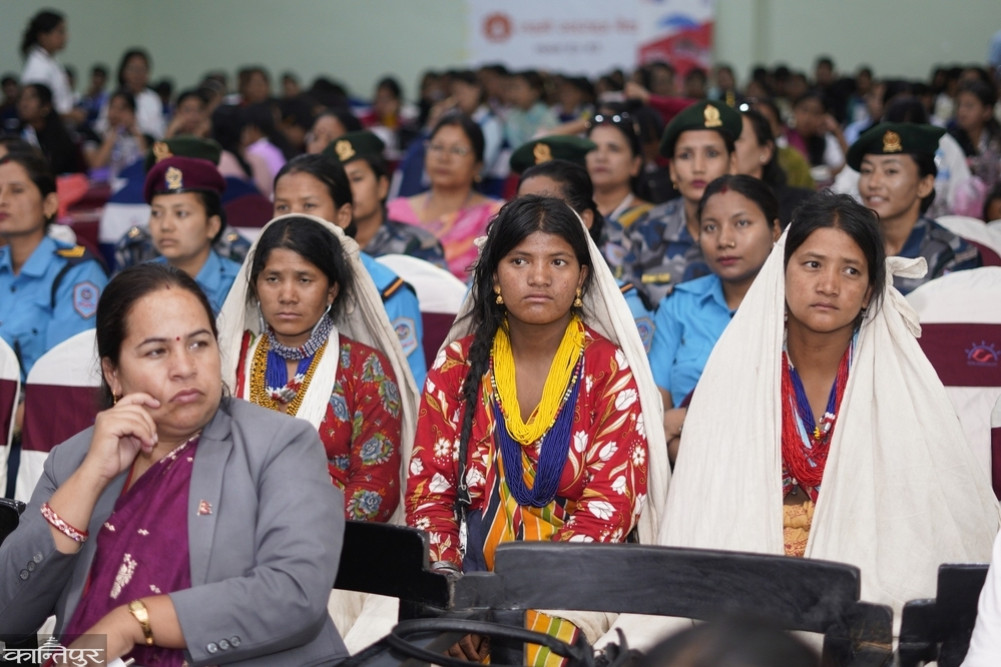
The sight of the girls, looking into each other's eyes and asking their questions, while keeping their parents and state policymakers in front of them, was both proud and emotional. Raising questions from girls from far away made me feel like I sometimes felt alone, and I felt supported.
We use Google Cloud Translation Services. Google requires we provide the following disclaimer relating to use of this service:
This service may contain translations powered by Google. Google disclaims all warranties related to the translations, expressed or implied, including any warranties of accuracy, reliability, and any implied warranties of merchantability, fitness for a particular purpose, and noninfringement.
The function hall of Shubha Hotel in Birendranagar, the capital of Karnali Province, not only witnessed the two-day conference, but also became a place where the voices of the ‘daughters’ of Karnali Province were voiced. More than 200 ‘daughters’ from 79 local levels in 10 districts gathered there, having braved the winters of Dolpa, crossed the Mugu hills, crossed the Bhanjyang of Humla, and crossed the mountains of Rukum, Kalikot, Jajarkot, Salyan, Dailekh, Surkhet, and Jajarkot. In terms of geography and work, I have also been writing news from the Far West. The Far West and Karnali are similar not only geographically but also in terms of remoteness, traditional kinship, and social challenges.
The second edition of the 'Karnali Chhori Sammelan' organized by Jyoti Foundation in Birendranagar on 16th and 17th of Jestha provided an opportunity to hear the experiences and voices of teenagers and youth from the mountains/hills.
In their eyes, from making policies at Singha Durbar in Kathmandu to the mainstream media centered on the capital, Karnali is always viewed and branded through the prism of the same power. Karnali is portrayed as a province with poverty, remoteness, child marriage, Chhaupadi and always waiting for help rather than its successes and potential. However, the two-day Birendranagar Manthan has proven such an established belief wrong. It has put pressure on people to change their perspective when looking at Karnali. It was clear that it was not just the innocent Karnali who were begging for 'mercy', but citizens who could shake the foundation of Singha Durbar for their rights and chart a future roadmap were being prepared there.
Not only girls from accessible and accessible areas participated in the conference, but also indigenous girls from the Raute, Raji, Kusunda, Badi and Bote communities, who have been marginalized from the mainstream of the state for years, were present there in large numbers. Along with them, girls from the disabled, gender and sexual minority communities, who are facing double discrimination and suffering in the society, were also firmly expressing their opinions. They seemed to have taken the stage to fight the battle for existence and identity. 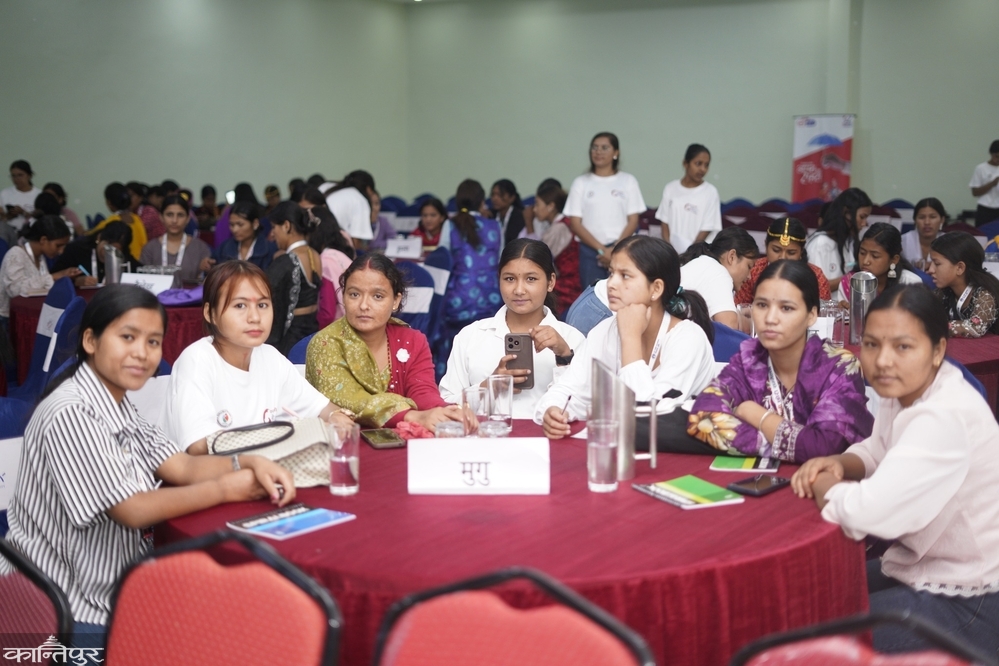
In the two-day conference, 10 separate special sessions were conducted to keep the 'hearts of girls' from 10 districts. In these discussions, many ground-level issues and realities came to the surface. Which forced the policy makers to think. In the entire conference, not only one or two representatives spoke, 87 girls got the opportunity to go directly to the stage and hold the microphone and tell their experiences, tears, anger and wonderful experiences.
The voices of the girls were not limited to a closed room or to each other. Ministers of the Karnali State Government and high-ranking stakeholders were present in front of the stage to listen to their sharp questions and voices. The way the girls were able to raise their questions eye to eye with their own guardians and state policymakers was a proud and emotional scene. When I sometimes felt lonely when I raised the questions of the girls from far away, I felt that there was more support there. The ministers had noted the sharp questions, complaints and dreams asked by the girls in their diaries. They also seemed to be listening to their questions and strong voices attentively. They did not seem to speak and walk around the conference like they did at other times. There, the people's representatives were seen giving their entire time to their daughters and listening to them.
When the daughters took the stage in various sessions, the atmosphere of the hall changed. They not only told their stories, but also drew a blueprint for the future of Karnali. 'We, the daughter generation, want to erase the identity that we have always been backward, remote and inaccessible,' said Vijay Punamagar of Aathbiskot in Rukum West, holding the microphone in front of the ministers and expressing her determination, which led to thunderous applause in the hall. She added, 'We can reach from the courtyard to the sky and from the nation to the foreign country. The daughters of Karnali have become secretaries of the Government of Nepal. If the state does not easily grant the rights granted by the constitution, we will take them even if it means taking them away.' But, now we should not always be branded as poor and remote.'
In this wave of change and self-respect, the perspective added by Deepa Baral of Raskot Municipality in Kalikot was more considerate and practical. Pointing out the need to develop ourselves instead of using remoteness as an excuse, she said, 'Daughters should become self-reliant, capable. It is not enough to just say that there is a shortage, that we are in a remote area, we have to start from our own home.'
The experiences of the daughters who came from the remote Himalayan village of Humla, which is connected to the Chinese border, sounded shocking and challenging. Namu Tamang of Namkha Rural Municipality in Humla complained about the lack of basic necessities, and the situation became serious. She said, 'We have a huge shortage of health and employment. On top of that, society pressures us to get married at a young age.' We always limit our daughters to kitchen work.' Jong Tamang from Humla also gave an example of how strong the patriarchal thinking is, adding, 'They say that our daughters should not study, but now we will not leave without studying.' Their determination was directly challenging the conservative society that prevents the flight of daughters in the name of tradition. 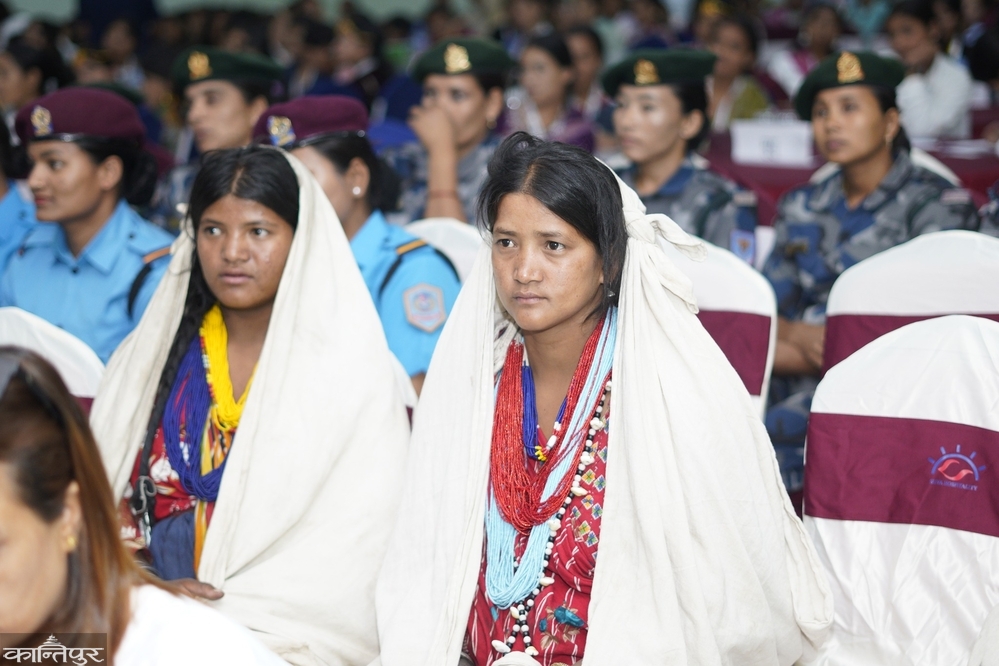 Photo courtesy: Jyoti Foundation
Numana Rokaya from Tilagufa Municipality in Kalikot also reiterated the same confidence. Coming to participate in the conference for the second time, she told the ministers about the changing picture on the ground, 'It is not that we cannot do any work, now the society is gradually becoming girl-dominated. Girls are becoming more active in our villages. There are challenges in reducing social evils. Women and girls have had to endure a lot of violence.' Shikshadevi Budha of Karmarong, Mugu's 'Upper Mugu' area, and Ramana Shahi of Khatyad, who take five days to reach their homes from Kathmandu, said that despite the remoteness of the geography, the Chhayanath Rara Express has started running and the situation is getting easier, and that they are starting to feel a new possibility of prosperity in Karnali. The
conference brought to the surface the pain that the girls of Karnali are experiencing internally and the sharp edge of the social mirror with equal courage, which would have made anyone's eyes sting. The hall became very emotional and serious when the girls of Dolpa spoke about how terrible the hardships they have to face to study, the Chhaupadi system and the security challenges are still in the mountainous and remote areas. 'It is a large district in terms of area, but there are no facilities. In a cold place like Dolpa, you have to stay outside during menstruation. There are many Chhaupadi systems. We are not even safe from our own fathers and uncles in our own homes,' this shocking statement by Jagdulla's Chhaya Basnet and Kaike's Sharda Budha seemed to be flouting the law, security mechanisms, and social consciousness. Chhaya's words also reflected the pain and suffering of the Dolpali geography where pregnant women die prematurely without receiving timely treatment.
As Rabina Malla of Mugu Soruk and Ramana Shahi of Khatyad continued to narrate the bitter truth of having to sleep in a chhaupadi hut for seven days and not being able to go to school, my mind went to Achham in the far west. Where the state's policy and campaign to demolish chhaugoths were carried out. However, Ramana strongly questioned, 'Girls should be allowed to study higher education, technical education should also be provided.' A campaign to demolish chhaugoths was launched in Achham. But why was this campaign never carried out in our country? We have suffered a lot, there is gender discrimination. How can Karnali girls rise in such a situation? I am 21 years old, all my friends in the village are married. Society questions me why I did not get married. Rabina Malla added, "We are still forced to live in the Chhaupadi Goth, the family does not understand. There is a law, but it must be implemented now."
The girls of Karnali are ready to fight against social evils and challenges. But they need freedom from an environment where violence is tolerated in the name of becoming tolerant. They no longer need pity or sympathy, but opportunities for higher and technical education, concrete intervention with a budget from the local and provincial governments against evil practices like Chhaupadi and child marriage, and legal guarantees to live safely in their own homes. As a reporter, observing the hope, anger, and determination in the eyes of those 200 girls for two days, I realized that Karnali, which encompasses mountains like Surkhet, Dailekh, Jajarkot, and Salyan, as well as mountainous regions like Dolpa, Humla, and Mugu, is not only a backward, remote, and deprived geography, but also one that is awakening and struggling to decide its own destiny. When those 87 girls from the endangered Raute, Raji, and Kusunda communities to the Badi and Bote communities stood on stage and roared, it felt like no one was going to stop the new blueprint for an inclusive and just future for Karnali.